


2026年8月のホワイトアウト サバイバルのプレイヤーたちが支出をボイコットする理由
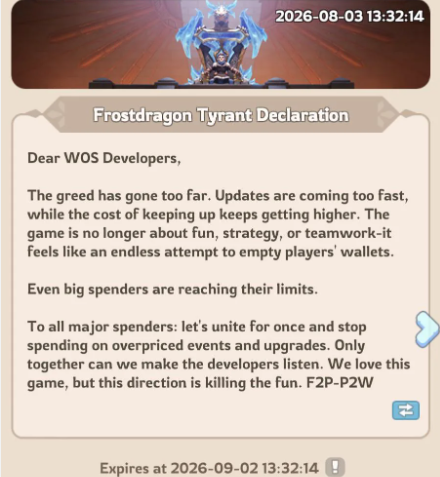
ホワイトアウト サバイバルのコミュニティは、チーフギアとチーフチャームのさらなる進行(T6ギアおよびチャームレベル17と18を含む)の報告を受けた後、2026年8月の支出ボイコットを組織し始めました。この議論は単一の公式イベントではなくプレイヤー主導の運動であり、正確なロールアウト要件はライブクライアントでの確認が必要なままです。この記事では懸念点を説明し、コミュニティの報告と確認されたシステムを区別し、同盟および州レベルの調整を調べ、無料で遊べるプレイヤー、中程度の課金者、および高額課金者に実践的なオプションを提供します。
Whiteout Survivalコミュニティは2026年8月に、別のChief進行の報告層と競争アカウントを最新の状態に保つための累積コストに対する懸念によって駆動され、支出を削減または一時停止するよう呼びかける声が高まっています。この動きはすべてのプレイヤーが同じ決定を下すことを要求するものではありません;以前に固定されたFrost Star予算を維持している人は比較することができます Topuplist and the Whiteout Survivalトップアップページ,しかし重要なステップは、個人的な支出計画を変える前に抗議を理解することです。
これはコミュニティの動きであり、1人の主催者と1つの普遍ルールを持つ単一の公式ゲーム内イベントではありません。異なる州、アライアンス、個々のプレイヤーがブーコットという言葉を異なる意味で使用しています。一部は完全な購入一時停止を望んでいます。一部は新しい進行システムのみを避けています。他の人は、無料イベントへの参加を続けながら、十分な時間をかけて支出を遅らせるようにプレイヤーに求めています。
Why the Boycott Appeared Now
The immediate concern is not one isolated bundle. Community posts published in early August point to reported T6 Chief Gear and additional Chief Charm levels, commonly described as levels 17 and 18. Players see these systems as another extension of an already expensive competitive progression path.
Chief progression affects more than a collection screen. It influences combat performance, rankings, alliance expectations and the gap between accounts that can immediately purchase new materials and accounts that must accumulate them slowly. When a new tier arrives before many players feel comfortable with the previous tier, the update can be experienced as moving the finish line rather than adding a satisfying long-term objective.
The reported August 17 rollout window has made the discussion more urgent. That date should still be checked against official notices and the live client. Community screenshots and alliance announcements can show that a protest is real, but they do not replace developer confirmation of final costs, material quantities or regional timing.
What Players Are Actually Protesting
The strongest complaints focus on progression cadence. Many players accept that a live strategy game needs new goals, but they want enough time for earlier investments to remain meaningful. If each new system quickly requires another large purchase cycle, the account can feel permanently unfinished.
A second concern is competitive pressure. Whiteout Survival is built around alliances, state events and rankings where one person's spending can affect many teammates. A player may not personally want the newest tier but can still feel obligated to upgrade because the alliance relies on that account for Bear Trap damage, Foundry, State of Power or cross-state battles.
A third concern is transparency. Players want to know the complete cost, material path, unlock conditions and long-term value before committing. When the community learns through screenshots, partial previews or staggered server information, uncertainty can amplify frustration.
The boycott therefore combines economic, competitive and communication issues. Treating it only as anger about prices misses why it has spread across different player groups.
Confirmed Systems and Community-Reported Changes
Chief Gear and Chief Charms are established account-wide progression systems. Chief Gear uses six equipment pieces, and Chief Charms are distributed across those pieces and the three troop types. This makes even a small level increase potentially broad because progress can be repeated across many slots.
The existence of community discussion around T6 gear and Charm levels 17 and 18 is documented. The exact live requirements, pack structure, upgrade materials and server rollout should not be treated as final until official information appears for the relevant account.
This distinction protects players on both sides of the debate. Supporters of the boycott do not need to exaggerate unconfirmed costs to explain their concern. Players who prefer to wait do not need to dismiss the movement simply because every number is not yet official.
Topic | Current status | Safest player response |
|---|---|---|
Spending boycott | Active community-led discussion | Read the rules adopted by your own state or alliance |
T6 Chief Gear | Reported upcoming progression | Wait for official requirements before budgeting |
Chief Charm levels 17 and 18 | Reported in community previews | Do not calculate exact cost from incomplete screenshots |
August 17 rollout | Widely discussed target window | Confirm through the official notice and live client |
Global participation | Not universal | Decide personally without attacking players who choose differently |
Why a State-Level Boycott Is Difficult
A spending boycott becomes more visible when an entire state coordinates, but Whiteout Survival states are not financially or competitively uniform. High spenders, moderate spenders and free-to-play players experience the same update differently.
A high spender may view a temporary pause as a meaningful signal because the account normally contributes substantial revenue. A moderate spender may already be selective and have little additional spending to remove. A free-to-play player can support the discussion publicly but cannot reduce purchases that were not happening.
States also compete on schedules that do not pause for a protest. If one state stops upgrading while a rival continues, the short-term competitive cost can be real. That possibility creates a coordination problem: players may support the boycott in principle while fearing that others will gain an advantage.
Successful coordination therefore depends on clear scope. A state should define whether the pause covers all purchases, only new progression packs, only one date, or a longer period. Vague instructions create arguments and make participation impossible to measure.
Alliance Leaders Need a Neutral Message
Alliance leadership should explain the choice without turning it into a loyalty test. Members have different budgets, account histories and reasons for playing. Public shaming can damage the alliance more than any new progression tier.
A useful announcement states the concern, the proposed start and end time, the purchases included and whether participation is voluntary. It should also direct members to official information when it becomes available.
Leaders should avoid requesting screenshots of private payment history. The goal is collective communication, not surveillance. Players who continue spending should not be harassed, and players who pause should not be blamed for a lower event score.
The strongest alliance response is one that preserves trust. A spending debate will pass; damaged relationships may not.
What Free-to-Play Players Can Do
Free-to-play players can contribute information and reduce misinformation. They can compare official notices with community claims, document material sources and help alliances understand how much progress is realistically available without purchases.
They should not pretend that their normal zero-spend behavior is a new financial sacrifice. Their useful contribution is visibility, testing and communication. They can also resist pressure to spend simply because new tiers appear.
For account planning, the practical move is to preserve universal resources until the upgrade path is clear. Do not convert flexible materials based on a screenshot that may belong to another server phase or test environment.
What Moderate Spenders Can Do
Moderate spenders often have the most flexible response. They can pause one category without abandoning the entire account. For example, a player may continue a previously valued monthly routine while refusing new Chief progression packs until full requirements are known.
The key is to define the budget before the shop opens. If the boycott motivates a pause, record the amount that would normally have been spent. This creates a real decision rather than a symbolic statement followed by unplanned purchases during an event.
After official details arrive, evaluate whether the new tier changes the value of existing purchases. A system that requires broad upgrades across many slots may demand a different plan from a narrow upgrade that can be earned gradually.
What High Spenders Should Evaluate
High spenders face both personal and alliance consequences. Their upgrades can determine rally strength and state competitiveness, so a purchase pause may attract pressure from teammates. That pressure should not replace personal consent.
Before deciding, calculate the purpose of the account. Is the goal to lead the state, compete in every cross-state event, collect cosmetics or maintain a social role? A new progression tier has different value for each goal.
High spenders should also ask whether immediate completion is necessary. Many systems provide long-term progression, and the first-day premium can be much higher than the cost of gradual participation. Waiting for complete material tables, event sources and real combat testing can improve the decision even without joining a full boycott.
The Difference Between Pausing and Quitting
A boycott is not automatically a decision to uninstall. Players can continue completing daily tasks, supporting alliances and participating in events while changing purchase behavior.
This distinction matters because some discussions become unnecessarily extreme. A player can enjoy Whiteout Survival while criticizing a progression decision. Another player can continue spending while agreeing that communication should improve.
Quitting is a personal response to overall enjoyment. A temporary spending pause is a targeted economic signal. Mixing the two makes it harder to understand what the community is asking for.
How to Audit the New Progression When It Appears
When the official update reaches the relevant server, begin with the complete upgrade path. Record the number of tiers, slots, required materials and material sources. Check whether the system is immediately available to every state age or arrives through phased progression.
Next, inspect free sources. Events, alliance activities, shops and milestone rewards may provide some materials. Do not calculate the paid cost before subtracting realistic free income over the time period in which the upgrade is meant to progress.
Then evaluate combat impact. A visible power number does not always translate proportionally into event results. Watch rally reports, troop statistics and matchups before assuming that every account must complete the tier immediately.
Finally, compare the system with the account's role. A rally leader and a support account should not automatically follow the same upgrade order.
Avoid Cost Estimates Built From Incomplete Screenshots
A cropped pack image can show one price without revealing purchase limits, material substitutions, prerequisite levels or free event income. Multiplying that price across every slot may create a dramatic number that is not accurate.
The opposite error is also possible. Looking at one inexpensive early upgrade can hide the cost of later stages. Both optimistic and pessimistic estimates need the full progression table.
Use ranges only when the assumptions are visible. Label every estimate as preliminary and replace it when official data becomes available. A protest does not become stronger by using an unreliable number.
The Risk of Competitive Retaliation
Community disagreements can spill into state politics. Alliances may accuse one another of breaking a boycott, protecting whales or weakening the state. These conflicts can affect event coordination long after the spending period ends.
Keep the discussion focused on systems and decisions. Do not publish individual receipts, target players in world chat or threaten exclusion based on private purchases. If a state chooses coordinated action, use voluntary participation and a clear end date.
Developers can measure aggregate spending without players creating personal conflict. The community should not damage itself while trying to send a message.
What a Useful Developer Response Would Include
Players are asking for more than a generic acknowledgment. A useful response would clarify rollout dates, unlock conditions, material requirements, free acquisition routes and whether progression is intended to be completed immediately or over a longer cycle.
It would also explain how older investment retains value. Players are more willing to accept a new tier when they understand that previous progress remains meaningful rather than being instantly replaced.
Clear information does not guarantee that everyone will like the system, but it allows the discussion to move from speculation to informed choice.
How to Make a Personal Decision
Begin with enjoyment. If the game remains fun without immediate completion of the newest progression, waiting is a valid choice. Then examine competitive responsibility. If an alliance expects purchases that exceed personal comfort, discuss the expectation rather than silently accepting it.
Set a hard budget in ordinary currency, not only Frost Stars or pack counts. Decide which categories are allowed during the boycott period and which are paused. Record the decision before viewing limited offers.
After official details arrive, revisit the plan once. Do not change it repeatedly because of leaderboard movement or social pressure. A stable budget is more useful than a perfect prediction.
Final Assessment
The August 2026 Whiteout Survival spending boycott is real as a community conversation, but it is not one universal campaign and should not be described as official game policy. Its momentum comes from accumulated concern about progression cadence, competitive pressure and incomplete information around reported T6 Chief Gear and Charm levels 17 and 18.
Players do not need to agree on one response. A complete pause, selective pause, delayed purchase or normal spending can each be a deliberate decision. What matters is separating verified information from community reports and preventing alliance pressure from replacing personal choice.
The most constructive outcome would be clearer official information and a progression path players can evaluate before paying. Until then, the safest approach is to preserve flexible resources, avoid unsupported cost claims and make spending decisions from a written budget rather than fear of falling behind.
FAQ
Is the Whiteout Survival spending boycott an official event?
No. It is a player-led community movement discussed across states, alliances and public forums. Participation and rules vary.
Why are players calling for a boycott?
The main concerns involve progression cadence, reported T6 Chief Gear, reported Chief Charm levels 17 and 18, competitive pressure and uncertainty about the total cost and rollout.
Is the August 17 progression update officially confirmed?
August 17 is widely discussed in community material, but players should confirm the final date, requirements and regional availability through official notices and the live client.
Do free-to-play players have a role in the boycott?
They can help verify information, document free material sources and support respectful discussion. Their normal zero-spend behavior is different from a spender actively pausing purchases.
Where can players manage a purchase that remains inside a pre-set budget?
Players who choose to maintain a planned budget can review Topuplist and the Whiteout Survivalトップアップページ. The boycott discussion should never be used to pressure someone either to buy or to stop buying.
Should an alliance punish members who continue spending?
No. Alliances can propose voluntary coordination, but harassment, public shaming and demands for private payment records are harmful and unnecessary.