


Genshin Impact Players Are Worried About a Growing 4-Star Problem — Is HoYoverse Changing Its Character Strategy?
For years, one of Genshin Impact's greatest strengths was its roster diversity. While limited 5-star characters often dominated marketing campaigns, many of the game's most beloved and powerful units were actually 4-stars.
Characters like Bennett, Xingqiu, Xiangling, and Fischl became staples of countless teams and proved that players didn't need a roster full of premium characters to clear endgame content.
However, a recent discussion on Reddit has sparked a heated debate within the community. Many players believe that new 4-star characters are becoming less frequent, more niche, and increasingly dependent on high constellation levels to perform well.
The discussion quickly evolved beyond simple character counts and raised a larger question:
Is HoYoverse gradually changing the role of 4-star characters in Genshin Impact?
What Started the Reddit Discussion?
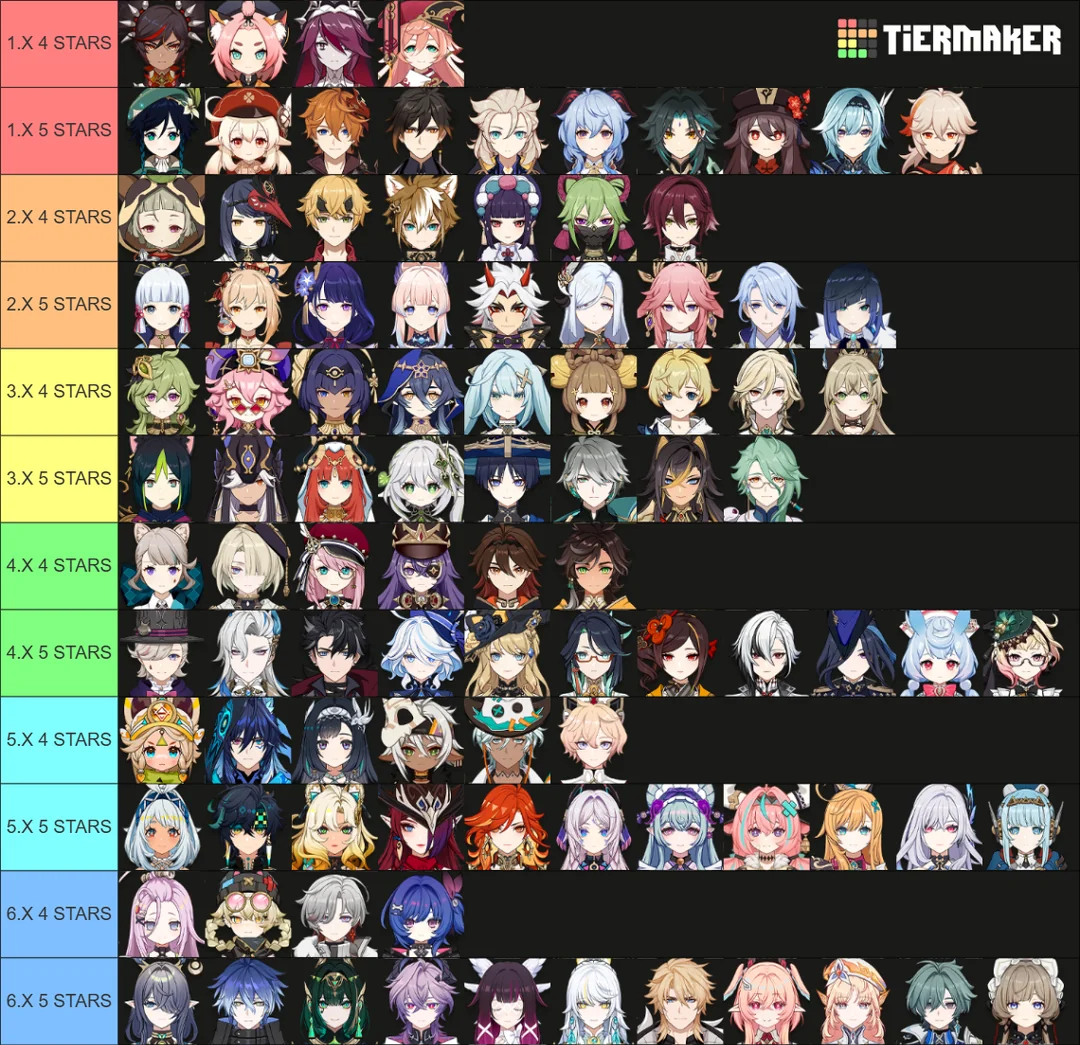
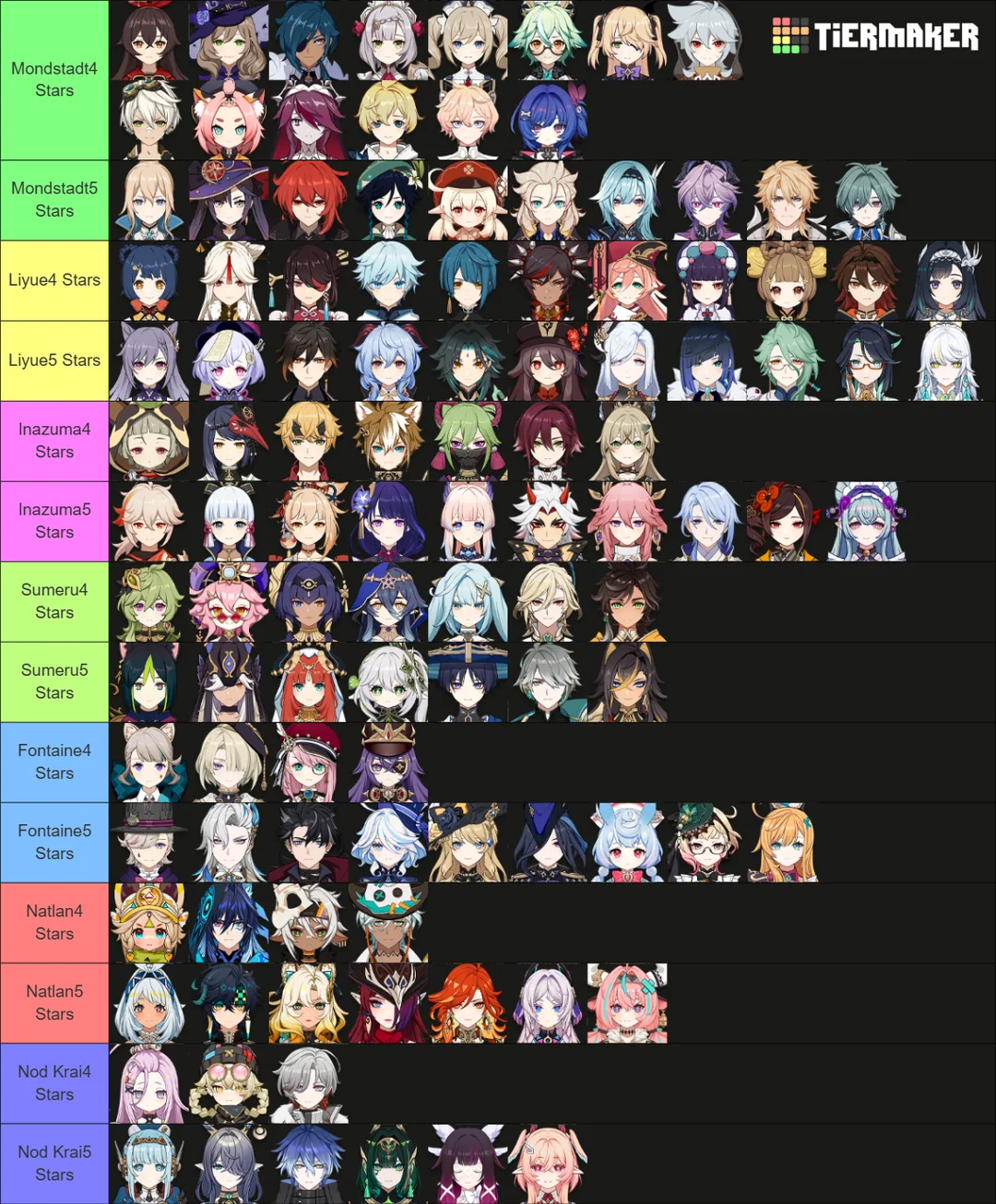
The conversation began when players compared the number of 4-star and 5-star characters released across different regions and major version cycles.
Many commenters noted that earlier regions maintained a relatively healthy balance between premium and accessible characters. By contrast, the current Version 6 era appears heavily focused on 5-star releases, while new 4-stars arrive less frequently and often serve highly specialized roles.
For long-time players, this feels like a major shift from the game's original design philosophy.
The concern isn't simply that there are fewer 4-stars.
It's that the purpose of 4-star characters seems to be changing.
The Golden Era of 4-Star Characters
One reason this discussion resonates so strongly is because Genshin's early 4-stars remain extraordinarily relevant even years after release.
The Original Powerhouses
These characters became famous because they were:
Flexible
Powerful at low constellations
Easy to fit into many teams
Competitive with some 5-star options
Many players see them as the benchmark that modern 4-stars struggle to reach.
HoYoverse has openly demonstrated a more cautious approach to character balance in recent years, leading some players to believe that the era of universally powerful 4-stars may be over.
Why Modern 4-Stars Feel Different
A recurring theme throughout the Reddit discussion is that modern 4-stars often feel designed around specific teams rather than serving as general-purpose options.
Several newer characters were frequently mentioned by players:
Jahoda
Many players praised Jahoda's story presence and personality but expressed disappointment with her gameplay design. Some comments described her as a character with strong narrative appeal whose kit failed to meet expectations.
Prune
Prune became a major talking point because many players feel the character requires higher constellation levels before reaching their full potential. Others view Prune primarily as a support tailored for specific premium teams.
Illuga
Illuga is often cited as an example of a modern specialist support. While undeniably effective in the right environment, many players argue that the character's value depends heavily on synergy with specific carries.
Aino
Unlike some of the other examples, Aino received praise from many players as a useful utility option. Despite not being considered a top-tier damage dealer, Aino provides valuable Hydro application and interacts well with several Version 6 mechanics.
This contrast highlights the central debate:
Modern 4-stars aren't necessarily weaker—but they are often far more specialized.
The Community's Four-Tier Theory of Modern 4-Stars
One of the most interesting ideas to emerge from the Reddit discussion was a player-created framework that categorizes modern 4-stars into four distinct groups.
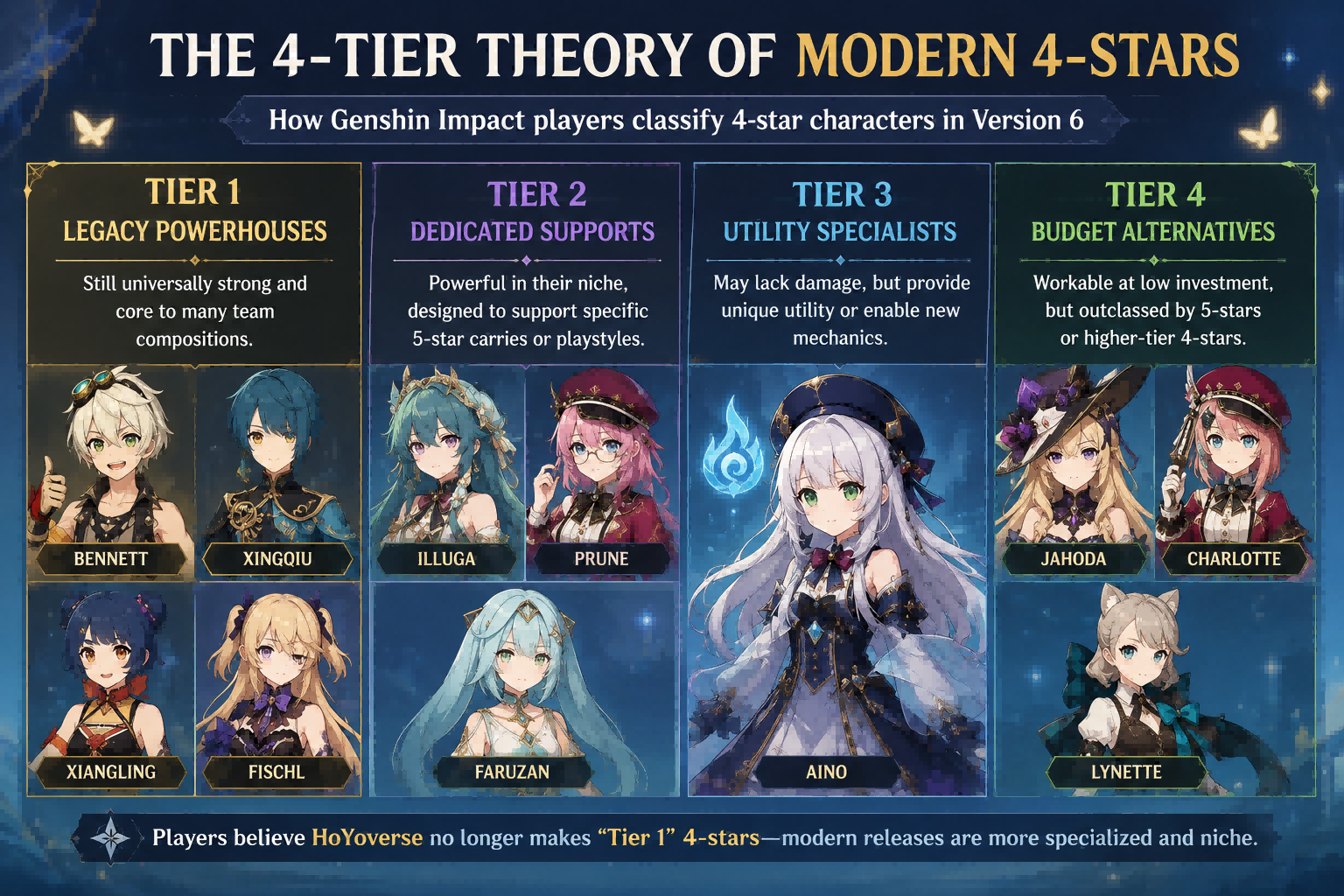
While this is community opinion rather than official design philosophy, it offers an interesting lens through which to view recent releases.
Tier 1 — Legacy Powerhouses
Examples:
Bennett
Xingqiu
Xiangling
Fischl
These characters remain effective across multiple teams and continue to influence the game's meta years after release.
Many players believe HoYoverse intentionally avoids creating 4-stars at this power level today.
Tier 2 — Dedicated Premium Supports
Examples:
Illuga
Prune
Faruzan
These characters can be extremely strong but are often designed around supporting specific 5-star characters or team archetypes.
Tier 3 — Utility Specialists
Examples:
Aino
These characters may not dominate damage charts but provide unique utility that helps free-to-play players access new mechanics and team options.
Tier 4 — Budget Alternatives
Examples frequently mentioned by players include:
Jahoda
Charlotte
Lynette
These characters often function as lower-investment alternatives to premium units but rarely become centerpieces of the meta.
Whether players agree with this framework or not, it reflects how many Travelers perceive the current state of 4-star design.
Regional Representation Is Becoming a Concern
Another major topic raised in the discussion involves regional character distribution.
Several players pointed out that even in Version 6, newer nations still have surprisingly limited 4-star representation.
According to community observations:
Many commenters noted that Fontaine and Natlan currently have only a small number of 4-star representatives compared to older regions.
For players who enjoy building nation-themed teams, this creates a frustrating situation.
One popular comment summarized the issue by joking that a full Fontaine 4-star team still feels like a distant dream.
Why Players Compare Genshin Impact to Honkai: Star Rail and Zenless Zone Zero
The discussion eventually expanded beyond Genshin itself.
Many players began comparing HoYoverse's approach across its different games.
The Honkai: Star Rail Concern
A common fear among players is that Genshin could eventually follow a path similar to Honkai: Star Rail.
Some players argue that Star Rail has dramatically slowed the release of new 4-star characters, with development resources increasingly focused on premium 5-star units.
Whether this comparison is entirely fair is debatable, but it reflects a broader anxiety about the future of accessible character releases.
The Zenless Zone Zero Comparison
Players also referenced Zenless Zone Zero.
Although A-Rank character releases have also slowed in ZZZ, some players feel that ZZZ provides better long-term access to older characters through its shop systems and rotation structure.
By contrast, many Genshin players believe the game's Starglitter shop has remained largely unchanged for too long.
This has reignited calls for:
Updated Starglitter rotations
More frequent 4-star availability
Additional constellation acquisition methods
The Hidden Cost of Chasing 4-Star Constellations
Ironically, one of the biggest complaints isn't the number of 4-stars at all.
It's the difficulty of obtaining specific ones.
Unlike featured 5-star characters, 4-stars still lack a dedicated hard guarantee system.
As a result, players often report situations where they:
Obtain multiple copies of the featured 5-star
Lose several 50/50s
Spend hundreds of wishes
...and still fail to fully complete the constellation of the specific 4-star they wanted.
For characters such as Prune or Illuga, whose performance may improve significantly with additional constellations, this can become surprisingly expensive.
Many players argue that chasing a C6 4-star can sometimes cost more Primogems than obtaining a limited 5-star character.
Managing Your Primogem Budget More Efficiently
Because constellation-focused banners can quickly drain saved resources, planning ahead has become more important than ever.
Whether you're preparing for future Version 6 banners, targeting a specific 4-star constellation, or saving for your favorite 5-star character, having enough Genesis Crystals available can make banner planning far less stressful.
💡 Traveler Tip: Many players compare prices across trusted recharge platforms before major updates arrive.
You can check the latest Genesis Crystal packages on:
Topuplist Genshin Impact Top Up
Topuplist supports multiple payment methods, instant delivery, and global recharge options for Travelers worldwide.
What Players Hope for Version 6 and Beyond
Despite the concerns raised throughout the discussion, most players aren't asking HoYoverse to stop releasing exciting 5-star characters.
Instead, the community's requests are surprisingly simple:
More new 4-star characters
Better regional balance
Stronger low-constellation performance
Improvements to the 4-star acquisition system
Updated Starglitter shop rotations
More opportunities to obtain older 4-stars
Many players still view 4-stars as one of the foundations that made Genshin Impact accessible and enjoyable from the beginning.
The debate ultimately isn't about power.
It's about preserving variety, accessibility, and player choice.
Final Thoughts
The Reddit discussion highlights a growing concern shared by many long-time Travelers:
4-star characters feel increasingly specialized, harder to obtain, and less central to the game's evolving roster strategy.
Whether this perception reflects HoYoverse's actual design direction remains unclear.
However, the conversation itself reveals something important—players still care deeply about 4-star characters.
As Version 6 continues to evolve, the community will be watching closely to see whether future updates bring more accessible options, better regional representation, and a renewed focus on the characters that helped define Genshin Impact's early success.