

Wild Rift Loss Shields: Why a Full Bar Can Come Too Late
A Fortitude bar that fills after a defeat is not the same as a Loss Shield you already had when that defeat was resolved. In Wild Rift’s standard Ranked Queue, Riot lists the end-of-game calculation in this order: Ranked Marks, Ranked Fortitude, then Fortitude converted into a Loss Shield. That timing explains why a new shield can appear even though the match still cost you a Mark.
Read the shield indicator and the progress bar as different pieces of information. The indicator shows protection already available; the bar shows progress toward another shield. For a close promotion or demotion situation, that difference matters more than how full the bar looks before you queue.
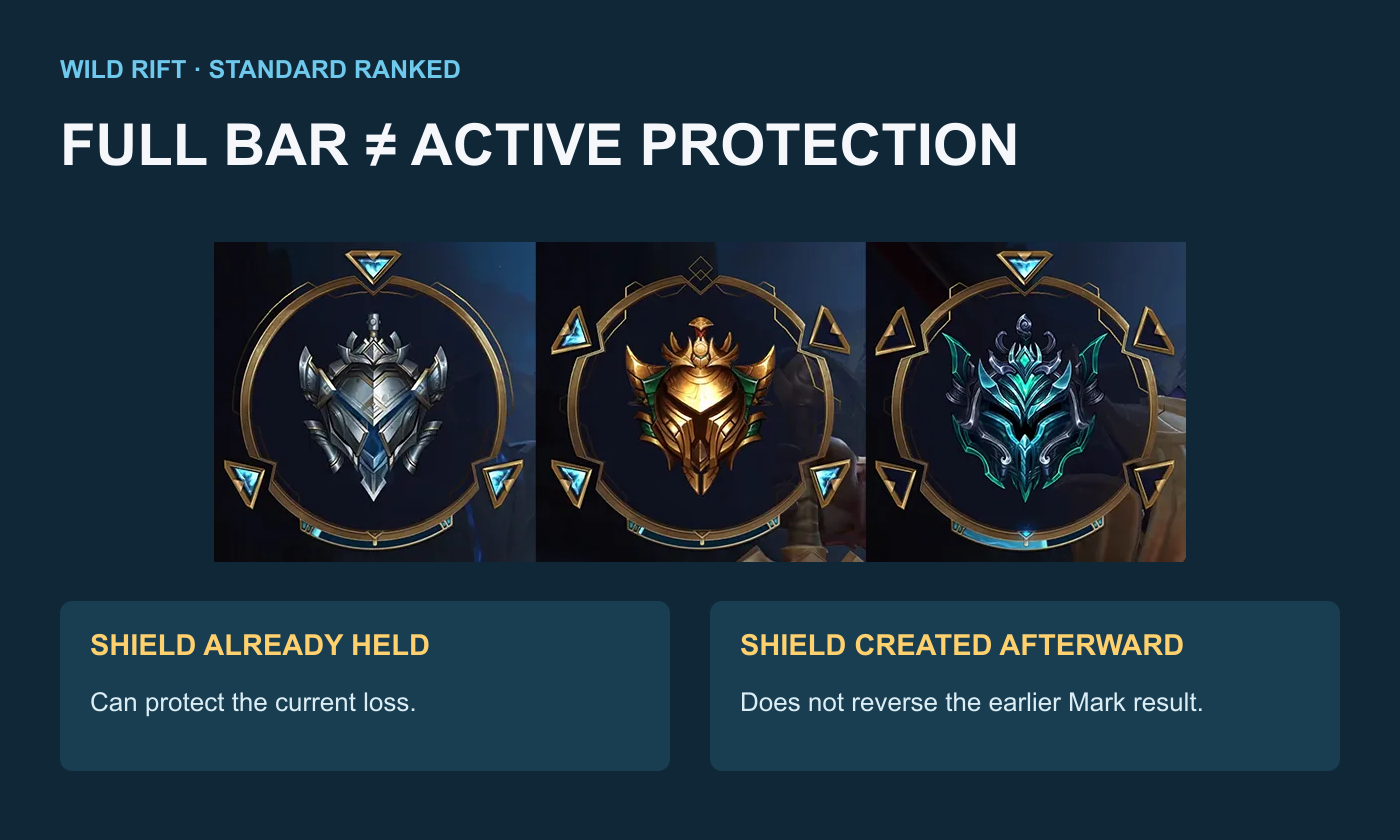
The calculation order explains the apparently missing protection
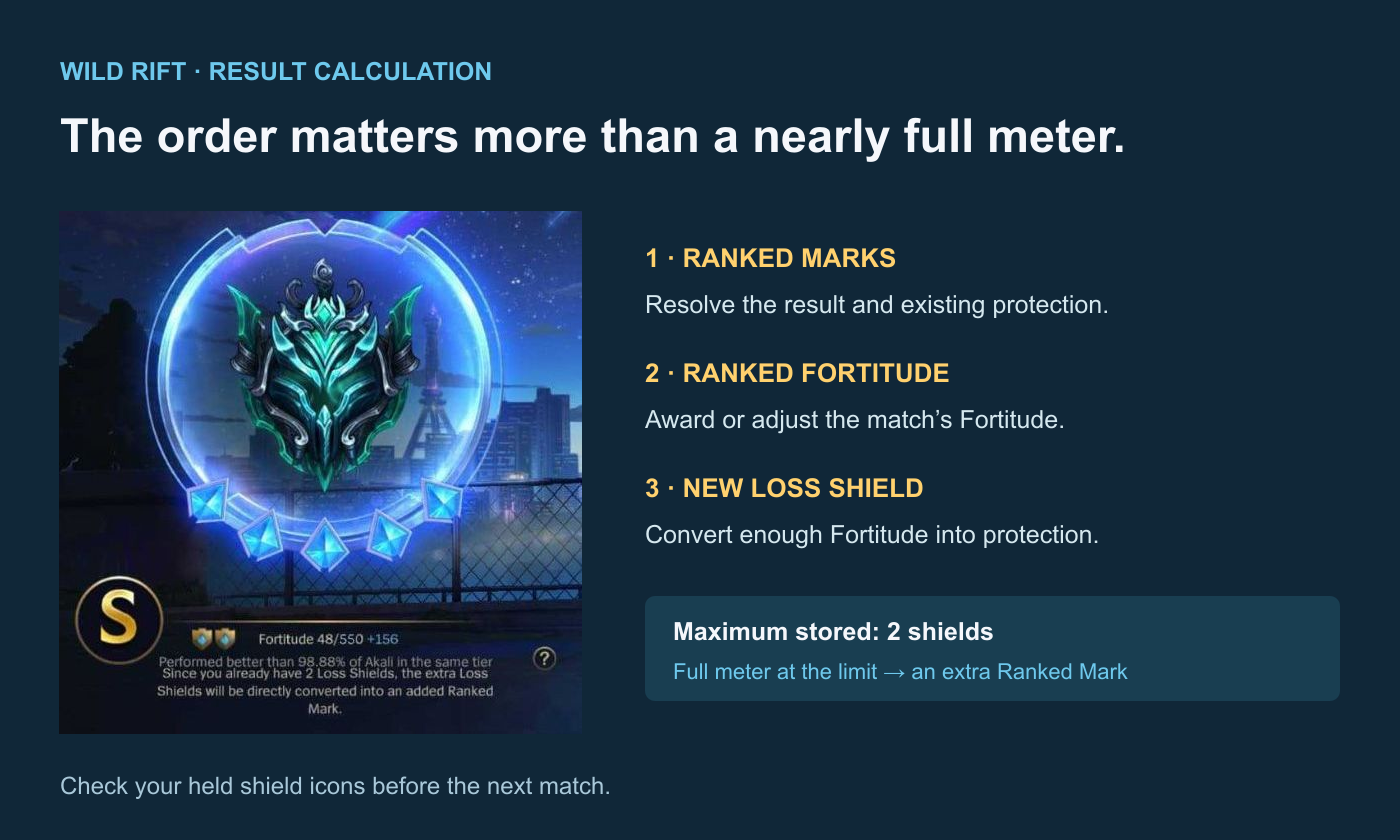
Riot’s Ranked Fortitude explanation says an active Loss Shield is consumed instead of a Ranked Mark when you lose. It then gives the following end-of-game order. A shield created in the last stage is available after that creation; it does not become a shield you held during the earlier Mark calculation.
Ranked Marks are resolved.
Ranked Fortitude is awarded or adjusted.
Enough Fortitude converts into a new Loss Shield.
 League of Legends: Wild Rift
For example, suppose you enter a match without a shield, lose, and earn enough Fortitude afterward to fill the bar. The new shield and the lost Mark can both be correct outcomes. To judge that result, check what protection existed before the match result rather than reading only the final screen.
You can store 2 shields; further overflow has another use
Riot identifies Loss Shields through the small gold-and-blue shield icons beside Fortitude. The circle around the Ranked emblem also glows blue when at least one shield is held. Those visual cues are more useful than guessing from the amount of blue on the progress bar.
The storage limit is 2 Loss Shields. If you fill the Fortitude meter while already holding 2, the extra shield converts directly into an additional Ranked Mark. You are not building an unlimited reserve of saved losses. This also explains why a full meter can sometimes produce a Mark rather than another shield icon.
The Fortitude requirement increases with your tier
The same official page lists the following bar caps for standard Ranked. These numbers describe the Fortitude needed to fill the bar at that tier, not how many points every match awards and not the weekly earning limit.
Ranked tier | Fortitude bar cap |
|---|---|
Iron | 250 |
Bronze | 300 |
Silver | 350 |
Gold | 400 |
Platinum | 450 |
Emerald | 500 |
Diamond | 550 |
Master–Sovereign | 600 |
A promotion can therefore change how much Fortitude is needed for the next shield. Use your current tier and the live meter when planning around protection; do not carry a threshold remembered from a lower tier into a higher one.
Good play helps, but Fortitude has a weekly earning cap
Riot names win streaks, persevering with an AFK teammate and facing a strong opposing team among the reasons a match can award more Fortitude. The end-of-game screen shows how your points were earned. Negative behavior, including leaving mid-game, can reduce Fortitude instead.
There is also a weekly cap on the Fortitude you can earn. If the number stops rising, do not assume the meter is broken or that every further match must generate another shield. Check the displayed earning information and separate a weekly earning limit from the storage limit for shields.
Legendary Queue does not use this Fortitude protection
The Fortitude page explicitly excludes Legendary Queue. Riot’s Legendary Queue explanation describes a separate Legendary Points progression system, while the standard Ranked overview explains the normal Mark-and-Fortitude relationship. A protection expectation from one queue should not be carried into the other.
Before the next match, check the queue name, the shield icons you actually hold and the current Fortitude threshold. If you are reviewing a disappointing result, compare those with the order of the result calculation. That gives you a concrete explanation of the lost Mark instead of relying on a nearly full bar.