


VALORANT VCT EMEA Stage 2 Playoffs: How Champions Qualification Works
The VALORANT Champions Tour EMEA Stage 2 Playoffs begin at Riot Games Arena in Berlin on August 20, 2026, followed by the Barcelona Finals at Olímpic Arena from August 28 to 30. Eight teams enter a double-elimination bracket after four direct group-stage qualifiers are joined by four Arena Stage survivors. The champion and runner-up secure direct Champions qualification, while the two highest eligible Circuit Points teams claim EMEA's remaining places. This guide explains how teams reached the bracket, where each qualifier starts, the BO3 and BO5 structure, the confirmed prize distribution, and the qualification stakes.
The VALORANT Champions Tour EMEA Stage 2 Playoffs begin in Berlin on August 20, 2026, turning the regional season's final bracket into a direct qualification test for Champions. Players separately preparing VALORANT Points for confirmed store purchases can use Topuplist and the dedicated VALORANT top-up page, while viewers should focus on the eight-team double-elimination structure, the confirmed placement stakes, and the difference between direct qualification and the Circuit Points route. The Berlin Playoffs run from August 20 to 23 before the Barcelona Finals from August 28 to 30.
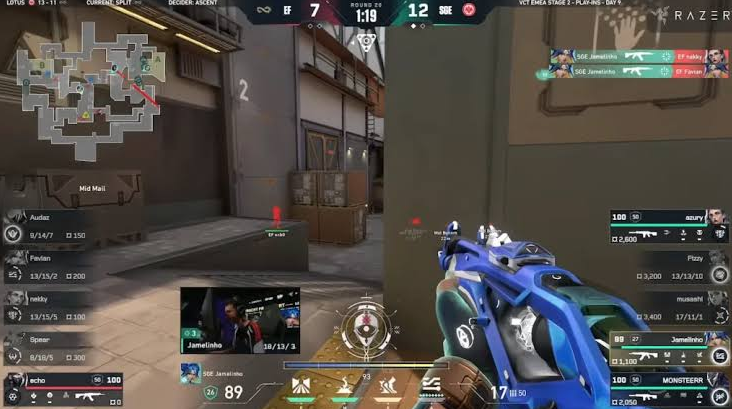
Stage 2 Playoff Facts
Stage 2 started with twelve EMEA teams divided into two groups of six. The top two teams from each group advanced directly to the Playoffs. The other eight VCT teams entered the Arena Stage, where they were joined by four Challengers teams. Four Arena Stage teams then earned the remaining Playoff positions.
Item | Confirmed format |
|---|---|
Berlin Playoffs | August 20-23, 2026 |
Barcelona Finals | August 28-30, 2026 |
Berlin venue | Riot Games Arena |
Barcelona venue | Olímpic Arena |
Playoff teams | 8 |
Bracket | Double elimination |
Direct group qualifiers | 4 |
Arena Stage qualifiers | 4 |
Direct Champions qualification | Stage 2 champion and runner-up |
Stage 2 prize pool | $250,000 |
This path gives direct group qualifiers a preparation advantage, but it also means Arena Stage survivors arrive with recent elimination matches already played. Rest and momentum pull in opposite directions, making the opening round more than a simple comparison of group records.
How the Arena Stage Builds the Final Eight
The Arena Stage exists between group play and the main Playoffs. Eight VCT teams from the group stage join four Challengers teams, and four advance. The phase rewards the group-stage leaders with direct Playoff access while giving the remaining VCT teams and Challengers representatives a separate route into the final eight.
A team that survives the Arena Stage has already demonstrated that it can perform under immediate elimination pressure. However, it may also reveal more map choices, defensive setups, pistol plans, and timeout responses before meeting a rested direct qualifier.
For viewers, the label attached to a team matters less than the route it took. A direct qualifier may have stronger season results, but an Arena survivor may enter with sharper recent reads. The first Playoff series tests whether preparation time or competitive rhythm produces the larger advantage.
Double Elimination Explained
The eight Playoff teams do not all begin in the same part of the bracket. The two group winners enter the Upper Semifinals, the two group runners-up and the top two Arena Stage teams enter Upper Round 1, and the third- and fourth-place Arena Stage teams begin in Lower Round 1. From there, an upper-bracket loss sends a team to the lower bracket, while a second loss ends the run.
The upper bracket is therefore a resource. Staying there reduces the number of elimination matches required to reach the final stages and gives teams more preparation time between series. Dropping early creates a longer route in which every later match can end the season.
Double elimination also changes how viewers should interpret one bad result. A narrow opening defeat may be recoverable if the team identifies the map-veto or adaptation problem. A lower-bracket win does not erase the weakness, but it proves the roster can correct it while under pressure.
Most Playoff series use a best-of-three format. The Lower Final and Grand Final expand to best-of-five, increasing the importance of map-pool depth, stamina, and adaptation across a longer series. A team built around two reliable maps may survive an early BO3 but face a much harder test when five-map preparation becomes relevant in Barcelona.
The most important bracket questions are:
Which teams preserve map-pool flexibility after the first veto?
Which losing team receives the more difficult lower-bracket opponent?
How much preparation can be reused across consecutive series?
Does a roster improve in rematches, or repeat the same tactical weakness?
Which team reaches a qualification match with two chances still available?
How Champions Qualification Works
The Stage 2 champion and runner-up earn the two direct EMEA qualifications to Champions. This makes the series that determine the finalists more important than ordinary prize-placement matches. Reaching the final is not only a chance to win Stage 2; it locks the season's international destination.
The two remaining EMEA Champions places go to the teams with the highest eligible Circuit Points totals after the direct qualifiers are accounted for. Circuit Points have accumulated across the season, so a team can miss the Stage 2 final and still remain alive through the points route. That possibility depends on its total relative to the other eligible EMEA teams.
The distinction is essential:
Direct qualification is controlled by the current Stage 2 bracket.
Points qualification depends on the full season table.
A team cannot evaluate its position using Stage 2 points alone.
Results by rival teams can change the required finishing position.
A viewer should keep the live Circuit Points table open during the final rounds. Statements such as “a top-four finish is enough” are only valid when the relevant rival scenarios have been calculated.
Stage 2 Prize Money
The $250,000 prize pool is distributed by placement. The published breakdown assigns $100,000 to first place, $65,000 to second, $40,000 to third, $25,000 to fourth, $10,000 to each fifth- and sixth-place team, and no prize money to the seventh- and eighth-place teams.
Placement | Prize money |
|---|---|
1st | $100,000 |
2nd | $65,000 |
3rd | $40,000 |
4th | $25,000 |
5th-6th | $10,000 each |
7th-8th | $0 |
These rewards create several layers of pressure. A team that reaches the final secures direct Champions qualification in addition to the larger prize, while fifth- and sixth-place teams still receive a financial award and seventh- and eighth-place teams do not.
What to Watch in the Opening Round
The first useful signal is map veto depth. Best-of-three series reward teams that have at least two dependable maps and a workable third option. A roster with one elite map can still lose if the opponent removes it and forces the series onto weaker territory.
The second is defensive adaptation. Teams often enter with prepared attacks, but Playoff survival depends on recognizing opponent tendencies during the series. Watch timeout timing, site-stack changes, economy reads, and whether a team repeats a failed retake pattern.
The third is pistol conversion. Winning a pistol is valuable, but the more revealing statistic is whether the team converts the following anti-eco round. Losing immediately after a pistol win erases much of the economic advantage.
The fourth is ultimate economy. Late-round observer graphics show which team has tools for the next gun round. A team may save weapons while also preserving ultimates, creating a stronger future buy than the scoreboard alone suggests.
The fifth is mental recovery. Double elimination gives an upper-bracket loser another chance, but only if the team can reset before the lower-bracket match. Repeated early-round mistakes often show that the previous loss was not fully processed.
A Useful Viewing Method
Before each series, record three pieces of information: both teams' route to the bracket, their recent map preferences, and the qualification consequence of winning or losing. This creates context without requiring a large statistics sheet.
During map one, watch the veto assumptions. Did the favored team actually look comfortable on its selected map? Did the opponent reveal a prepared counter? Avoid deciding the entire series from the opening six rounds because economy swings can distort a short sample.
During map two, look for adaptation. A team that lost map one should change pace, defaults, utility timing, or defensive positioning. If nothing changes, the strategic problem may be deeper than individual aim.
If the series reaches map three, economy discipline and agent comfort become critical. Decider maps are often less frequently played, so basic trading, spacing, and communication carry more weight.
After the result, update the bracket and points scenarios. Do not rely on an old graphic after another team has advanced or been eliminated.
Upper Bracket Versus Lower Bracket Value
An upper-bracket run creates two major advantages. The first is insurance: one loss remains available. The second is reduced match volume, which limits fatigue and the amount of strategy exposed to future opponents.
A lower-bracket run can build momentum, but every additional series creates preparation demands. Teams must study another opponent, maintain sleep and practice routines, and avoid revealing all of their strongest set plays too early.
Viewers sometimes describe a lower-bracket team as automatically more dangerous because it has “nothing to lose.” In reality, it has everything to lose in every match. The useful question is whether the roster has expanded its solutions or is surviving through repeated individual heroics.
Why the Two Venues Matter
The Berlin Playoffs are staged at Riot Games Arena, moving the decisive part of Stage 2 into a live competitive environment. The Barcelona Finals then carry the final championship matches to Olímpic Arena. Crowd reaction can amplify momentum after clutches, aggressive defensive pushes, or long overtime maps, but the venue change also creates a second travel and preparation checkpoint.
Experience on stage matters most when communication becomes difficult. Teams need concise calls, disciplined timeout use, and players who can reset after a loud opponent highlight. LAN pressure does not create entirely new skill, but it can expose hesitation that online group play did not punish.
The venue also makes scheduling discipline important for viewers. Match pages can display times in local or automatically converted formats. Confirm the selected timezone before planning a full day around a series.
A Qualification Scenario Worksheet
A useful qualification calculation begins with the Circuit Points table before the Playoffs, then applies only the current official season rules. Do not import a point schedule from an older event or an unofficial summary when calculating the remaining Champions route.
Create one row for every team still able to compete for the points route. Record its existing Circuit Points total, the current placement scenarios, and whether it can still finish in the direct top two or remain eligible for the points route.
Worksheet field | Calculation |
|---|---|
Current total | Points earned before the next Playoff result |
Minimum final total | Current total plus the lowest placement still possible |
Maximum final total | Current total plus the highest placement still possible |
Direct qualification | Yes while a top-two Stage 2 finish remains possible |
Rival dependency | Results that must occur for the team to lead the points route |
After every elimination, replace the range with the team's confirmed placement points. Then recalculate the other teams' minimum and maximum totals. If one team's minimum exceeds every rival's maximum, its points position is secure. If the ranges overlap, qualification still depends on later results.
This worksheet is more reliable than a static “must reach top four” statement because it changes with the bracket. It also shows why a one-point difference between third and fourth can decide the remaining route even when both teams miss direct qualification.
Final Recommendation
The best way to follow the VCT EMEA Stage 2 Playoffs is to track three connected stories: survival in the double-elimination bracket, the two direct Champions places, and the changing Circuit Points race for the final two places. The Berlin Playoffs begin on August 20, while the Barcelona Finals complete the event from August 28 to 30.
Watch map vetoes before star-player statistics, treat the upper bracket as valuable insurance, and update qualification scenarios after every elimination. A team may lose one series and still reach Champions, while another may win several matches but remain dependent on points. That tension is what makes Stage 2 more than a regional trophy race.
FAQ
When do the VCT EMEA Stage 2 Playoffs begin?
The Berlin Playoffs begin on August 20, 2026, and run through August 23 at Riot Games Arena. The Barcelona Finals take place from August 28 to 30 at Olímpic Arena.
How many teams reach the Playoffs?
Eight teams qualify: four directly from the group stage and four through the Arena Stage. The two group winners start in Upper Semifinals, while the two group runners-up and the top two Arena Stage teams start in Upper Round 1; the remaining two Arena Stage qualifiers start in Lower Round 1.
Is the bracket single or double elimination?
It is double elimination. An upper-bracket loss sends a team to the lower bracket; a second loss eliminates it.
How do teams qualify for Champions?
The Stage 2 champion and runner-up qualify directly. The two remaining EMEA places go to the highest eligible teams in the season Circuit Points standings after those direct qualifiers are removed.
What is the Stage 2 prize pool?
The total prize pool is $250,000. First place receives $100,000, second receives $65,000, fifth and sixth receive $10,000 each, and seventh and eighth receive $0.
Where can I recharge VALORANT Points?
Players preparing VALORANT Points for confirmed in-game store purchases can use Topuplist and the VALORANT recharge page. Topuplist provides game top-ups and does not sell accounts.