


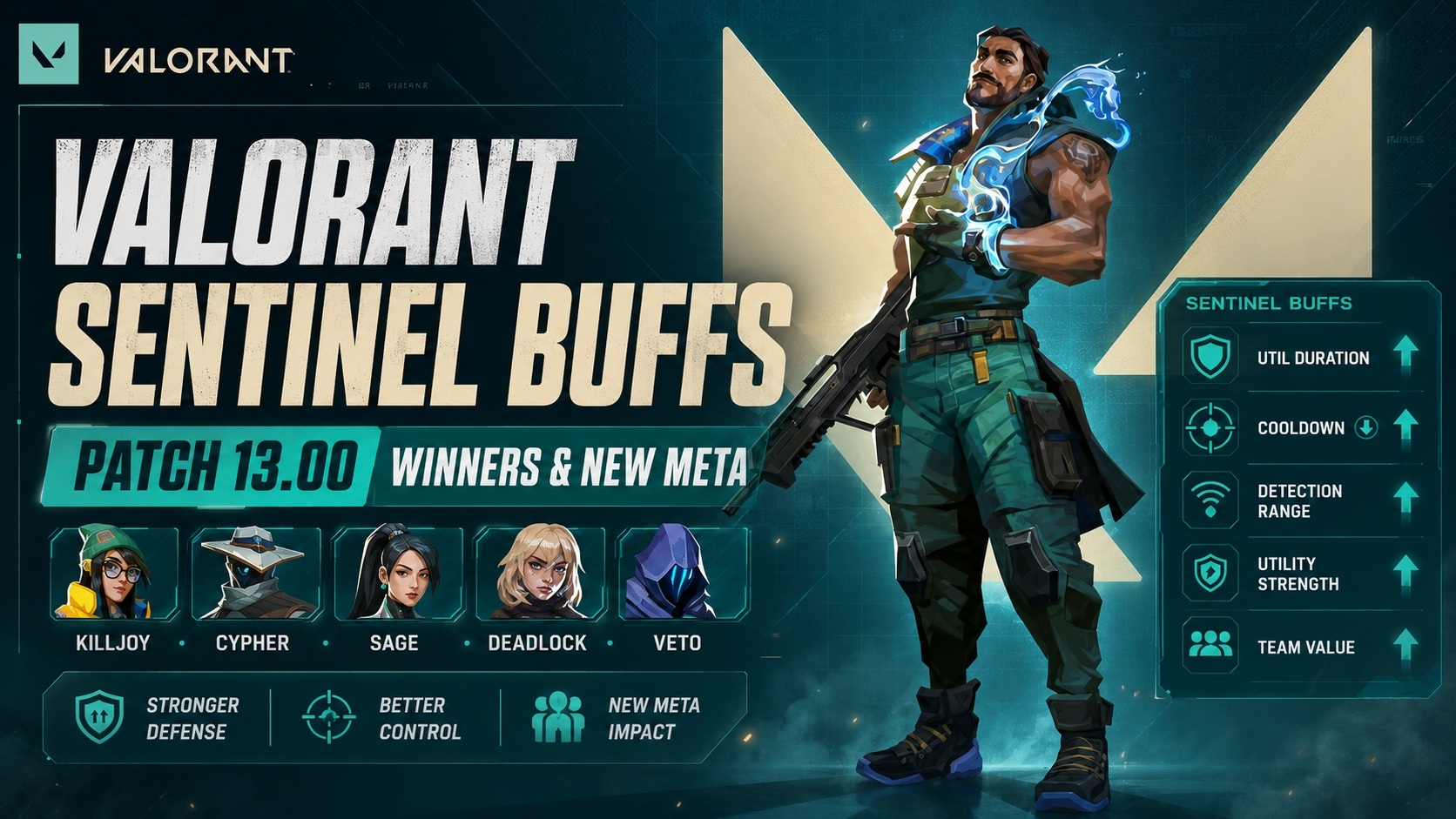
VALORANT Sentinel Buffs Patch 13.00: Winners & New Meta
Planning to pick up a new weapon skin, bundle, or Battle Pass during V26 Act 4? Visit the English Topuplist VALORANT Top Up page to browse available VALORANT Points packages. Check the supported region, account details, package contents, and final price before completing payment. Topuplist is a third-party recharge platform and is not affiliated with Riot Games.
VALORANT Patch 13.00 directly buffs five Sentinels: Cypher, Killjoy, Veto, Sage, and Deadlock.
The changes are designed to make defensive utility more reliable against repeated, low-information site rushes. Instead of completely redesigning the role, Riot has improved activation speed, ability duration, repositioning flexibility, self-sustain, and cooldown availability.
Killjoy is the biggest overall winner of Patch 13.00. Three parts of her kit received meaningful improvements, strengthening her information gathering, site delay, and post-plant control. Cypher becomes more reliable against fast entries, Deadlock gains more freedom to use GravNet proactively, Veto can adapt his setup more easily, and Sage becomes considerably more self-sufficient.
However, the patch does not automatically make every buffed Sentinel a top-tier pick. Map geometry, team composition, rank, and coordination still determine which Agent delivers the most value.
This analysis ranks the Patch 13.00 Sentinel winners, explains how the role hierarchy may change, examines the indirect impact on Chamber and Vyse, and shows attackers how to counter the emerging defensive meta.
All VALORANT Sentinel Buffs in Patch 13.00
Riot’s official VALORANT Patch 13.00 notes list direct changes for five members of the Sentinel roster.
These buffs do not all serve the same purpose.
Killjoy receives improvements across several phases of a round. Cypher and Deadlock gain reliability. Veto becomes less restricted by his original placement decisions, while Sage receives a personal consistency buff rather than stronger area denial.
Chamber and Vyse did not receive direct balance adjustments in Patch 13.00.
Why Riot Buffed Sentinels
Riot describes Sentinels as an important part of VALORANT’s tactical loop. Their job is not merely to watch flanks or place traps. They are also expected to discourage attackers from repeatedly committing five players to a site without scouting the defensive setup first.
Low-Information Rushes Were Too Easy to Repeat
Fast attacks should remain a legitimate strategy. The issue arises when attackers can repeatedly rush through defensive utility without gathering information, forcing resources, or adjusting their timing.
Patch 13.00 increases the cost of ignoring Sentinel setups.
Faster Trapwire activation, longer Nanoswarm duration, and more dependable Alarmbot movement mean attackers may need to:
Scout before entering
Clear utility with abilities
Force traps before committing
Rotate away from a heavily defended site
Change the timing of their execute
Preserve enough utility for the final site hit
The patch does not remove aggressive play. It makes unsupported and predictable aggression easier to punish.
Solo Anchors Gain More Time to Survive
A Sentinel is often expected to hold one site while teammates contest other areas.
The anchor does not necessarily need to eliminate every attacker. Their first responsibility is to slow the execute, gather information, survive long enough for rotations, and create trade opportunities.
Several Patch 13.00 changes directly improve that process.
Killjoy can delay for longer. Cypher’s wire converts information more quickly. Deadlock may use GravNet early without permanently sacrificing its late-round availability. Veto can reposition his setup faster when attackers change direction.
Macro Strategy Becomes More Important
The broad effect is likely to be a greater emphasis on:
Early information gathering
Utility-clearing sequences
Default map control
Delayed site hits
Mid-round rotations
Forcing defensive resources
Attacking the weaker side of the map
Teams that identify the Sentinel, understand the setup, and force utility before committing should still find openings.
Patch 13.00 Sentinel Winner Ranking
This ranking evaluates the practical effect of each buff rather than simply comparing the size of the numbers.
This is an early meta projection, not a confirmed professional ranking. Pick rates and team compositions may shift once players develop new setups and competitive teams test the changes.
Killjoy Is the Biggest Patch 13.00 Winner
Killjoy receives the broadest and most immediately useful collection of buffs.
Her Turret, Nanoswarm, and Alarmbot each perform different functions. Improving all three strengthens her throughout the entire round rather than only enhancing one specialized interaction.
Faster Turret Fire Creates More Pressure
Killjoy’s Turret now fires 50% faster.
The Turret remains primarily an information and disruption tool. It is not intended to replace Killjoy’s weapon or become a reliable source of eliminations on its own.
However, faster fire changes how comfortably attackers can ignore it.
A Turret can now:
Apply chip damage more quickly
Interrupt an attacker’s crosshair placement
Confirm an enemy position faster
Create a stronger swing opportunity for Killjoy
Force attackers to spend time destroying it
Punish players who enter while focused on another angle
Attackers who previously ran past the Turret may now need to clear it before committing to the fight.
The strongest setups will use the Turret to create timing advantages rather than expecting it to secure kills independently.
Longer Nanoswarm Improves Every Delay Situation
Nanoswarm duration increases from four seconds to five.
One additional second may sound minor, but the Spike timer and plant animation make small timing advantages important.
A longer Nanoswarm can:
Delay a plant for more time
Deny a defuse for an additional second
Hold attackers outside a choke point
Give rotating defenders more time to arrive
Extend sequential post-plant utility
Force attackers to cancel an interaction
The greatest value comes from chaining utility rather than using every Nanoswarm simultaneously.
For example, Killjoy can activate one Nanoswarm to stop the initial plant attempt, wait for the attackers to recommit, and then use the second. In a post-plant situation, sequential activation consumes more of the defuse window than overlapping both devices.
Attackers may respond by faking the plant or defuse to force Killjoy into using her utility early.
Faster Alarmbot Makes Combinations More Reliable
Alarmbot movement speed is also increased by 50%.
The faster bot should reach detected targets more consistently, reducing the opportunity for aggressive Agents to escape before it applies Vulnerable.
This improves Killjoy’s combinations with:
Nanoswarm
Turret damage
Teammate grenades
Shock Bolts
Molotovs
Defensive crossfires
Alarmbot also becomes more dependable for monitoring a late lurk or an unattended route.
Players must still place it carefully. A predictable Alarmbot can be destroyed before activation, and its range restriction continues to affect Killjoy’s rotations.
Is Killjoy the Best Sentinel Now?
Killjoy is the strongest candidate for the biggest winner, but she is not automatically the best Sentinel on every map.
Her main strengths are concentrated site control, plant denial, and structured post-plants. Her limitations remain:
Utility range restrictions
Predictable setup locations
Vulnerability to utility clearing
Reduced value during distant rotations
Dependence on good device placement
Cypher remains superior when a team needs persistent information across a larger area. Chamber may still be preferred for Operator-focused strategies. Deadlock can offer stronger active choke-point punishment in a coordinated composition.
Killjoy is therefore best understood as the most complete Patch 13.00 winner rather than a mandatory universal pick.
Cypher’s Trapwire Buff Punishes Fast Entries
Cypher receives only one numerical change, but it directly improves his primary anti-entry tool.
Trapwire windup is reduced from 0.9 seconds to 0.7 seconds.
Why 0.2 Seconds Matters
VALORANT fights are decided within extremely short reaction windows.
A 0.2-second reduction gives an enemy less time to:
Destroy the wire
Escape its effective area
Adjust movement
Warn the entry player
Complete a mobility sequence
Take a favorable duel before being affected
The buff is particularly relevant against fast entry patterns involving Jett, Neon, Raze, Yoru, or a coordinated group pushing through the same choke point.
It does not mean Trapwire automatically stops every movement ability. Placement, height, terrain, and the exact entry path still matter.
The improvement simply makes careless movement less forgiving.
Cypher Becomes Better at Converting Information
Cypher already excels at learning where enemies are moving. The buff helps him convert that information into a more immediate combat advantage.
A triggered wire can create an opportunity to:
Swing while the attacker is distracted
Fire through a Cyber Cage
Combine the tether with damaging utility
Delay the entry long enough for a rotation
Separate the first attacker from the rest of the team
The strongest Cypher players will continue changing wire heights and locations so opponents cannot clear them automatically.
Cypher vs Killjoy After Patch 13.00
The comparison depends on what a team needs.
Choose Cypher when the composition needs:
Wider map information
Reliable flank surveillance
Lurker detection
Flexible Spycam positions
Utility that remains useful across distant areas
Choose Killjoy when the composition needs:
Stronger site delay
Plant denial
Post-plant utility
Concentrated defensive control
Lockdown for executes or retakes
Killjoy receives more direct power in Patch 13.00, but Cypher’s information remains strategically unique.
Deadlock Gains More Freedom to Use GravNet
Deadlock receives a GravNet cooldown reduction from 60 seconds to 50 seconds.
This is not a dramatic rework, but it changes how confidently Deadlock can use the ability during the early round.
Early GravNet Is Less Expensive
Before the reduction, an early GravNet could mean losing access to the ability during the final execute.
At 50 seconds, a second use becomes more realistic during slower rounds. Deadlock can contest an early choke point, disrupt map control, or support a teammate’s fight without always saving GravNet for the final site hit.
This encourages proactive usage.
Potential early-round uses include:
Stopping a fast opening push
Contesting an important orb
Supporting an aggressive defender
Forcing attackers away from a narrow route
Delaying a coordinated entry
Combining with reconnaissance utility
If the round continues, GravNet may return for the execute, retake, or post-plant.
GravNet Combinations Become More Practical
GravNet is strongest when another ability punishes enemies whose movement has been restricted.
Strong combinations include:
Raze Paint Shells
Sova Shock Bolt
Brimstone Incendiary
Viper Snake Bite
Breach Aftershock
Tejo damage utility
The cooldown buff does not increase GravNet’s direct power, but it creates more opportunities to execute these combinations.
Does Deadlock Replace Killjoy or Cypher?
Deadlock still serves a different purpose.
Killjoy and Cypher provide more passive information and can maintain value without immediate teammate involvement. Deadlock is strongest when the team actively combines abilities around a predictable choke point.
Her weaknesses remain:
Limited passive flank surveillance
Dependence on enemy noise for Sonic Sensor
Greater coordination requirements
Lower value when attackers play slowly and quietly
Deadlock may therefore gain more in coordinated teams than in uncommunicative solo queue matches.
Veto Becomes More Flexible
Veto receives three improvements across Interceptor and Crosscut.
These buffs target flexibility rather than raw damage.
Interceptor Can Be Repositioned Faster
Interceptor’s reclaim cooldown falls from 30 seconds to 20 seconds.
This reduces the punishment for placing it during the early round and then needing to rotate.
Veto can now:
Recover the device sooner
Move it toward the threatened site
Adapt after attackers reveal their plan
Preserve anti-utility value during rotations
Avoid remaining committed to one defensive setup
This is especially important for an Agent whose value depends on denying or destroying incoming utility.
Crosscut Covers a Larger Area
Crosscut’s usable area increases from 24 metres to 30 metres.
The larger range provides more freedom when creating setups. Veto can place or interact with the ability from safer, less predictable positions and cover more space during defensive rotations.
This may improve Crosscut on larger sites and in situations where Veto must remain behind cover.
Faster Arming Improves Reactive Setups
Crosscut now arms in 0.75 seconds instead of 1.5 seconds.
Halving the arming time makes emergency deployment considerably more practical.
Veto should be better able to:
Set utility after hearing an execute
Prepare a retake route
Respond to a sudden rotation
Rebuild a setup after repositioning
Use Crosscut without giving attackers as much time to react
Is Veto Meta After the Buffs?
The changes solve several usability problems, but they do not guarantee that Veto replaces more established Sentinels.
His main advantage is anti-utility control. This becomes most valuable against teams using coordinated Initiator abilities and structured site executes.
His long-term position will depend on whether teams prefer:
Veto’s utility denial
Cypher’s information
Killjoy’s delay
Deadlock’s choke-point control
Chamber’s weapon-focused pressure
Vyse’s isolation tools
Patch 13.00 makes Veto more practical. More ranked and professional data is needed before calling him a definitive top-tier Sentinel.
Sage’s Self-Heal Buff Raises Her Ranked Floor
Sage can now restore up to 100 health to herself over time instead of 50.
This is a substantial personal survivability buff, but it does not directly strengthen her wall, slows, or information gathering.
Sage Can Recover From Early Damage
Sage players frequently take direct fights while defending an important route or supporting a teammate.
The stronger self-heal allows Sage to recover more effectively from chip damage and re-enter the round with enough health to survive another duel.
It benefits situations where Sage:
Takes an early rifle body shot
Receives damage from utility
Escapes an opening fight
Needs to remain alive for Resurrection
Must defend another area later in the round
The heal still occurs over time. Sage must disengage and survive long enough to receive its full value.
Why the Buff Is Stronger in Ranked
The self-heal may have greater practical impact in ranked than in professional play.
Ranked matches often include:
Less coordinated healing priorities
More individual fights
Inconsistent team spacing
Fewer planned defensive rotations
Greater reliance on personal survivability
A Sage player who can restore more of her own health becomes less dependent on teammates and more capable of taking another engagement.
What the Sage Buff Does Not Change
The update does not:
Increase Barrier Orb durability
Expand Slow Orb
Improve Resurrection
Add information utility
Remove her map dependence
Solve competition for the Sentinel slot
Sage remains strongest when Barrier Orb creates exceptional value or when a composition benefits significantly from Resurrection and slowing utility.
The buff raises her consistency more than it changes her strategic identity.
Chamber and Vyse Are the Indirect Losers
Chamber and Vyse were not directly nerfed.
However, Agent strength is relative. When several competitors improve, an unchanged Agent may lose priority even if their personal kit remains exactly the same.
Chamber Faces More Competition
Chamber occupies a Sentinel slot but provides less traditional site-delay utility than Killjoy, Cypher, Deadlock, or Sage.
His strengths remain:
Operator synergy
Opening-duel pressure
Safe repositioning
Weapon economy
Long-range defensive control
Patch 13.00 does not remove those advantages.
The issue is that teams selecting only one Sentinel may increasingly prefer the stronger information and delay offered by the buffed Agents.
Chamber remains valuable when the composition is specifically built around his ability to secure an opening elimination.
Vyse Must Defend Her Niche
Vyse continues to offer isolation, flashes, route control, and weapon disruption.
Her kit can still perform well on maps with narrow entrances or predictable site hits. However, Killjoy and Deadlock now provide stronger alternatives for teams focused on stopping direct executes.
Vyse must justify her slot through her unique strengths rather than broad numerical improvements.
Why Unchanged Agents Can Lose Pick Priority
A team has only five Agent slots.
Selecting a Sentinel means sacrificing another Agent from a different role or choosing one Sentinel over another. As the competition becomes stronger, unchanged Agents must deliver a clear tactical advantage.
Chamber and Vyse are therefore indirect losers in terms of internal role competition, not weaker Agents in absolute terms.
How Sentinel Team Compositions May Change
Single-Sentinel Compositions Become More Reliable
The most likely immediate result is not necessarily a double-Sentinel meta.
A stronger single Sentinel may provide enough defensive control for teams to retain:
Two Initiators
Two Controllers
Two Duelists
A flexible hybrid composition
Killjoy and Cypher remain the safest choices when a team wants one Sentinel capable of delivering value with limited support.
Could Double-Sentinel Compositions Return?
Double-Sentinel compositions may become more attractive on specific maps or against highly aggressive opponents.
Potential advantages include:
Stronger flank control
More defensive information
Layered site delay
Better anti-rush utility
Greater post-plant control
The cost is role compression.
Adding a second Sentinel usually means removing an Initiator, Controller, or Duelist. This can reduce site-entry power, smoke coverage, or information-gathering options on attack.
Double-Sentinel setups are therefore more likely to appear in specialized strategies than become the default on every map.
Best Sentinel Pairings After Patch 13.00
Killjoy and Cypher
This pairing maximizes passive information and flank coverage. It can become overly defensive and may duplicate responsibilities.
Killjoy and Deadlock
Killjoy supplies information and plant denial, while Deadlock adds active choke-point punishment. The pairing works best with coordinated damage utility.
Sage and Cypher
Sage controls routes while Cypher monitors the wider map. The composition provides strong structure but may lack explosive retake tools.
Veto and Killjoy
Veto limits incoming utility while Killjoy anchors the site. This can be effective against highly structured executes but requires clear placement responsibilities.
Ranked Meta vs Professional Meta
The Sentinel buffs may produce different results across skill levels.
Ranked Favors Self-Sufficient Picks
Killjoy, Cypher, and Sage should be the most accessible ranked winners.
They offer recognizable value without requiring complicated combinations:
Killjoy delays and monitors
Cypher provides information
Sage heals and controls routes
Their utility remains useful even when teammates are not perfectly coordinated.
Coordinated Teams Can Unlock Deadlock and Veto
Deadlock and Veto gain more value when teams plan around their abilities.
Deadlock benefits from synchronized damage combinations. Veto requires an understanding of enemy utility patterns and coordinated repositioning.
Professional teams may find specialized uses that are less visible in early ranked statistics.
Early Statistics May Be Misleading
Immediately after a patch:
More players experiment with buffed Agents
Familiarity varies between characters
New setups are still developing
Pick rate can rise faster than win rate
Different ranks use utility differently
Professional teams need practice time
Early pick-rate increases do not automatically prove that an Agent has become dominant.
Sentinel Power Rankings by Category
Category-based rankings are more useful than declaring one Agent universally strongest.
The best Sentinel depends on what the team lacks. A composition that already has strong information may benefit more from Deadlock or Sage, while a team with limited flank control may require Cypher.
How Attackers Should Counter the New Sentinel Meta
The buffs increase defensive reliability, but attackers still have several forms of counterplay.
Stop Dry-Rushing Sentinel Sites
Before committing, determine:
Which Sentinel is defending the site
Where their utility is likely positioned
Whether the setup has been used in previous rounds
Which abilities can clear it
Whether rotating is more efficient
A repeated rush through the same choke point allows the Sentinel to maximize a prepared setup.
Use Initiator Utility First
Patch 13.00 also reduces several Initiator signature cooldowns, giving attackers more opportunities to gather information and disrupt defensive utility.
Useful tools include:
Drones
Prowlers
Recon scans
Suppression
Flashes
Stuns
Area-damage abilities
The entry player should not be the first object Sentinels see. Scouting or expendable utility should reveal the setup whenever possible.
Force Utility Before the Final Execute
A strong anti-Sentinel sequence is:
Show pressure near the site.
Trigger or destroy part of the setup.
Fall back safely.
Wait for temporary effects to expire.
Reassess the defense.
Re-enter or rotate.
Preserve enough utility for the final execute.
This prevents the Sentinel from using every ability at maximum value during one decisive push.
Punish Defensive Rotations
Many Sentinel setups lose value when the Agent leaves their original position.
Attackers should track:
When Killjoy devices deactivate
Where Cypher has placed his information utility
Whether Deadlock has already used GravNet
Whether Sage has spent Barrier Orb
Whether Veto has reclaimed his utility
A Sentinel rotating away may leave a site with limited defensive resources.
Vary Entry Timing
Fast attacks are not inherently bad. Predictable fast attacks are the real weakness.
Mix:
Slow defaults
Contact plays
Delayed executes
Utility-heavy site hits
Late rotations
Occasional explosive rushes
Changing the timing prevents Sentinels from using identical setups and activation patterns every round.
Biggest Playstyle Winners and Losers
Likely Winners
Patch 13.00 should favor:
Patient attackers
Information-heavy defaults
Solo site anchors
Utility-combination teams
Players who preserve resources
Late-round rotations
Teams that vary their timing
Likely Losers
The patch may punish:
Repeated five-player rushes
Duelists who ignore traps
Teams without scouting utility
Predictable Spike plants
Attackers who reveal the Spike too early
Defenders who waste every ability immediately
These are projected tactical effects rather than guaranteed outcomes.
Common Misconceptions About the Sentinel Buffs
“Every Sentinel Was Buffed”
Five Sentinels received direct changes: Cypher, Killjoy, Veto, Sage, and Deadlock.
Chamber and Vyse were not directly adjusted.
“Killjoy’s Turret Is Now a Primary Damage Tool”
The Turret remains an information and pressure device.
The fire-rate buff makes ignoring it more dangerous, but Killjoy must still convert its contact into a favorable fight.
“Sage Can Instantly Heal Herself to Full”
The Healing Orb change increases the total Self Heal-Over-Time from 50 to 100.
The recovery is not instant, and Sage must remain alive long enough to receive it.
“Deadlock Is Automatically Top Tier”
Deadlock can use GravNet more often, but her passive information limitations remain.
She is strongest when teammates coordinate damage and crowd-control abilities around her setup.
“Sentinel Buffs Make Attacking Impossible”
Attackers retain drones, scans, suppression, flashes, damaging utility, rotations, and timing changes.
The patch rewards preparation rather than making defense unbeatable.
Frequently Asked Questions
Which Sentinels were buffed in VALORANT Patch 13.00?
Cypher, Killjoy, Veto, Sage, and Deadlock received direct buffs.
Who is the biggest winner of Patch 13.00?
Killjoy is the biggest overall winner because Turret, Nanoswarm, and Alarmbot all received direct improvements.
Is Killjoy better than Cypher after Patch 13.00?
Killjoy offers stronger concentrated site control, plant denial, and post-plant utility. Cypher provides broader information and flank surveillance. The better choice depends on the map and composition.
Is Sage meta after her self-heal buff?
Sage should become more reliable in ranked, but her overall viability remains dependent on Barrier Orb value, map geometry, and team composition.
Is Deadlock good after Patch 13.00?
Deadlock becomes more flexible because GravNet can return sooner. She remains strongest in coordinated teams that combine her utility with damage abilities.
Is Veto worth playing after the buffs?
Veto’s utility is now easier to reposition and deploy reactively. He may be valuable against utility-heavy teams, although more data is needed to define his long-term meta position.
Were Chamber and Vyse buffed?
No direct Chamber or Vyse balance changes were listed in the official Patch 13.00 notes.
Will double-Sentinel compositions become meta?
They may appear on specific maps or in defensive strategies, but adding a second Sentinel usually costs a Duelist, Initiator, or Controller slot.
How do attackers counter the Sentinel buffs?
Scout the setup, use Initiator utility, force defensive resources, vary attack timing, and rotate away from heavily defended sites when necessary.
Final Verdict: Did Patch 13.00 Create a Sentinel Meta?
Patch 13.00 raises the overall strength and reliability of the Sentinel role.
Killjoy gains the most immediate value because three abilities improve. Cypher becomes better at punishing careless entries. Deadlock gains more freedom to use GravNet before the final site hit. Veto can reposition and deploy his setup more effectively, while Sage becomes a stronger self-sufficient ranked pick.
Chamber and Vyse remain viable, but they face greater competition for a limited number of team slots.
The patch does not guarantee a slow, defense-dominated meta. Initiators also gain shorter cooldowns, providing attackers with additional tools for gathering information and clearing setups.
The more likely result is a healthier tactical exchange:
Sentinels punish unsupported rushes.
Initiators reveal and disrupt defensive setups.
Attackers force resources before committing.
Defenders gain more time to rotate.
Teams must vary their timing and strategy.
Patch 13.00 does not eliminate aggression from VALORANT. It makes aggression without preparation less reliable.