


VALORANT Retake Mode: Rules, Loadouts, Maps & Tips
Looking to purchase VALORANT Points for weapon skins, bundles, or the latest Battle Pass? Visit the English Topuplist VALORANT Top Up page to browse the available VP packages. Confirm that your account region is supported and enter your Riot ID correctly in the Name#Tag format before completing payment. Topuplist is a third-party recharge platform and is not affiliated with Riot Games.
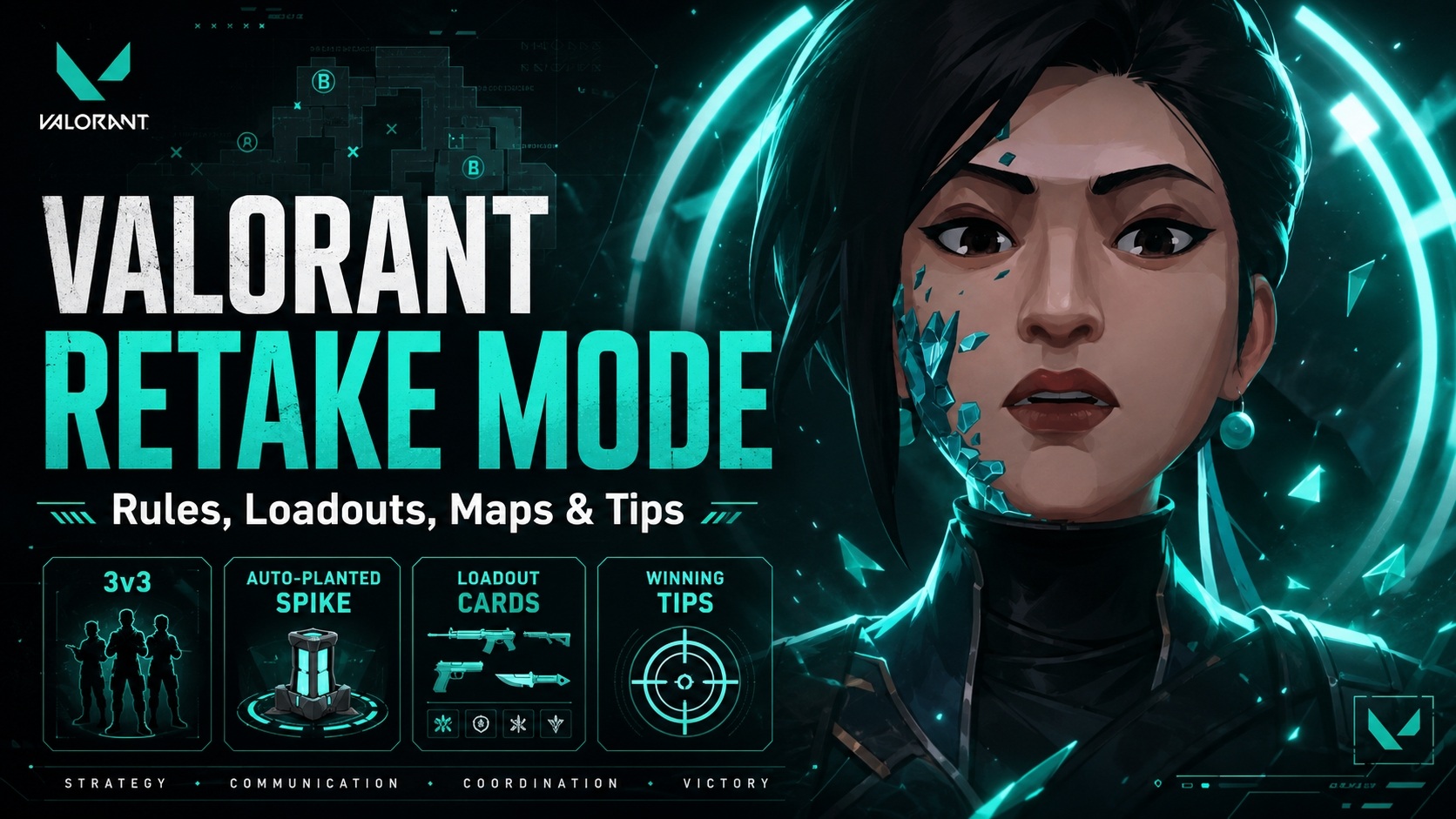
VALORANT Retake is a limited-time 3v3 mode built entirely around post-plant situations. Instead of playing through a full round, one team begins by defending an automatically planted Spike while the other must enter the site, clear defensive positions, and complete the defuse before time expires.
Teams swap between the Planter and Retaker roles after every round, and the first team to win five rounds takes the match. Retake also removes the normal credit economy and replaces it with randomized cards containing weapons, armor, and ability charges.
Introduced in VALORANT Patch 13.00, Retake provides a fast way to practise trades, site clearing, crossfires, utility timing, Spike control, and defuse pressure.
This guide explains the complete VALORANT Retake rules, loadout system, available maps, recommended Agents, team compositions, and strategies for both sides.
What Is Retake Mode in VALORANT?
Retake removes the early stages of a standard VALORANT round and sends players directly into the post-plant phase.
There is no opening default, map-wide site selection, traditional buy phase, manual Spike plant, or full 5v5 setup. Every round instead focuses on a single tactical question:
Can the Planters protect the Spike until it detonates?
Can the Retakers clear the site and defuse it in time?
The smaller 3v3 format makes every decision more important. Losing one player immediately removes one-third of the team, while poorly timed utility can leave no second chance for the final site entry or defuse.
Retake mainly tests:
Post-plant positioning
Site-retake coordination
Utility sequencing
Trading teammates
Crossfire creation
Spike timer awareness
Defuse protection
Short-handed decision-making
Is VALORANT Retake a Permanent Mode?
Riot introduced Retake as a limited-time mode, not a permanent queue.
It became available with Patch 13.00 and V26 Act 4. Riot may remove, return, or adjust the mode in later updates, so players reading this guide after the launch period should check the live queue menu or the latest official patch notes.
VALORANT Retake Rules at a Glance
Retake rounds are shorter and more concentrated than standard VALORANT rounds. There is little time to gather information, and teams cannot spend the opening minute slowly testing several areas of the map.
How a VALORANT Retake Round Works
The Spike Is Automatically Planted
Riot describes Retake as a pre-planted Spike mode. At the beginning of each round, the plant position is visible, and the Spike automatically plants a few seconds after the round begins.
Players do not carry or manually plant the Spike.
The plant location is selected from a curated collection of positions for the active site. This prevents every round from producing exactly the same post-plant setup while keeping the scenarios strategically reasonable.
Because the plant location is visible, both teams should immediately evaluate:
Which defensive positions can see the Spike?
Which entrances will the Retakers use?
Is the Spike planted for long-range or close-range control?
Which utility can deny the defuse?
Which angles must be cleared first?
What Do Planters Do?
Planters begin with control of the selected site and defend the automatically planted Spike.
They win the round by:
Eliminating all Retakers
Preventing the defuse until the Spike detonates
Planters should quickly establish a post-plant structure rather than searching for unnecessary early fights. Their objective is not simply to earn three eliminations; it is to consume the Retakers’ limited time.
What Do Retakers Do?
Retakers begin outside the active site and must enter, clear the defenders, and defuse the Spike.
They win by:
Eliminating the Planters and completing the defuse
Defusing while one or more Planters remain alive
Eliminating every defender does not automatically win the round. The Spike must still be defused before it detonates.
Teams Swap Roles Every Round
Planters become Retakers after each round, and Retakers become Planters.
This constant role rotation prevents one team from playing only the easier side of a selected scenario. It also allows players to observe an enemy setup and then apply or counter it when the sides change.
Teams should avoid repeating the same defensive positions every time they become Planters. Once opponents understand the setup, they can prepare specific utility to dismantle it.
First Team to Five Rounds Wins
Retake uses a first-to-five format.
Rounds can end through:
Complete team elimination
Successful Spike defuse
Spike detonation
The compact format makes early rounds important, but the escalating loadout system means later rounds usually feature stronger weapons and more dangerous utility.
How VALORANT Retake Loadouts Work
Retake does not use the normal VALORANT credit economy.
Players do not save credits, buy equipment from the regular shop, or receive economic advantages for winning consecutive rounds. Instead, each player selects equipment from randomized cards.
Weapon and Armor Cards
One card determines the available weapon and armor package.
Each card presents two randomized choices. Players must select the package that best suits the active site, their Agent, and their intended role.
Earlier rounds may feature lighter equipment, while later choices escalate toward stronger loadouts.
This creates different combat conditions throughout a match. One round may favor close-range positioning and careful trades, while another may produce rifle-heavy fights where a single positioning mistake is immediately punished.
Ability-Charge Cards
The second card provides ability charges.
These options are also randomized and become stronger as rounds progress. Players should not automatically choose the option with the largest number of charges. The value of an ability depends on the side, map, plant position, and team composition.
For example:
A flash may be more valuable when retaking through a narrow entrance.
A molotov may be more valuable when defending a long-range plant.
A smoke may be essential when the Retakers lack another way to block a sightline.
Recon utility may be stronger than damage when the defenders’ locations are unknown.
Loadouts Escalate During the Match
Card quality increases round by round.
Early rounds place more emphasis on positioning, close-range trades, and limited resources. Later rounds become more lethal as stronger weapons and additional utility enter play.
Teams should adjust rather than using the same strategy throughout the match.
A close defensive position that works against weaker equipment may become easy to punish once the opposing team receives rifles, flashes, or damaging utility.
How to Choose the Best Retake Loadout
Select a Weapon for the Site
Weapon value depends heavily on the active site and plant location.
Rifles are the safest general choice because they support both close and long-range engagements.
SMGs perform well around compact corners and fast site entries but struggle against long post-plant positions.
Shotguns can punish predictable entrances, although they become ineffective when the opposing team maintains distance.
Sniper rifles can dominate a long sightline but require a safe position and teammate protection.
Sidearms reward disciplined aim and close coordination when stronger weapons are unavailable.
Do not choose a weapon only because it is theoretically more expensive. Consider where you expect to fight.
Consider Armor and Entry Responsibility
Armor matters most for the player likely to take first contact.
A Retaker entering before teammates may benefit from additional survivability, while a player holding a distant post-plant angle may prioritize a stronger weapon.
When reviewing the two card options, ask:
Am I entering first?
Will I fight at close or long range?
Does my Agent have an escape ability?
Can a teammate trade me?
Do we already have enough firepower?
Choose Utility for Your Current Side
Planters generally benefit from:
Molotovs
Smokes
Slows
Traps
Recon tools
Defuse-denial abilities
Repositioning or escape abilities
Retakers generally benefit from:
Flashes
Stuns
Recon
Suppression
Displacement
Entry mobility
Corner-clearing damage
Because roles swap every round, an Agent should ideally provide some value on both sides.
Coordinate Loadouts With Teammates
Three players choosing similar tools can create an unbalanced setup.
A reliable 3v3 team usually wants access to three basic functions:
Information or site-clearing utility
An entry or first-contact tool
Smoke, control, or Spike-delay utility
Check teammate selections before confirming your own card. A weaker individual choice may create a stronger overall composition.
All Maps in VALORANT Retake Mode
Retake launched with sites from five maps.
Each match takes place on one randomly selected site rather than using the full map.
Players can review the wider locations and layouts through Riot’s official VALORANT maps directory.
Ascent Retake Tips
Ascent sites combine open sightlines with strong defensive cover.
Planter Strategy
Planters should establish a crossfire between the site and a longer post-plant position. Avoid placing all three players behind the same piece of cover, as one flash or damaging ability may remove the entire setup.
Keep at least one player close enough to contest the Spike and another far enough away to punish a full defuse.
Retaker Strategy
Retakers should block long sightlines before exposing themselves. Use reconnaissance, flashes, or smokes to remove defenders from favorable angles.
Enter through multiple routes when possible. Three players approaching through one narrow entrance are easy to delay.
Bind Retake Tips
Bind’s compact site geometry rewards explosive utility.
Planter Strategy
Use close crossfires and hold damaging utility until Retakers commit. Shotguns and SMGs can be effective, but avoid exposing yourself before teammates are ready to trade.
Retaker Strategy
Clear tight corners with utility rather than face-checking them. A flash, stun, grenade, or scouting ability should lead the entry.
Be prepared for defenders playing close to narrow entrances.
Haven Retake Tips
Haven provides several possible entry paths and more angles to monitor.
Planter Strategy
Assign responsibility for each major entrance. Do not allow one player to watch two routes while another watches an area the Retakers cannot access.
Reposition after firing so the opposing team cannot clear every defender in a predictable order.
Retaker Strategy
Pressure from two entrances when possible. Entering from only one side allows defenders to focus their full attention on a single choke point.
Gather information before splitting the team, as isolated players can be eliminated without a trade.
Summit Retake Tips
Summit adds route-changing walls and vertical positions to post-plant scenarios.
Planter Strategy
Track which droppable walls are open or closed. A closed route can funnel Retakers into a predictable entrance, making delay utility more effective.
Protect elevated positions and avoid becoming trapped on the wrong side of a wall.
Retaker Strategy
Confirm the available routes before using utility. On B-side scenarios, clear Tower and other elevated positions before committing to the defuse.
Reconnaissance becomes especially valuable when a closed wall restricts the team to one entrance.
For more map-specific advice, use a dedicated Summit layout and callout guide alongside this Retake overview.
Sunset Retake Tips
Sunset rewards synchronized entry timing.
Planter Strategy
Use site cover to build crossfires and preserve utility for the actual defuse attempt. Avoid overextending into the Retakers’ starting area.
Retaker Strategy
Clear close corners and elevated positions in a logical order. Use smokes to remove long post-plant angles, then enter immediately behind a flash, stun, or scouting ability.
Best Agents for VALORANT Retake
Almost every Agent can contribute, but some kits naturally perform better in repeated post-plant and retake scenarios.
Players can review current kits through Riot’s official VALORANT Agent pages.
Best Duelists
Jett
Jett can cross exposed areas with Tailwind, create temporary cover with Cloudburst, and challenge isolated defenders.
She is especially useful when the Retakers need one player to enter first and create immediate space.
Raze
Raze is one of the strongest corner-clearing Agents in Retake.
Boom Bot checks compact positions, Paint Shells force defenders away from cover, and Blast Packs allow her to close distance quickly.
Neon
Neon can attack a site before defenders fully adjust.
Relay Bolt disrupts common holding positions, while her movement allows her to exploit gaps created by teammate utility.
Best Initiators
Sova
Sova provides reliable information before a site entry. Recon Bolt and Owl Drone reduce the number of angles the team must clear blindly.
Shock Bolts and Hunter’s Fury can also deny a defuse or punish defenders playing around the Spike.
Breach
Breach is ideal for coordinated retakes.
Fault Line, Flashpoint, and Aftershock can clear several defensive positions without requiring Breach to expose himself first.
Fade
Fade’s Haunt and Prowlers identify defenders playing around close corners. Seize becomes especially dangerous when combined with grenades or molotovs.
KAY/O
KAY/O can suppress defensive abilities before the Retakers enter. His flashes support coordinated swings, while FRAG/ment clears common post-plant positions.
Gekko
Gekko is particularly valuable because Wingman can interact with a planted Spike.
Wingman can apply defuse pressure while Gekko and his teammates protect the area. Dizzy gathers information, while Mosh Pit denies Spike interaction.
Best Controllers
Omen
Omen provides flexible smokes, a long-range blind, and repositioning options.
Smoking the Spike can protect a defuser, although defenders may still fire through the smoke. Paranoia is especially effective when several defenders occupy the same lane.
Viper
Viper excels on the Planter side.
Poison Cloud and Snake Bite delay the defuse, while Toxic Screen divides the site. Her utility can force Retakers to spend valuable seconds waiting or taking damage.
Brimstone
Brimstone offers simple, fast smoke placement and strong Spike denial through Incendiary.
Stim Beacon can also accelerate an aggressive retake.
Clove
Clove suits Retake’s combat-heavy rounds because they can continue placing smokes after death.
This reduces the impact of losing the Controller during the initial site entry.
Best Sentinels
Killjoy
Killjoy is one of the strongest Planter-side Agents.
Nanoswarm delays defuses, Turret gathers information, and Alarmbot reveals or weakens approaching Retakers.
Cypher
Cypher can monitor entrances with Trapwire and Spycam while using Cyber Cage to block vision around the Spike.
His information helps Planters avoid unnecessary peeks.
Deadlock
Deadlock’s utility is effective when Retakers are forced through narrow paths. GravNet restricts movement, while Sonic Sensor punishes noisy entries.
Sage
Slow Orb consumes valuable retake time, while Barrier Orb can block a route or temporarily protect the Spike.
Resurrection is also especially influential in a 3v3 mode, where restoring one teammate significantly changes the player-count advantage.
Best 3v3 Retake Team Compositions
Balanced Composition
Jett, Sova, Omen
Jett enters and creates space.
Sova identifies defensive positions.
Omen blocks sightlines and supports the defuse.
This is a flexible lineup that works on both sides without requiring complex setups.
Post-Plant Composition
Viper, Killjoy, Gekko
This lineup offers several layers of Spike delay through Snake Bite, Nanoswarm, Mosh Pit, and information utility.
Its weakness is aggressive retaking. The composition must use Gekko and utility timing carefully when roles swap.
Aggressive Retake Composition
Raze, Breach, Clove
Breach prepares the entry, Raze clears space, and Clove provides smoke coverage even if eliminated.
This composition lacks Sova-style long-range information but excels at fast, coordinated engagements.
Solo Queue-Friendly Composition
Jett, Fade, Omen
All three Agents can create individual value without complicated lineups. Fade provides straightforward information, Omen controls vision, and Jett handles first contact.
How to Play the Planter Side
Establish Positions Before Fighting
Planters already control the site. Do not throw away that advantage by pushing into the Retakers’ starting area.
Move into complementary post-plant positions before taking contact.
Create a Crossfire
Two players should be able to trade each other. The third player can watch a different route or hold delay utility for the Spike.
Avoid having all three players watch the same entrance.
Preserve Defuse-Denial Utility
Molotovs, smokes, stuns, slows, and traps become more valuable as the Retakers approach the Spike.
Using every ability at the beginning of the round may secure temporary space but leaves nothing to interrupt the final defuse.
Play the Timer
Planters win when the Spike detonates.
Do not chase a low-health opponent across the site if remaining hidden forces them to spend more time clearing angles.
When the Retakers tap the Spike, decide whether to swing immediately, use utility, or wait for a longer commitment.
Change Your Setup
Do not play the same post-plant position every time.
Alternate between:
Close crossfires
Long-range post-plants
Off-angles
Utility-heavy Spike control
Aggressive surprise positions
Retake matches are short, so opponents will quickly recognize repeated patterns.
How to Play the Retaker Side
Read the Plant Location
The plant location reveals which defensive angles are most likely.
Before entering, determine:
Which defender could see the Spike?
Which long-range position must be smoked?
Which close corners require utility?
Which player will begin the defuse?
Enter Together
Three isolated 1v1 fights favor the defenders.
Retakers should coordinate the first flash, smoke, recon ability, or stun and move immediately behind it. The second player must be prepared to trade the entry player.
Clear the Site in the Correct Order
A reliable sequence is:
Block the most dangerous long sightline.
Gather information with recon or clearing utility.
Clear the nearest close corners.
Take control of the Spike area.
Force remaining defenders away with damage utility.
Begin the defuse while teammates provide cover.
Use the Spike Tap
Tapping the Spike can force hidden defenders to reveal themselves.
Do not automatically commit to a full defuse while several unchecked positions remain. A short tap may draw out a swing, utility use, or gunshot that reveals the defender’s location.
Assign Defuse Responsibility
When all three Retakers survive the entry:
One player defuses.
Two players protect the defuser.
Avoid three players standing directly beside the Spike. Spread into positions that can trade without being eliminated by one ability.
Watch the Timer
A perfect site clear is useless if there is no time left to defuse.
When the timer becomes critical, the team may need to smoke the Spike, force a duel, or commit to the defuse before every angle is confirmed.
Best Utility Combinations
Recon and Damage
Strong examples include:
Sova Recon Bolt plus Raze Paint Shells
Fade Haunt plus Brimstone Incendiary
Cypher Spycam plus Viper Snake Bite
Information becomes more valuable when the team can immediately punish the revealed position.
Stun and Entry
Examples include:
Breach Fault Line plus Jett Tailwind
Neon Relay Bolt plus Raze Blast Pack
Deadlock GravNet plus Raze Paint Shells
The entry player should move while the enemy is still affected rather than waiting for the stun to end.
Smoke and Defuse
Omen, Brimstone, Clove, and Viper can obscure the Spike during a defuse attempt.
A smoke removes clear vision but does not make the defuser safe. Defenders can still spray through it, use damage abilities, or push inside.
Chained Spike Delay
Examples include:
Killjoy Nanoswarm followed by Viper Snake Bite
Sage Slow Orb followed by Brimstone Incendiary
Gekko Mosh Pit followed by Sova Shock Bolt
Use delay abilities one after another rather than overlapping all of them. Sequential utility consumes more of the Spike timer.
Solo Queue Tips
Use short, clear communication:
“Flashing site.”
“Drone first.”
“I’m tapping.”
“Stick the defuse.”
“Watch the post-plant.”
“Wait for my smoke.”
“Swing together.”
Other useful habits include:
Check teammate loadout selections.
Ping the plant location.
Announce which entrance you will use.
Avoid entering before teammates are ready.
Tell teammates when you are committing to the defuse.
Select self-sufficient Agents when communication is limited.
Prioritize trades over individual highlight plays.
Common Retake Mistakes
Entering One at a Time
Sequential entries allow defenders to take three isolated duels.
Using Every Ability Immediately
Preserve at least one important ability for the defuse or final site hold.
Ignoring the Spike Timer
Retakers must balance clearing defenders with leaving enough time to defuse.
Defusing Without Clearing Close Angles
Use a tap to force defenders to react before committing.
Playing Too Far From the Spike
Planters need enough distance to avoid easy clearing but must remain close enough to contest the defuse.
Standing Beside Teammates
Spread into tradeable positions instead of allowing one grenade or spray to hit multiple players.
Repeating the Same Setup
Opponents can directly counter predictable positions after the next side swap.
Chasing Eliminations
Planters should play for detonation, while Retakers should play for the defuse.
Overlapping Delay Abilities
Sequential delay is usually more effective than using every molotov or slow simultaneously.
Is Retake Good Practice for Competitive?
Retake is useful for improving a specific part of VALORANT.
It repeatedly trains:
Site-entry coordination
Post-plant positioning
Trading
Crossfires
Utility timing
Spike taps
Defuse protection
Clutch decisions
However, it does not reproduce every Competitive skill.
Retake removes:
Standard economy management
Early-round map control
Full 5v5 compositions
Manual Spike planting
Defaults and fakes
Full site-execute preparation
Long rotations between sites
Retake should supplement Competitive, Unrated, Swiftplay, Deathmatch, and custom practice rather than replacing them.
Retake vs Other VALORANT Modes
Retake vs Swiftplay
Swiftplay includes complete rounds, manual plants, broader map control, and a simplified economy.
Retake is more focused and begins directly at the post-plant stage.
Retake vs Unrated
Unrated offers full 5v5 tactical matches without Competitive rank consequences.
It is better for practising complete team strategy, while Retake provides more frequent late-round scenarios.
Retake vs Competitive
Competitive tests economy, communication, Agent composition, map control, adaptation, and pressure across a full match.
Retake is a separate limited-time queue focused on one phase of play. Riot’s Patch 13.00 notes do not list Competitive RR gains or losses for Retake.
Retake vs Deathmatch
Deathmatch is better for raw aim, movement, and weapon warmups.
Retake is better for utility, positioning, trading, and objective-based decision-making.
Frequently Asked Questions
What is VALORANT Retake mode?
Retake is a limited-time 3v3 mode focused on defending or retaking an automatically planted Spike.
How many players are in Retake?
Each team has three players.
How many rounds are required to win?
The first team to win five rounds wins the match.
Does Retake have a normal economy?
No. Players select randomized weapon, armor, and ability-charge options from cards.
How are Retake loadouts selected?
Each round includes two cards: one for weapons and armor and one for ability charges. Each card offers two randomized choices, and the available options improve as the match progresses.
Which maps are available in Retake?
Retake launched with sites from Ascent, Bind, Haven, Summit, and Sunset.
Is the Spike already planted?
The plant location is visible, and the Spike automatically plants a few seconds after the round begins.
Do teams swap sides?
Yes. Planters and Retakers exchange roles after every round.
Is Retake permanent?
No permanent status was announced at launch. Riot introduced it as a limited-time mode.
Is Retake good for warming up?
It is useful for warming up decision-making, utility timing, trades, and post-plant play. Deathmatch remains better for pure aim practice.
Does Retake affect Competitive rank?
Retake is separate from the Competitive queue, and Riot’s launch notes do not list RR gains or losses for the mode.
What are the best Agents for Retake?
Strong options include Omen, Sova, Breach, Raze, Gekko, Viper, Killjoy, Fade, and Clove.
Final Verdict
VALORANT Retake is one of the most efficient modes for repeatedly practising post-plant and site-retake situations.
Its 3v3 format makes every elimination, trade, and ability more influential. Randomized loadouts prevent matches from becoming completely predictable, while the side swap forces players to understand both defensive and retake perspectives.
Planters should establish crossfires, preserve defuse-denial utility, and play the timer. Retakers should enter together, clear angles in a logical order, and leave enough time to complete the defuse.
Retake cannot replace full 5v5 practice, but it provides concentrated training for the part of a round where communication, utility timing, and Spike awareness matter most.