

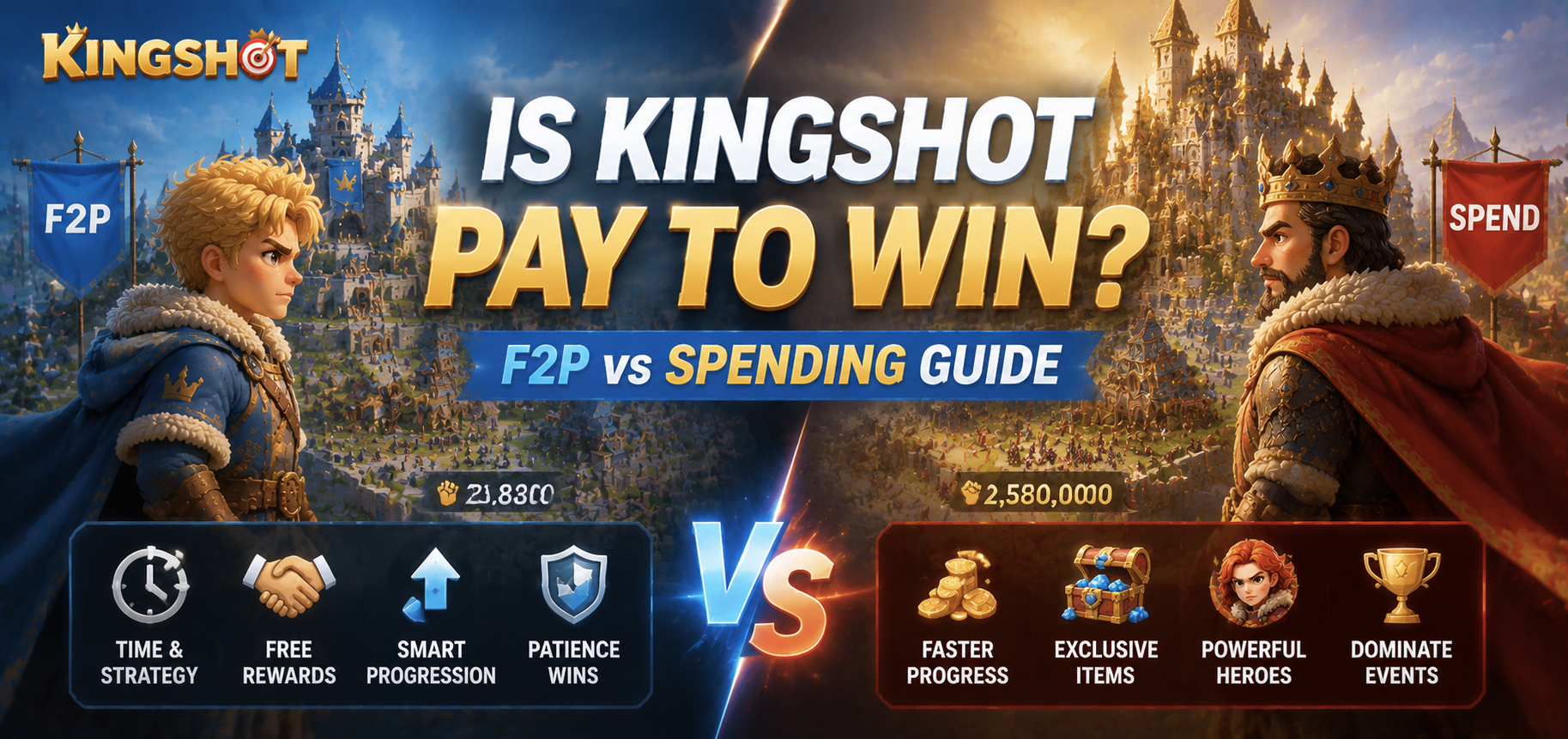
Is Kingshot Pay to Win? F2P vs Spending Guide
Is Kingshot pay to win? F2P can compete via strategy and events; spending accelerates through gems. A balanced 2026 spending guide.
If you are deciding whether Kingshot is worth your time as a non-spender, the first practical step is knowing your gem sources — and a tracked Kingshot top-up at Topuplist through the official Topuplist storefront is one option if you ever choose to accelerate. But the more important question is whether the game even lets free players compete. This guide gives the straight answer using how Kingshot's progression, gem economy and events actually work.
The Short Answer
Kingshot is free-to-play friendly, but not "free-to-win-instantly." Skilled F2P players can compete at high levels through smart strategy, hero synergy and alliance teamwork, because the game rewards planning over pure spending. At the same time, in-app purchases speed up progression dramatically, and a spender who plays well will outpace an F2P player who plays the same way. So the honest label is: not a hard pay-to-win game, but a time-gated one where money buys acceleration, not exclusive power.
This framing matters because "pay to win" gets thrown at almost every mobile strategy game, and the term has lost precision. A true pay-to-win game gates core content — a faction, a game mode, a hero type — behind a purchase a free player can never earn. Kingshot does not do that. What it does is make the path to a maxed roster long for non-spenders, and short for those who pay. If your definition of P2W requires a hard lock, Kingshot does not qualify; if your definition is "money clearly wins," then yes, it shares that trait with every free-to-play title that sells progression. Most players land somewhere in between, which is exactly where this guide sits.
No Hard Paywalls, But Acceleration Exists
There are no heroes, game modes or core systems locked behind a paywall you can never reach. Every meaningful hero is obtainable through gem wheels, events, shops and alliance rewards over time. What spending changes is the speed — a whale reaches a 4-star Amadeus in weeks; an F2P player reaches the same breakpoint across several generation cycles of disciplined saving. The game also hands out generous freebies through gift codes, login events and mail, so even a strict non-spender accumulates a meaningful gem reserve if they log in daily. The gap is real, but it is a gap of pace, not of access.
Smart Strategy Beats Raw Spending
The game's own community positioning emphasizes that planning, hero synergy and alliance cooperation let F2P players stay competitive. A player who joins a top alliance, times speedups for event milestones, and concentrates gems on the right wheel will beat a spender who spreads purchases thin and ignores events. Money helps, but it does not replace understanding the meta. The classic example is Hero Roulette: a spender who spins every wheel "just because" wastes gems, while an F2P player who hoards for one 120-spin milestone finishes a core hero. The disciplined free player's restraint often outperforms the careless payer's wallet over a full server cycle.
What "Free-to-Play" Means in Kingshot
Free-to-play in Kingshot means you never open your wallet and rely on the steady drip of free resources: daily quests, alliance gifts, event rewards, Bear Hunt, Hall of Governors, Intel Missions, and gift codes. The premium currency is Gems, and a large share of gems are earnable without paying — through events, alliance activity, mail rewards and codes. F2P does not mean "powerless"; it means "slower and more dependent on discipline." Beyond gems, Kingshot's economy runs on in-game resources — Gold, Bread, Wood, Stone and Iron — that you produce from buildings and gather with marches rather than buy directly. These are the materials that actually build your city and train troops, so a free player who manages them well is never blocked; they are simply slower than a spender who tops up for bundles. The players who thrive without spending are the ones who treat the game like a routine: same daily checklist, same event planning, same gem-hoarding habit, week after week. That consistency compounds, and over a server's life it closes a surprising amount of the gap that looks uncrossable in the first month.
How Spending Actually Helps
Spending in Kingshot funnels almost entirely into two things: more gems (which feed Hero Roulette and growth bundles) and direct value packs (gold, speedups, resources, hero materials). Understanding these two channels tells you exactly where your money goes. Crucially, neither channel grants power that is unavailable to free players — it only changes the rate at which you acquire it. That is the line that separates Kingshot from a true pay-to-win title, where money unlocks content others cannot reach. Here, money buys tempo: faster star-ups, earlier growth bundles, and the ability to act on every wheel the moment it opens rather than waiting for it.
Gems to Hero Roulette
The single biggest spender advantage is reaching Hero Roulette milestones (especially the 120-spin target that grants 50 hero fragments) on demand, rather than waiting months to save enough gems. That accelerates star levels on core heroes like Amadeus, Marlin or the latest generation units. F2P players can still hit these milestones — they just wait for the right wheel and save relentlessly. The numbers are well documented by roulette guides: reaching 120 spins costs roughly 162,000 gems before free Lucky Chips, while 70 spins is treated as the first serious milestone (seven 10-spins). Always 10-spin rather than single, because the 10% discount and milestone counting add up, and claim every daily free Lucky Token — they do not expire and reduce the eventual gem cost. A spender shortcuts this with a top-up; an F2P player simply banks every free gem and token until the target is in reach.
Speedups, Packs and Growth Bundles
Paid bundles that combine gold, speedups, resources and hero materials give long-term progress per dollar, while packs that only give gold are poor value. Smart spenders buy during events (anniversaries, seasonal events) and calculate net value before buying a season or battle pass. The advantage is real but incremental: it compresses time, it does not unlock anything an F2P player cannot eventually get. Speedups deserve a special note — F2P players should hoard them for event milestones rather than burning them on routine upgrades, because events convert speedups into ranking rewards and shards. A spender can afford to use speedups casually; a free player who does the same watches their event placement collapse. The discipline difference, not the wallet, is what separates a thriving F2P account from a stuck one.
What F2P Players Can Realistically Achieve
A disciplined F2P player can build a competitive core (Marlin, Zoe, Hilde, Petra, Jabel and the Epic fillers), climb Arena to a meaningful rank, hold a garrison, and contribute to alliance events. What they will not do is top the power leaderboard on a competitive server or field a maxed latest-generation roster quickly. The realistic F2P ceiling is "respected account that wins short events and holds its own in KvK," not "server dictator." The gap between that ceiling and the whale's account is real, but it is a gap of raw power and speed, not of being locked out of the game's content. An F2P player can still experience every mode, every event, and every hero eventually — they simply arrive later and with fewer stars. For most players, that trade is acceptable, and it is the defining difference between Kingshot and a game where non-spenders are effectively excluded from the endgame.
Arena, Events and Alliance Rewards
Arena is one of the most important routes for low spenders to steadily obtain Legendary hero gear, and higher Arena rank means more stable gear and resource income. Events like Bear Hunt, Alliance Showdown and Hall of Governors pay out huge rewards for F2P and low spenders who plan around them. Join a top 1-3 alliance early — the chest, speedup and gem income difference is enormous, and HELP speed plus rally frequency compound your growth. Beyond the raw loot, alliances provide Sanctuary and ruins buffs that improve building, training and gathering efficiency, and rally participation that a solo player can never match. For a free player, the alliance is not optional socializing — it is the single largest multiplier on every resource you earn.
Catching Up Without a Wallet
F2P players close the gap through consistency, not bursts. Daily free Hero Roulette spins, VIP point collection (toward VIP 7, which grants a daily Legendary universal shard), and hammer mastery (gear stays valuable across hero generations even as heroes get replaced) are the long-term levers. The advice from F2P growth guides such as Kingshot Data's F2P guide is consistent: open key queues, push Town Center, enter a top alliance, build the VIP7 routine, and stack hammers. The "hammer" point is worth stressing — because heroes get replaced by newer generations but gear does not, mastery accumulation creates a permanent account advantage that outlasts any single hero meta, which is exactly the kind of long-term edge a non-spender needs.
The Time-Gating Reality
The honest caveat is time-gating. Hero generations unlock on a server-age schedule (roughly every 80 days), so a new server simply does not have Gen 5 or Gen 6 heroes yet, regardless of how much you spend on older ones. Spending cannot buy a hero your server has not unlocked. This is why "pay to win" is the wrong frame: you can accelerate within your generation, but you cannot skip the server's timeline. For players who hate time-gated mechanics, that is the real friction — not a paywall. A spender on a Day-10 server is still stuck with Gen 1 heroes until the calendar says otherwise, which keeps the playing field surprisingly level in a server's first months.
The Gem Economy: Free vs Paid
The gem economy is the heart of the F2P-versus-spender debate, because gems are the currency that drives hero progression. Understanding where gems come from — and how the free and paid streams differ — is the clearest way to see whether the game respects your time. The free stream is wide but slow; the paid stream is a tap you can open whenever you choose.
Daily and Event Income
Free gems come from daily missions, alliance gifts and treasure chests, event milestones, Bear Hunt rankings, Hall of Governors placement, Intel Missions, mail rewards and gift codes. Paid gems come from top-ups and bundles. The gap between a F2P and a spender is the volume and timing of gems, not access to a different currency. A F2P player who banks every free gem for the right wheel often finishes a core hero; a spender finishes three. The key habit is treating gift codes and mail rewards as non-negotiable daily pickups — codes like Kingshot888 and VIP777 hand out hundreds of gems and valuable skill books at no cost, and over a year those free drops add up to several wheel milestones a pure spender might assume only money can buy.
A Balanced Spending Plan (If You Do Spend)
If you decide to spend, do it with a plan so the money actually moves your account. Community budget guidance breaks spending into three tiers, and the point of naming them is to make your purchase intentional rather than emotional. A player who decides "I will micro-spend for permanent boosters" gets lasting value; a player who opens the shop daily and buys whatever glows gets a lighter wallet and a scattered account.
Tier | Typical Spend | Best Use |
Micro | 3-10 | First-buy offers that grant permanent boosters |
Mid | 20-50 | Event bundles and sustained progression |
Whale | $100+ | Only if ROI is clear and you accept a big spend |
Micro, Mid and Whale Tiers
Micro (3-10) is best spent on first-buy offers that grant permanent boosters — the highest return per dollar and a safe entry. These one-time offers often pay for themselves across the account's life, so they are the rare purchase almost every guide agrees on. Mid (20-50) is the sweet spot for event bundles and sustained progression, especially during anniversaries or seasonal events, where bundle value spikes and you can secure several core heroes' shards at once. Whale (>$100) only makes sense if you are sure about ROI and comfortable with a large spend; measure it by tracking value per dollar and favoring upgrades that permanently improve income over short-window boosts. Above all, set a budget before you start and treat it as a plan, because mobile strategy games are designed to make the next pack always feel necessary — discipline, not the size of your wallet, is what keeps spending healthy. When you do decide to buy, a tracked Kingshot top-up at Topuplist through the official Topuplist storefront keeps your gem delivery visible and recoverable, so the purchase never becomes a black box.
What to Buy and What to Skip
Buy bundles that include gold plus speedups plus resources plus hero materials, because they give long-term progress. Skip packs that exclusively give gold, and avoid buying early-game packs when growth packs and wheel events offer far better shard and widget value. Always calculate the net value of a season or battle pass before buying, and never spend gems on heroes you will replace within 60 days. A useful rule is to measure value per dollar in terms of the resource you actually need: if you only want gems, compare the gem yield across packs rather than the headline price, and favor packs that bundle hero materials you would otherwise grind for weeks. The worst habit is reactive spending — buying a pack because it popped up — which scatters your account instead of deepening one core hero. Treat every purchase as a deliberate step in your build plan, not an impulse. If a pack does not advance a hero you are actively building or a resource you are actively short on, it is probably skip-worthy.
The Verdict
Kingshot sits in the "F2P-friendly with acceleration" camp rather than the hard pay-to-win camp. Free players can reach a respected, event-winning account through discipline, alliance play and event timing. Spenders trade money for time and a higher ceiling. If you do choose to speed things up, a tracked Kingshot top-up at Topuplist through the official Topuplist storefront keeps your gem delivery visible and recoverable — but no top-up buys a hero your server has not unlocked yet.
The bottom line for a new player: judge Kingshot by what it asks of you, not just what it sells. If you can commit to a daily routine, an active alliance, and patient gem saving, you will enjoy nearly everything the game offers without paying. If you want to lead a competitive server or field the newest generation at max stars immediately, a budget helps — but it is a multiplier on good habits, not a replacement for them. Players who hate time-gated progression should know the time gate is the real limit; everyone else will find Kingshot refreshingly fair for a mobile strategy title.
FAQ
Is Kingshot pay to win?
Not in the hard sense — there are no paywalled heroes or modes. But spending accelerates progression significantly through gems and bundles, so it is time-gated rather than paywalled.
Can free-to-play players compete in Kingshot?
Yes. F2P players can build a competitive core, climb Arena, and win short events through strategy, alliance play and disciplined gem saving.
Where does spending actually help most?
Spending helps most by reaching Hero Roulette milestones (like 120 spins) on demand and buying event bundles, which compress the time to star up core heroes.
What should F2P players prioritize?
Join a top alliance early, push Town Center, reach VIP 7 for the daily Legendary shard, stack hammers, and save gems for the right Hero Roulette.
Can money skip hero generations?
No. Hero generations unlock on a server-age schedule (about every 80 days), so spending cannot buy a hero your server has not unlocked.
What is the best first purchase if I spend?
A micro first-buy offer that grants permanent boosters gives the highest return per dollar; avoid packs that only give gold.