


Clash of Clans Chief‘s Chronicles 2026: The 6 Archetypes Explained
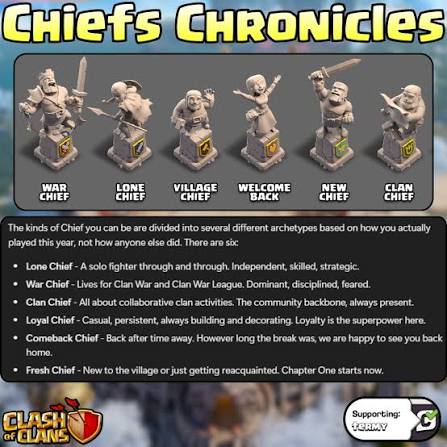
Curious which Chief you turned out to be? While you check, top up fast and safely with a Clash of Clans top-up at Topuplist through the official storefront — then read on to decode your archetype.
Every Clash of Clans player is a Chief, but this year the game finally tells you what kind of Chief you are. The Chief‘s Chronicles event, live from August 6 to August 31, 2026, analyzes your last year of play and sorts you into one of exactly six archetypes. The result is part personality quiz, part year-in-review, and it has taken over the Clash community — Reddit, X (Twitter), and Discord are full of players sharing their archetype badges, comparing results, and debating which type is the most “accurate.”
This article explains every Chief type in detail: what the six labels mean, which of your stats decide the outcome, whether you can influence or change the result, and how sharing your archetype earns you a free Card Pack for the Clash of Cards event. By the end, you will know exactly what your archetype says about you — and what to do with it.
What Are the Chief‘s Chronicles Archetypes?
The Chief’s Chronicles archetypes are personality labels generated from your actual play data over the past year. Unlike a generic quiz that asks how you think you play, the Chronicles read your real statistics — your battles, your Clan War activity, your building habits, and your community participation — and then match that data to one of six profiles.
The six archetypes are designed to reflect the diverse ways players engage with Clash of Clans. Whether you are a competitive war specialist, a solo farmer, or a returning player who just came back after a long break, there is a label that fits your unique journey.
Chief Type | Core Identity | Typical Play Style |
|---|---|---|
Lone Chief | Independent solo fighter | Farms and pushes on their own terms, strategic, self-reliant |
War Chief | Competitive war specialist | Lives for Clan War and Clan War League, disciplined and dominant |
Clan Chief | Community backbone | Always present for donations, Clan Games, and clan events |
Loyal Chief | Persistent builder | Casual but consistent, always upgrading and decorating |
Comeback Chief | Returning player | Back after a break, celebrated for coming home |
Fresh Chief | New or returning beginner | Early in the journey, Chapter One just started |
Supercell designed the system so that no archetype is a ranking. There is no “best Chief” and no “worst Chief” — the event frames every result as a badge of honour. That framing matters, because it changes how the community uses the feature. Instead of a leaderboard that makes most players feel left out, the Chronicles gives everyone a shareable identity, which is exactly why the event spread so quickly across social media.
How the Game Decides Your Chief Type
Your archetype is calculated from how you actually played this year, not from how anyone else played. The system weighs a combination of signals drawn from the four Chronicle chapters:
Battle activity — how many Town Halls you destroyed, how many 3-star attacks you earned, and how active your attack log is.
Clan activity — Clan War star placements, Clan War attacks, donations, and general clan participation.
Army habits — which Hero Equipment you used most, Super Troop usage, and even which hero fell in battle the most.
Consistency — whether you played throughout the year, took a long break, or only recently started.
The exact weighting is not published, and players have already noticed that two people can have similar-looking accounts yet land in different archetypes — small differences like a two-month gap in activity versus a full year of daily play are enough to shift the result. That is by design: the archetype is meant to reflect the shape of your year, not a single headline number.
This data-driven approach gives the feature credibility. Players trust the result because it is based on their actual behaviour, not on a few hypothetical questions. The Chronicles walkthrough also makes the experience engaging by presenting stats through interactive minigames, so even if your archetype becomes obvious halfway through, the journey remains entertaining.
The 6 Chief Types Explained in Detail
Lone Chief
The Lone Chief is the solo fighter. This archetype describes players who raid on their own terms — they attack whenever they want, farm efficiently, push trophies when the mood strikes, and generally do not depend on a clan to progress. “Independent, skilled, strategic” is how Supercell sums it up.
If you are a Lone Chief, the data behind it usually shows a year of heavy solo raiding: a steady stream of attacks, strong farming stats, and comparatively little clan activity. There is nothing lonely about it in a negative sense — in Clash of Clans, solo progression is a legitimate and respected play style, and many of the game‘s strongest farmers are Lone Chiefs by choice. These players often excel at resource management and base design, relying on their own strategic instincts rather than clan coordination.
War Chief
The War Chief lives for Clan War and Clan War League. This is the archetype for competitive players: “dominant, disciplined, feared.” If your year was defined by war after war, reliable star placements, and showing up for every attack phase, the Chronicles will almost certainly label you a War Chief.
War Chiefs tend to be the most proud of their result, because the label is a direct reward for the discipline that war play requires. If you see a clanmate sharing a War Chief badge, you are looking at someone who carried their fair share of war attacks all year. These players often study attack strategies meticulously, plan their troop compositions carefully, and execute under pressure. For them, the War Chief badge is a mark of competitive honour.
Clan Chief
The Clan Chief is the community backbone. This archetype belongs to players who are always present for collaborative clan activities — donations, Clan Games, friendly challenges, and clan events. Supercell describes the Clan Chief as “always present,” and the underlying data reflects it: high donation counts, active Clan Games participation, and consistent clan engagement.
In a game where clans live or die by their most active members, the Clan Chief archetype is effectively the game acknowledging the people who keep clans alive. If you are a Clan Chief, your clan almost certainly knows it already. These players are the glue that holds teams together, often acting as recruiters, mentors, and morale boosters. Their contribution may not always show up in war stats, but their impact on clan culture is immeasurable.
Loyal Chief
The Loyal Chief is the persistent builder: casual, steady, and always working on the village. “Loyalty is the superpower here” — this archetype celebrates the players who may not war hard or farm obsessively, but who keep logging in, keep upgrading, and keep decorating month after month.
The data behind a Loyal Chief usually shows long-term consistency rather than intensity: a full year of activity, steady building progress, and a decorated village that has grown visibly over time. For many players, this is the most flattering label in the set, because it recognizes dedication over flash. Loyal Chiefs often take pride in their base aesthetics, carefully arranging decorations and tracking their progression milestones. They are the steady heartbeat of the player base, proving that consistency can be just as impressive as intensity.
Comeback Chief
The Comeback Chief is the returning player. However long the break was — a month, a season, or several years — this archetype celebrates the fact that you came back home. “We are happy to see you back home” is the entire spirit of the label.
Supercell clearly built this archetype to reward lapsed players who returned for the anniversary, and it works: returning players get a positive, welcoming identity instead of a reminder of their absence. If you recently re-downloaded the game after a break, your Chronicles will reflect that story in the shape of your activity graph. Comeback Chiefs are often pleasantly surprised by how much the game has evolved, and the archetype gives them a gentle reintroduction to the community, encouraging them to stay and explore new features.
Fresh Chief
The Fresh Chief is new to the village or just getting reacquainted. “Chapter One starts now.” This archetype belongs to accounts that do not have a full year of history yet — brand-new players, or players whose activity is too recent to form a longer pattern.
Fresh Chiefs get the same statue, the same shareable badge, and the same warm framing as everyone else. For new players, the archetype is an invitation: your story is just beginning, and next year‘s Chronicles will have a whole year of you in it. Fresh Chiefs are encouraged to explore the game’s many features, join a clan, and start building their legacy. The archetype removes any pressure to perform immediately and instead celebrates the excitement of discovery.
What Your Chief Type Says About Your Play Style
Beyond the badge itself, your archetype is a useful mirror of how you actually play — and a decent predictor of which events and rewards suit you best.
A Lone Chief should prioritize solo-friendly content: the Card Hunt in Clash of Cards, Resource Fest windows, and Trophy pushes, where their independence is an advantage. A War Chief should treat Clan War and Clan War League as the backbone of the month, and use the Medal Event‘s Quest Medals on war-relevant Hero Equipment. A Clan Chief will get the most value from clan-wide events like Clan Games (August 22–28) and from helping clanmates complete Clash of Cards trades. A Loyal Chief can lean into the month’s steady progression rewards — the daily Card Packs, the Trader freebies, and the building-focused boosts. A Comeback Chief should use the anniversary‘s catch-up content: free skins, the temporary Elephant Rider giveaway, and the Clash of Cards collection to re-engage. A Fresh Chief should focus on the tutorial pack, the earliest milestones, and building a clan network that will shape next year’s archetype.
The Chronicles effectively tells you which reward lane is yours, which makes it more than a vanity feature — it is a personalized calendar for the month. By aligning your activities with your archetype, you can maximize your rewards and enjoy the anniversary event to its fullest.
Which Stats Feed Into Your Archetype
The four Chronicle chapters each contribute data that feeds the archetype calculation. Here is how the chapters map to the labels:
Chronicle Chapter | What It Measures | Most Likely To Shape |
|---|---|---|
Battles | Town Halls destroyed, 3-star attacks, raid volume | Lone Chief, War Chief |
Clan Castle | War star placements, war attacks, donations | War Chief, Clan Chief |
Army Barracks | Hero Equipment usage, Super Troops, hero defeats | Lone Chief, War Chief |
Community | Global milestones, your place in the bigger picture | Comeback Chief, Fresh Chief |
The reveal style also matters to the experience: stats are shown through Guess, Smash, and Reveal minigames across the chapters, which keeps the walkthrough fun even if your archetype was already obvious to you halfway through. This interactive approach makes the data feel personal and engaging, transforming raw numbers into a memorable storytelling experience.
Can You Choose or Change Your Chief Type?
No — your Chief type is determined by your play data, and you cannot pick or change it manually. The event reads your actual history and assigns the archetype that best matches it. This is a deliberate design choice: a chooseable archetype would be meaningless, while a data-driven one feels authentic, which is exactly why players trust the result.
There is one important nuance: the archetype reflects last year‘s data, not the last week. You cannot grind for a few days and change your result — the calculation is based on the whole year of play that the event summarizes. If you want a different archetype next time, the honest answer is to change how you play over the long term: join a war clan for a War Chief result, or go fully solo for a Lone Chief.
One consolation if you do not like your label: the archetype is a snapshot of the past year, and the game will almost certainly run the Chronicles again next Clashiversary. A player who becomes a War Chief this year but goes fully casual next year will see their label shift accordingly. In that sense, the archetype is less a verdict and more a diary entry — it records the year you actually had, not the player you aspire to be. The community has embraced this framing, with players treating the reveal as a yearly ritual rather than a permanent identity, sharing their archetype year over year to track how their play style evolved. If you want next year‘s entry to read differently, there is a full twelve months of play data between now and then to change it.
How to See Your Archetype and Statue
Your archetype appears at the end of the Chronicles walkthrough, and it is permanently attached to your statue decoration:
Enter via the Chief’s Chronicles shield on the left side of your village, near the Trader.
Smash open the gate and complete the four chapters.
Open the reward box at the end to receive your statue — the statue‘s design matches your archetype.
Place the statue in your village; the label (for example, “War Chief 2026”) is visible to anyone who visits.
Each of the six statues is a distinct decoration: Lone Chief 2026, War Chief 2026, Clan Chief 2026, Loyal Chief 2026, Comeback Chief 2026, and Fresh Chief 2026. You only receive one, and it stays in your village permanently as a year-stamped record of the Chief you were. The Clash of Clans Wiki lists all six decorations if you want to preview the designs.
Ready to share your archetype in style? A quick Clash of Clans top-up at Topuplist through the official storefront keeps your village looking its best for the screenshot.
Sharing Your Chief Type for a Free Card Pack
Sharing is where the archetype becomes useful rather than just fun:
After completing your Chronicles, tap the central flag.
Choose your preferred ratio and share to social media.
You earn a free Card Pack for the Clash of Cards event.
Every community share also unlocks milestone rewards for all players.
Because the free Card Pack feeds directly into the 60-card Clash of Cards collection (whose grand prize is the Manga Fury Prince skin), sharing your archetype is effectively a free step toward the biggest reward of the anniversary month. And since community milestones benefit everyone, there is no downside to posting your result — even a simple text post with a screenshot of your statue helps push the global reward track. The community has already unlocked multiple free card packs through these shared milestones.
If you want to speed up the rest of your anniversary progress — skipping trade cooldowns, finishing upgrades before the Resource Fest windows, or keeping a gem reserve for the Medal Event — a quick Clash of Clans top-up at Topuplist covers you in minutes. You can also browse all available games and options at the Topuplist official storefront.
FAQ
Q1: How many Chief types are there in Clash of Clans?
There are six Chief archetypes in Chief‘s Chronicles: Lone Chief, War Chief, Clan Chief, Loyal Chief, Comeback Chief, and Fresh Chief.
Q2: Can I choose my Chief type?
No. Your archetype is calculated from your actual play data over the past year, and it cannot be manually selected or changed.
Q3: What is the rarest Chief type?
None of the six types is officially rarer than another — the distribution depends entirely on how the player base actually plays. All six are equally valid results.
Q4: How do I find out my Chief type?
Complete the Chief‘s Chronicles walkthrough (enter via the shield near the Trader, smash the gate, finish the four chapters) and your archetype is revealed with the statue reward.
Q5: Do I get a different reward per Chief type?
The reward is the same shape for everyone — one statue decoration matching your archetype — but the statue’s design and label differ per type, and you can only earn one.
Q6: When does Chief‘s Chronicles end?
The event runs from August 6 to August 31, 2026. After that, you can no longer complete the walkthrough or claim your statue.