


SUGO Chat Party Guide: How Rooms, Gifts, Levels and Rewards Work
Comprehensive overview of SUGO's voice chat party ecosystem covering room discovery, party room economics, host and mic seat management, the dual leveling system, PK competition mechanics, daily rewards, and how gifts drive the entire social economy.
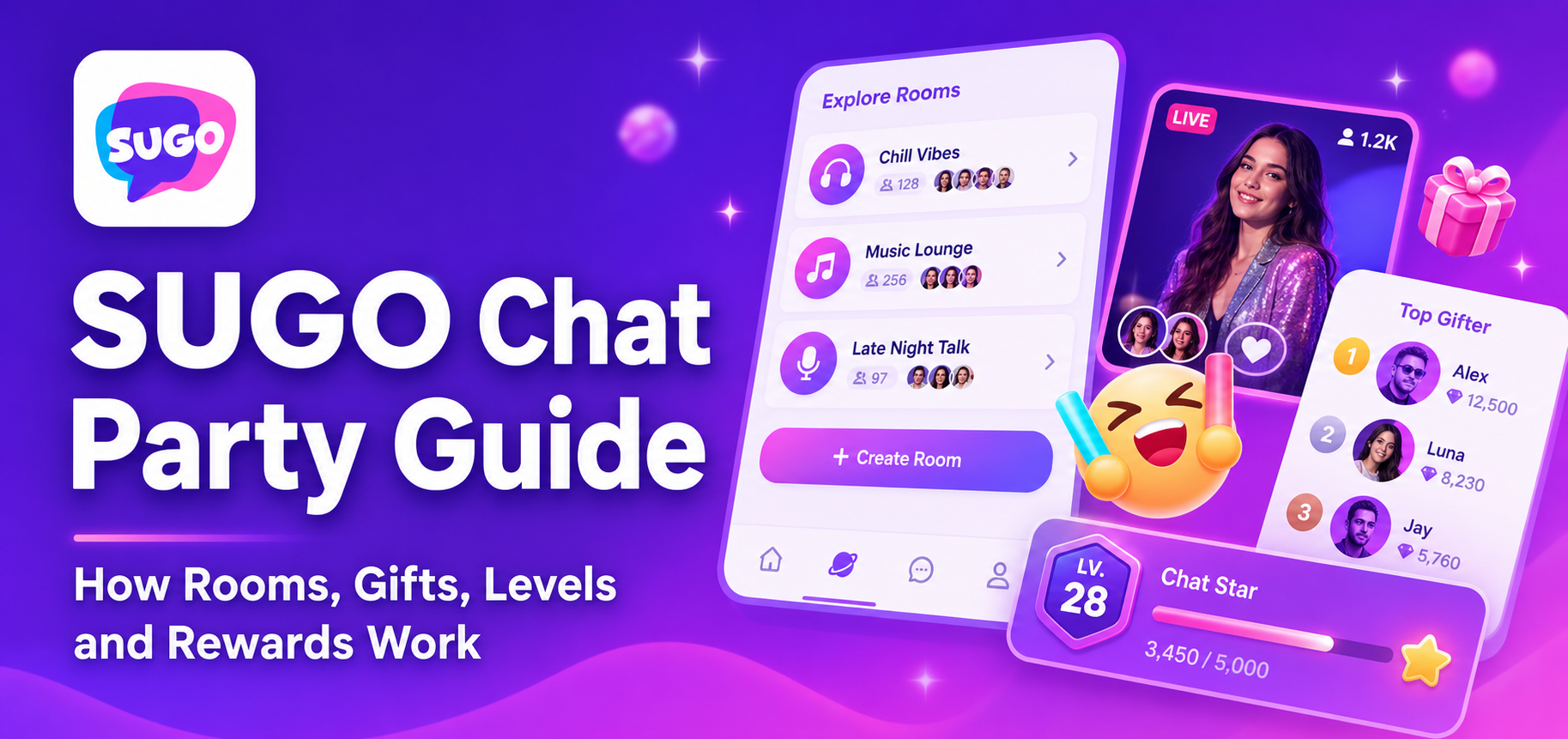
SUGO: Voice Live Chat Party is more than a collection of voice rooms — it is a structured social ecosystem where room dynamics, gift economics, level progression, and reward systems interlock to create an engaging live audio experience. Understanding how these systems work together — rather than in isolation — is the key to navigating SUGO effectively, whether you are a casual listener, an aspiring host, or a dedicated community builder.
At its core, SUGO organizes social interaction around voice rooms — live audio spaces hosted by individuals or groups around specific topics, activities, or moods. Within these rooms, users interact through voice, text, and virtual gifts. Every gift sent feeds into a dual-leveling system — Wealth Level (for senders) and Charm Level (for receivers) — that permanently tracks your platform identity. Rooms compete for visibility on discovery leaderboards through accumulated room points, with top-ranked rooms attracting more visitors and, consequently, more gift activity.
This guide explains how every piece of SUGO's chat party system fits together: room types and discovery, party room economics, host roles and mic management, the gift economy in its full social context, Wealth and Charm level progression, PK competition mechanics, daily missions and rewards, and advanced community-building strategies. Information is drawn from the SUGO official blog, partner platform documentation, and aggregated community experience.
SUGO Voice Rooms: Types, Discovery, and Navigation
Room Categories
When you open SUGO, the home screen presents a feed of active voice rooms ranked by a combination of listener count, gift activity, and room point accumulation. Rooms are tagged by category, making it easy to find spaces aligned with your interests:
Chat & Social: General conversation rooms where hosts facilitate discussions on rotating topics. These are the most common room type and the best starting point for new users.
Music & Karaoke: Hosts perform songs, play music, or run open-mic karaoke sessions. These rooms typically feature the highest gift volume due to performance-based appreciation.
Language Exchange: Rooms dedicated to practicing specific languages with native speakers. SUGO's global user base makes these rooms particularly active for English, Arabic, Turkish, Spanish, and Southeast Asian language practice.
Gaming & Trivia: Hosts run quiz games, trivia competitions, truth-or-dare wheels, and dice-based mini-games that keep participants engaged and active.
Dating & Romance: Rooms oriented around meeting new people, speed-friending, and romantic connection. These rooms tend to have stricter moderation and clearer participation rules.
Late Night: Informal, lower-energy rooms active during nighttime hours in major time zones. Often smaller and more intimate than daytime rooms.
How Room Ranking Works
Rooms appear in the discovery feed in order of ranking, which is determined by:
Total room points accumulated through gifts during the current ranking period (daily, weekly, or monthly)
Active listener count — higher concurrent listeners boost ranking
Gift volume and value — consistent gift activity, not just occasional large gifts, drives stable rankings
Host and participant engagement metrics — rooms with active mic rotation, text chat participation, and repeat visitors rank higher than rooms with high listener counts but low engagement
The ranking system creates a virtuous cycle for top-performing rooms: high ranking → more discovery visibility → more new visitors → more potential gifters → higher ranking. This is why hosts and their fan clubs invest heavily in maintaining room ranking during peak hours.
Room Discovery Tips for New Users
Start with medium-ranked rooms (50–200 listeners). Top-ranked rooms with 500+ listeners can be chaotic and impersonal for newcomers. Empty rooms are awkward. Medium rooms offer the best balance of engagement and approachability.
Filter by language. Set your language preference in your profile settings. SUGO's recommendation engine uses this signal to surface rooms where you can understand the conversation.
Observe before participating. Spend 5–10 minutes listening to a room's dynamic before requesting mic access or sending your first gift. Understanding the room culture — how formal or casual it is, how hosts interact with listeners, what kind of content is typical — makes your eventual participation more natural and well-received.
Party Rooms: SUGO's Premium Room Format
Party rooms are SUGO's premium room tier — a gated, higher-stakes version of the standard voice room with entry fees, prize pools, and participation requirements designed to filter for engaged users.
Party Room Economics
Source: SUGO Coins Guide 2026; SUGO partner platform data
How Party Room Prize Pools Work
Party rooms that meet the quota requirements (70% verified users, 50+ daily active participants) unlock a 6,250-coin prize pool. This pool is distributed among hosts and top-performing participants based on contribution metrics during the party session. For hosts in rooms that consistently meet quotas:
Daily earnings potential: A host running 3 successful party sessions per day at 80% quota achievement can generate approximately 1,248–1,872 coins per day in prize pool distributions.
Break-even analysis: At 1,200 coins per session entry and potential returns of 520–780 coins per host per cycle (assuming 8–12 hosts sharing the 6,250-coin pool), a host needs 1.5–2.3 successful cycles to break even on entry costs. Active rooms with 3 daily sessions and high quota success rates generate consistent net positive returns.
For casual participants attending 1–2 party sessions per week with 40–60% quota success rates, returns average 208–468 coins per session — a 17–39% return on the 1,200-coin entry fee. This underperforms alternative coin uses like league competitions for casual users.
Party Room Strategy
For hosts: Build a stable, verified community of 50+ daily active participants before launching party room sessions. The quota requirements reward consistency — a room that occasionally hits 50 actives but dips below the threshold on off-days will see inconsistent prize pool distributions. Reciprocity-focused room cultures (where participants gift each other) achieve 75–85% verification rates versus 60% for entertainment-only rooms.
For participants: Target party rooms with established, consistent daily attendance — not rooms that are trying to build a party format from scratch. Reciprocity-focused rooms where mutual gifting is the norm provide better returns than pure entertainment rooms where you are primarily gifting the host without receiving return gifts.
Host Roles and Mic Management
The host is the most important person in any SUGO room. They set the tone, manage participation, moderate behavior, and — in many rooms — are the primary content creator whose performance drives gift activity.
Host Responsibilities
Setting the room topic and mood. The host determines whether a room is energetic and competitive or relaxed and conversational.
Managing the mic queue. Hosts rotate speaking slots to give multiple participants a chance to contribute. Effective rotation keeps rooms dynamic and prevents any single voice from dominating.
Acknowledging gifters. Publicly recognizing gift senders — by name — is the most important social function a host performs. Consistent acknowledgment builds loyalty and encourages repeat gifting.
Moderating disruptive behavior. Muting or removing users who spam, harass, or disrupt room flow.
Running room activities. Initiating games, trivia, karaoke rotations, and discussion topics that keep the room engaged.
Mic Seat Strategy
The visible "mic layout" in a SUGO room shows who is currently speaking — a small microphone icon animates when a user is actively talking. Experienced hosts use mic seat management strategically:
Rotating guest speakers to keep content fresh and give listeners opportunities to participate
Pinning VIP or high-wealth users to prominent mic positions, visually signaling to the room who the key supporters are
Creating "guest host" slots for regular community members to co-host sessions, building a deeper sense of ownership and community
Using the "raise hand" system to manage speaker requests without interrupting the current speaker
How to Become a Host
Any SUGO user can create a room — there is no formal application process. However, successful hosting requires preparation:
Build a regular audience first. Spend time as an active participant in other rooms, building relationships and a follower base before launching your own room. The most common hosting mistake is creating a room with no existing community to populate it.
Choose a clear room theme. Rooms with specific, consistent themes (karaoke, language exchange, trivia nights) attract repeat visitors more reliably than generic chat rooms.
Host on a schedule. Rooms that go live at the same time on the same days build habitual audiences. Irregular scheduling makes it impossible for listeners to plan around your sessions.
Engage with every participant. Acknowledge new arrivals, respond to text chat, and make every person who speaks feel heard. Rooms where the host ignores non-gifters quickly develop a cold, transactional atmosphere.
The Gift Economy in Its Full Social Context
Gifts on SUGO are not just transactions — they are the platform's social language. Understanding the full economic flow helps contextualize why certain gifting behaviors produce better results.
The Full Gift Flow
You purchase coins through the in-app store or a verified platform
You send a gift in a voice room, selecting from the gift catalog
The room receives room points (Coin Value ÷ 5), boosting room ranking
The host receives diamonds (approximately 70% of point value after platform fees), contributing to their earnings
You receive VIP progression credit for every coin spent, advancing your VIP tier
Your Wealth Level increases with cumulative spending
The host's Charm Level increases with cumulative gifts received
Your social standing in the room increases — hosts remember supporters, and consistent gifting builds community relationships
The Reciprocity Principle
In SUGO's most successful rooms, gifting is reciprocal — not one-directional. When you consistently gift a host, that host is more likely to recognize you, engage with you on mic, and introduce you to their community. When you gift other listeners in the room (particularly in party rooms where mutual gifting is the norm), you create a web of reciprocal relationships that generates return gifts and deeper social connections.
The rooms with the highest gift volumes are almost universally reciprocity-focused — not entertainment-only rooms where the host performs and the audience passively consumes. If you want to maximize both the social returns and the gift reciprocation from your SUGO experience, prioritize rooms where mutual gifting is the established culture.
Wealth Level and Charm Level: The Dual Progression System
SUGO's dual leveling system is the most important long-term identity mechanic on the platform. Unlike VIP, which is a monthly subscription, Wealth and Charm levels are permanent — they accumulate over the lifetime of your account and never reset.
Wealth Level: The Gifter's Progression
How it increases: Sending gifts — every coin spent on gifts contributes to Wealth Level progression. Larger gifts advance the meter faster per gift, but cumulative spending over time is the primary driver.
What it unlocks:
Level 1–10: Basic profile decorations, simple entry effects, and nameplate color options
Level 11–20: Enhanced entry effects (animated elements), expanded profile customization, more prominent room placement in participant lists
Level 21–40: Premium entry effects (luxury vehicles, elaborate animations), exclusive badges, VIP room access (with VIP4 subscription)
Level 41+: Maximum-visibility profile elements, app-wide recognition signals, the most prestigious entry effects and badges
Social significance: A high Wealth Level says "I have consistently supported this platform and its creators over time." It is a signal of commitment — not just spending power. In rooms where long-term community membership is valued, Wealth Level carries more weight than VIP tier.
Charm Level: The Receiver's Progression
How it increases: Receiving gifts from other users. Every gift another user sends to you — regardless of tier — contributes to Charm Level.
What it unlocks:
Escalating profile badges indicating your popularity and social value
Enhanced visibility in room discovery — high-Charm users are surfaced more prominently
Host eligibility markers — higher Charm Levels make it easier to attract an audience when you host
Community recognition — high Charm Level users are treated as valuable community members
Social significance: A high Charm Level says "people value me enough to spend their coins on me." It is the most authentic social proof signal on SUGO — unlike Wealth Level (which can be purchased) and VIP (which can be maintained through spending), Charm Level requires genuine social capital. Other users must choose to gift you; you cannot directly buy your Charm Level.
How to Balance Both Levels
The most respected users on SUGO typically have both high Wealth and high Charm:
High Wealth, Low Charm: A big spender who has not built reciprocal relationships. Respected for spending power but not necessarily socially integrated.
Low Wealth, High Charm: A charismatic participant who receives many gifts but gives few. Popular but potentially seen as taking more than contributing.
High Wealth, High Charm: The ideal profile — a generous gifter who has also built genuine social connections that inspire reciprocal gifting.
PK Battles: How SUGO's Competitive Mode Works
PK (Player Kill) battles are SUGO's competitive room-versus-room format — two rooms or two hosts face off in a timed competition, and the winner is determined by total gift points accumulated during the battle window.
PK Battle Mechanics
Duration: Typically 5–15 minutes per battle
Scoring: Total room points from all gifts sent during the battle window determine the winner
Audience role: Listeners choose which room or host to support by sending gifts to that side during the battle
Prize distribution: Winning rooms receive bonus room points, leaderboard advancement, and often exclusive event rewards
Frequency: PK battles run as part of weekly competitions, weekend tournaments, and seasonal championships
PK Gifting Strategy
PK battles compress normal gifting patterns into high-intensity windows. The standard combo strategy (3+ gifts in 60 seconds for 10–25% bonus points) becomes critical — the difference between winning and losing often comes down to gift timing and combo optimization rather than raw coin volume.
Optimal PK approach:
Open with combo gifts — establish early momentum with rapid Standard-tier combos
Save Premium gifts for the final 2–3 minutes — a well-timed Crown (1,000 points) at the battle's climax can be decisive
Coordinate with other supporters — in rooms with active fan clubs, synchronized gifting multiplies impact
Do not overspend on unwinnable battles — if the opposing room is consistently ahead by a significant margin, conserve coins for the next battle rather than chasing an unlikely comeback
Daily Missions, Rewards, and Free Coin Strategies
SUGO's daily reward system provides consistent free coin income that supplements purchased balances:
Daily Mission Categories
Total daily potential: 200–600 free coins per day, or 6,000–18,000 free coins per month.
Login Streak Bonuses
Consecutive daily logins trigger escalating rewards:
Day 1–3: Small coin bonuses, basic stickers
Day 4–6: Medium coin bonuses, free small gifts
Day 7: Weekly bonus — larger coin reward, free gift, or limited-time entry effect
Day 14–30: Monthly milestones with progressively larger coin and gift rewards
Consistent daily engagement — even just opening the app and joining a room for a few minutes — builds a meaningful passive coin income over time.
Referral Rewards
The referral system provides one-time coin bonuses for bringing new users to SUGO:
1 referral: 500 coins
2 referrals: 1,200 coins (cumulative)
5 referrals: 6,250 coins (cumulative, approximately $5.50 value)
Referral bonuses are stackable and can be combined with event promotions for maximum impact. The most efficient approach is to invite friends during active referral events (like the February 1–6 Invite Event), when bonus thresholds and rewards are typically enhanced.
Monthly Free Coin Strategy
For a budget-conscious user who wants to minimize purchased coin spending:
Complete daily missions every day → 6,000–18,000 coins/month
Maintain a 30-day login streak → additional 2,000–5,000 coins/month from streak bonuses
Invite 2 friends → 1,200 coins (one-time)
Participate in seasonal events → variable bonus coins, free gifts, and event badges
Total potential free coins per month: 8,000–23,000+ coins — enough to cover VIP1 (500 coins), multiple party room entries (1,200 coins each), and a modest gifting budget without any purchased coins at all.
When free coins are not enough: Topuplist provides affordable SUGO coin packages with instant delivery for those moments when an event, PK battle, or special occasion calls for more than your free coin balance can cover. Visit Topuplist's SUGO Live recharge page to top up in under a minute.
Building a Long-Term SUGO Community
For users who want to move beyond casual participation and build meaningful communities, here is a practical roadmap:
Month 1: Establish Your Presence
Complete your profile with a clear photo, bio, and correct language/region settings
Identify 2–3 medium-sized rooms (50–200 listeners) that match your interests and visit them consistently
Spend the first two weeks primarily listening — learn room culture, host personalities, and community dynamics
Send small gifts (Roses, Hearts) to hosts during moments of genuine appreciation. Do not force it.
Use the text chat to engage with conversations. Being an active texter is the easiest way to become known in a room before you ever speak on mic.
Month 2: Become a Recognized Regular
By now, hosts in your chosen rooms should recognize your username
Increase gift frequency and begin experimenting with combos (3+ gifts in 60 seconds for bonus points)
Request mic access during appropriate moments — share a comment, ask a question, or participate in a game
Follow your favorite hosts and engage with their Moments posts (SUGO's social feed)
Consider VIP1 (500 coins) for the social badge — small cost, noticeable social signal
Month 3: Deepen Community Ties
Join a fan club for your favorite host (typically requires a coin contribution)
Participate actively in PK battles and room competitions as a supporter
Begin reciprocating gifts with other regular listeners — not just hosts
Consider VIP4 (20,000 coins/month) for VIP room access and event gift discounts
If hosting interests you, start planning your first room — choose a theme, schedule, and format
Month 4+: Expand or Host
As a regular: Continue building Wealth Level, deepening fan club participation, and expanding your network across rooms
As an aspiring host: Launch your first room with the audience you have built over months 1–3. An empty room launched by a newcomer rarely succeeds; a room launched by someone already known in 2–3 communities has a fighting chance.
Frequently Asked Questions
What is SUGO Chat Party?
SUGO: Voice Live Chat Party is a global social audio platform where users join live voice rooms to talk, sing, play games, and interact through voice, text, and virtual gifts. Rooms are organized by topic, language, and activity, with hosts managing the conversation flow. The platform is designed for adults 18+ and emphasizes a regulated, safe social environment.
How do SUGO voice rooms work?
Each room has a host who manages mic seats — visible slots for active speakers. Listeners join for free, can text chat immediately, and can request mic access to speak. Virtual gifts drive the room's economy: every gift generates room points (Coin Value ÷ 5) that boost room ranking and provide host income. Higher-ranked rooms appear more prominently in discovery feeds.
What is the difference between a regular room and a party room?
Standard rooms are free to join and open to all users. Party rooms cost 1,200 coins per session to enter and feature prize pools of up to 6,250 coins for rooms meeting quota requirements (70% verified users, 50+ daily active participants). Party rooms attract more engaged users, feature higher gift reciprocity, and are generally hosted by more experienced hosts.
How do I level up on SUGO?
Two permanent progression tracks: Wealth Level increases by sending gifts (cumulative lifetime spending) and unlocks profile decorations, entry effects, and badges. Charm Level increases by receiving gifts from other users and unlocks popularity badges, visibility boosts, and host eligibility signals. Both levels are permanent and never reset.
What are PK battles?
PK battles are timed competitions between two rooms or hosts. The winner is determined by total room points from gifts sent during the battle window (typically 5–15 minutes). Listeners support their chosen side by sending gifts. PK battles are a core part of SUGO's weekly competitions, weekend tournaments, and seasonal championship events.
How many free coins can I earn per day?
Daily missions yield 200–600 free coins per day. With login streak bonuses and event participation, total free coin income can reach 8,000–23,000+ coins per month — enough to cover VIP1, multiple party room entries, and a modest gifting budget without any purchased coins.
How do I find good rooms on SUGO?
Start with medium-ranked rooms (50–200 listeners) — they offer the best balance of engagement and approachability. Filter by language in your profile settings. Spend 5–10 minutes observing a room before participating. Rooms with active text chat, rotating mic seats, and hosts who acknowledge all participants (not just gifters) tend to provide the best experience.
Can anyone become a host on SUGO?
Yes, any user can create a room. However, successful hosting requires preparation: build a regular audience through consistent participation in other rooms first, choose a clear and consistent room theme, host on a regular schedule to build habitual audiences, and engage actively with every participant — not just gifters.
How do hosts earn money on SUGO?
Hosts accumulate diamonds from gifts received, which convert to withdrawable earnings at approximately 70% of room point value after platform fees. A 5,000-coin Crown (1,000 room points) nets the host roughly 700 coins in effective value. Hosts who maintain consistent, high-engagement rooms with 50+ daily active participants can generate meaningful income through the combination of gift receipts and party room prize pool distributions.
Last updated: July 2026. Room mechanics, reward structures, and level progression are based on publicly available data from SUGO's official blog, partner platform documentation, and community aggregation. Features may vary by region and app version.