


Where Winds Meet 2.0 Hidden Mountain Guide: Eastern Steampunk Region, Mohist Hill Sect, Gauntlets & Free Rewards
Everything in Where Winds Meet 2.0 Hidden Mountain: the Eastern Steampunk region, Mohist Hill Sect, Gauntlets, custom vehicles, new bosses, and 60 free pulls.
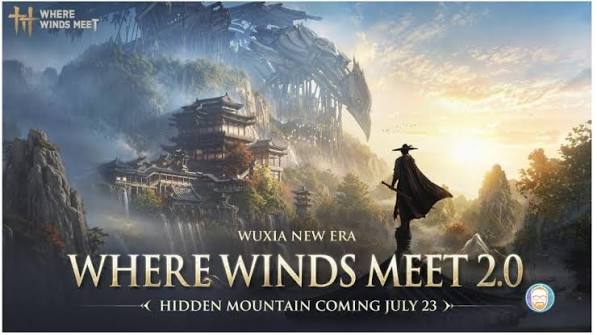
What Is Where Winds Meet 2.0 Hidden Mountain?
Where Winds Meet stepped into its 2.0 era on July 23, 2026 (UTC) with the Hidden Mountain expansion (不見山 / Bujian Mountain in the original). Developer Everstone Studio and publisher NetEase Games are billing this as the biggest update since the Xbox debut, and it is delivered as a free update for every player on every platform — no expansion pass, no separate purchase. If you have been away from the Jianghu, this is the moment the live game changes most of its core systems at once: a new region, a new sect, a new weapon, a crafting economy, and a full audiovisual overhaul.
The expansion's headline idea is an "Eastern Steampunk" world. Rather than adding more flat ground to walk across like the earlier Qinchuan and Imperial Palace updates, Hidden Mountain adds elevation to climb through — underwater trenches, underground palaces, mountain peaks, and floating sky cities stacked on top of one another.
For players who want to prepare their account, a Where Winds Meet top-up at Topuplist through the official Topuplist storefront is a convenient way to bank Echo Jades ahead of the new outfit drops, with regional pricing that makes planning cosmetic purchases easier.
The 2.0 Era in One Line
Version 2.0 is officially titled "Unseen Approach" (潜行将至) in the Chinese marketing, with Hidden Mountain as its centerpiece. It follows the Imperial Palace and Hexi updates and, like them, arrives free for existing players. Cross-platform progress carries between devices, so you can move from PC to mobile without starting over.
Item | Detail |
|---|---|
Version | Where Winds Meet 2.0 "Unseen Approach" |
Expansion | Hidden Mountain (不見山 / Bujian Mountain) |
Launch date | July 23, 2026 (UTC) |
Price | Free update for all players |
Platforms | PC (Steam, Epic), PS5, iOS, Android, Xbox Series S |
Entry point | Kaifeng |
Progress | Cross-platform, carries between devices |
Hidden Mountain: An Eastern Steampunk Vertical Region
Hidden Mountain is set on Bujian Mountain, a sprawling, multi-dimensional zone you literally cannot see the full shape of even while standing inside it — which is where the name "Hidden Mountain" comes from. The steampunk look is not a random genre swerve: the mountain's lore ties it to the Mohist Sect, legendary masters of ingenious engineering from ancient times who turned the entire mountain into one giant epic mechanism packed with hundreds of intricate mechanical devices.
The region's design leans on three core atmospheric elements — stone, light, and wind — and draws its theme from ancient sages chasing truth and wisdom, a contrast to Hexi's focus on painting and poetry. Every cliff, subterranean cave, and hidden enclave behind a roaring waterfall is meant to be fully explorable, not set dressing.
Six Layered Area Types
Unlike earlier horizontal maps (Qinghe, Kaifeng, Hexi, Imperial Palace), Hidden Mountain is built around movement between altitudes. Each height offers a distinct landscape, and the shortest route on the map is often not the accessible one — many destinations require entering from another level, operating a mechanism, or approaching from underground.
Area Type | What to Expect |
|---|---|
Underwater Mohist ruins | Hidden chambers, submerged structures, secret paths |
Underground labyrinths | Caverns, mechanisms, historical ruins |
Mohist City | Workshops, settlements, clockwork buildings, NPC activity |
Mountain cloudways | Elevated paths linking different vertical levels |
Mechanical sky city | High-altitude structures built with Mohist technology |
Clockwork towers | Vertical landmarks containing mechanisms and routes |
The scale is significant: the multi-level map spans over 2,000 meters of vertical depth, with 4 main areas, 14 sub-regions, 8 Jianghu Legacies, and more than 10,000 interactive NPCs. A useful habit the guide community repeats is to inspect nearby machinery before climbing straight at an objective — moving gears, suspended platforms, and connected structures often reveal the intended route.
Movement That Climbs Instead of Walking
Traversal leans hard into vertical movement. You reach nearly everything using Lightness Skill, climbing, gliding, and the new mechanical vehicles. Wind and lighting physics have been reworked across major scenes, so gusts visibly push clothing and leaves as you travel. Mechanical ziplines scattered across the Mohist city let you glide long distances rather than walking, and a new Clockwork Aircraft and Shuttle Train connect different parts of the region.
The Celestial Seize Upgrade
The Mystic Skill Celestial Seize receives a large upgrade in this region. Using an F Throw and F Link chain, you can grab objects remotely — for example, pulling a heavy urn across a room and throwing it to break structures, or rearranging mechanism puzzles from a distance. This turns environmental interaction into a core exploration tool rather than a gimmick, and it is essential for reaching several hidden routes.
The Mohist Hill Sect: Build, Don't Just Battle
The Mohist Hill Sect (墨山道) is hidden deep within the sea of clouds and is aimed at players who enjoy crafting and construction. It is the game's first building-specialized sect, and its disciples receive unique buffs to architectural and mechanical crafting abilities. The main storyline centers on this faction and the secrets of the mountain, adding fresh narrative developments and new martial arts content tied to their inventions.
Philosophy and Identity
Mohist Hill teaches players to explore the Jianghu through mechanical knowledge rather than martial lineage alone. Its philosophy emphasizes Utility, Universal Love, and Non-Aggression — mechanisms are treated as tools for solving problems, not symbols of personal power. You begin as an Apprentice and advance through research, mentorship, and submitted creations; the official global preview confirms progression is tied to completing Mohist-related quests after entering the region.
Aspect | Detail |
|---|---|
Role | First building/crafting-specialized sect |
Philosophy | Utility, Universal Love, Non-Aggression |
Buffs | Unique bonuses to architectural & mechanical crafting |
Activities | Research, construction, mechanical study |
Opposing faction | Qiongqi Artificers (mechanical power & control) |
Conflict | Mechanisms to help people vs. mechanisms for control |
Mohist Hill vs Qiongqi Artificers
The region introduces a clear ideological conflict: the Mohist Hill uses mechanisms to benefit ordinary people, while the rival Qiongqi Artificers value mechanical power and control. This rivalry drives several quests and explains why so many of the new enemies are mechanical rather than human. For players planning to invest, a Where Winds Meet top-up at Topuplist via the official Topuplist storefront can help you catch up on Echo Jades so you can focus on the new crafting and sect content without grinding currency.
Gauntlets and the New Close-Quarters Combat
The Gauntlets (手甲, also referred to as Hand Armor) are the long-awaited new weapon class, and community reaction around their addition has been especially strong — they finally bring classic wuxia fist combat into the global version in a fully realized form. They slot into the existing Path and Martial Art framework alongside swords, spears, umbrellas, fans, blades, and rope darts.
Fist-to-Flesh Discipline
The Gauntlet Discipline is built for ultra-close-quarters combat with a "fist-to-flesh" kinetic energy. It chains one strike into the next with lightning-fast combos and delivers devastating instant-burst damage to shatter enemy defenses. The style emphasizes short-range aggression, resource buildup, and execution-focused damage, with heavy crowd control, staggers, and lockdown potential — a distinct alternative to the ranged and blade play the game leaned on before.
Because a new weapon type means a fresh set of Martial Arts and Inner Way interactions to learn, treat the first week as experimentation rather than commitment. Version 2.0 also ships a gear-tuning overhaul that finally lets you undo a bad roll, which makes early Gauntlet experimentation far less punishing.
Bamboocut Kite and Rope Dart Synergy
The update also introduces the Bamboocut Kite Martial Art, which combines Gauntlets with a Rope Dart — a weapon that pairs naturally with the vertical terrain, swinging players across gaps and pulling enemies into range. The Rope Dart's crowd-control and repositioning synergize with Gauntlet burst windows, making the combined kit strong for the mountain's elevation-based fights. A balance pass in 2.0 also touches all eight Paths, so older weapons benefited from tuning alongside the new arrival.
Mechanical Crafting and Custom Vehicles
Hidden Mountain introduces a DIY mechanical crafting system and custom vehicle assembly. This is not cosmetic: components can be stitched together to build your own contraptions and vehicles, which then solve puzzles, open new pathways, and reach inaccessible locations. In earlier regions you found a route and traveled it; here you sometimes build the route.
Crafting Sits on the Critical Path
Devices exist to solve the mechanism puzzles gating parts of the region, so crafting sits directly on the critical path of exploration rather than beside it. Mohist Hill buffs make this smoother, but every wanderer can engage with the system. Expect environmental observation — identifying sounds, moving parts, and structural clues — to be as important as combat reflexes.
Vehicles Cross the Elevation Gaps
The custom vehicles exist specifically to cover elevation changes that Lightness Skill and climbing alone cannot. They help you cross the region's big vertical gaps alongside gliding and ziplines, and they double as puzzle tools. For returning players who want the new appearances and limited-time event rewards tied to the update, a Where Winds Meet top-up at Topuplist through the official Topuplist storefront is one way to top up Echo Jades so you can grab the seasonal cosmetics while you learn the crafting loop.
The Changeless Heart Campaign and New Bosses
Version 2.0 delivers a dedicated new storyline, Changeless Heart (不动心 / Changeless Heart), which picks up after the intrigue of the Imperial Palace arc and sends you toward Mohist Hill alongside familiar allies. The main story follows clues left by Aunt Han (韩姨) and leads into a millennium-old Mohist mystery. Access begins in Kaifeng, so head there first rather than looking for a new entrance out in the world.
Campaign Setup
Changeless Heart takes you into an underwater hall of gears crawling with mechanical puppets. It guards some of the Mohist Hill's deepest secrets and asks for both puzzle-solving and combat — a design that keeps narrative progression tied to intelligent exploration rather than pure damage races.
Boss Roster
The expansion brings a new caliber of bosses, many of them mechanical and clockwork horrors. Some fights require you to solve environmental mechanism puzzles mid-combat; others test you with relentless strikes or venomous blades. Expect encounters that mix puzzle-solving with reflex-heavy fighting rather than straight damage races.
| Encounter | Where | What to Expect | | --- | --- | | Changeless Heart campaign | Underwater hall of gears | Mechanical puppets, puzzle + combat | | Zhang Wanshi | Bottom of Moxin Lake | Commands mechanical puppets, giant controlled puppet | | Ci & Cuo | Open-world hidden room | Twin duo fighting in sync on suspension wires | | Ironheart Centipede | World boss | Clockwork horror with bulkhead weapon | | Qiongqi | Faction antagonist | Mechanical power faction |
The campaign bosses contrast with earlier ones that tested parry timing and duel reading: Hidden Mountain's foes have what amounts to a mechanical advantage, pushing you toward tools, positioning, and environmental manipulation instead of pure martial rhythm. If you clear content on reflexes alone, this campaign will feel different.
Visual and Audio Overhaul: Ray Tracing and Wind Dynamics
Version 2.0 ships a significant technical overhaul alongside the new content, and the "2.0" label is not just branding. The upgrades help the steampunk-inspired region feel distinct while polishing the entire world.
Lighting and Ray Tracing
A new light rendering and ray-tracing system realistically simulates the mountain's complex, delicate lighting — think shafts of sunlight cutting through underground caverns, then golden-hour glow at the sky-city peaks. This is the kind of across-the-board polish pass that makes the whole game feel like a new release.
Wind, Rock, and Layered Audio
Optimized wind dynamics create layered acoustics as gusts sweep through mountain canyons, while overhauled rock textures vividly depict the natural traces of wind, water, and time instead of static tiling. The result is a more atmospheric, modern-looking experience that better sells the sense of scale in floating cities and underground depths. Everstone also notes a collaboration with legendary martial arts choreographer Yuen Woo-ping (袁和平) for combat animation and action design, aiming to fuse traditional martial arts with modern gaming feel.
Free Rewards and How to Start (2.0 Launch Bonus)
According to the official developer letter on the Where Winds Meet website, wanderers who complete the Hidden Mountain version content can claim a total of 60 free pulls (including those converted from Echo Jades) and three exquisite outfits. These gifts are a direct thank-you for player support and a strong incentive to engage with the new region early.
60 Free Pulls and Three Outfits
The 60 free pulls effectively let new and returning players roll for the 2.0 banners without spending, and the three outfits are exclusive launch cosmetics. For players who want extra Echo Jades beyond the free allowance, a Where Winds Meet top-up at Topuplist through the official Topuplist storefront supports regional pricing and bundles so you can plan purchases with confidence.
Where to Enter
Start in Kaifeng, then follow the main Hidden Mountain story. The expansion is free, so there is no paywall between you and the content — only the usual exploration and combat challenges. Cross-progression means you can start on PC and finish on mobile without losing progress.
Player Reception and Known Community Pain Points
Hidden Mountain has been the game's biggest single update since launch, and the Steam concurrency rebound (peaking around 22,000 players on launch day, with a weekly peak near 33,000) shows it worked as a return catalyst. For a deeper zone walkthrough, see the Hidden Mountain expansion full guide covering every area type and boss.
What the Community Loves
Combat feel (≈9/10): the parry-based, weapon-diverse system — now with Gauntlets — is repeatedly called Sekiro-like and a cut above typical MMO action.
Exploration (≈8.5/10): corners hide constant side content, and Lightness Skill (wall-running, water-step, gliding) is smoother than many open-world games.
Creative freedom: you can pause combat to act as a builder, mechanic, or town doctor, even "practicing tai chi with a bear."
F2P friendly: the game is widely reviewed as cosmetic-only monetization, not pay-to-win, sustaining an 88–90% "Very Positive" Steam rating.
Open Complaints to Know Before You Dive In
A few issues the community raises are worth flagging so new players set expectations:
PvP ping/desync: Western players (NA/EU) report being matched with CN/JP pools on China-based servers, where opponents' lower ping creates an unfair edge. The demand is for region/ping-based matchmaking; no official change is confirmed yet.
Multi-character system: the added alt-character system splits progress, cosmetics, keybinds, and exploration — paid cosmetics must be re-bought per character. Many players say they would rather make a fresh account than maintain an alt.
"Menu hell" / complex UI: the layered menus are the most common new-player drop-off point, with UI scores around 5/10.
Localization/VO: occasional English VO stitching, subtitle misalignment, and leftover Chinese text hurt immersion; the community workaround is CN audio + EN/TR subtitles.
Performance: dense city areas can drop FPS (≈6.5/10), though the 2.0 overhaul improved path performance.
None of these block the PvE experience that Hidden Mountain centers on, but they explain why some reviews are mixed despite strong core systems.
Is Where Winds Meet 2.0 Worth Returning For?
If you left during the horizontal-map era, Yes — Hidden Mountain is the most substantial evolution of Where Winds Meet to date. The vertical steampunk region, Mohist engineering systems, Gauntlets combat, puzzle-infused bosses, and visual polish together deliver a fresh reason to return to the Jianghu. It reinvents exploration and combat without abandoning the core wuxia fantasy, and the free 60-pull launch bonus lowers the barrier to reconnect with the banner schedule.
The only real caveats are the community-reported PvP fairness and UI friction, which mostly affect competitive and new-player onboarding rather than the story and exploration that 2.0 leads with. Step into Hidden Mountain on July 23, claim your rewards, and let the mechanisms show you the way.
FAQ
1. When did Where Winds Meet 2.0 Hidden Mountain release?
Hidden Mountain launched on July 23, 2026 (UTC) as a free update for all platforms (PC via Steam and Epic, PS5, iOS, Android, and Xbox Series S). It is the start of the "Where Winds Meet 2.0" era and requires no separate purchase.
2. What is the Mohist Hill Sect in Where Winds Meet 2.0?
Mohist Hill (墨山道) is the game's first building- and crafting-specialized sect, hidden in the sea of clouds. Its disciples get unique buffs to architectural and mechanical crafting, and its philosophy emphasizes Utility, Universal Love, and Non-Aggression. It conflicts with the rival Qiongqi Artificers, who value mechanical power and control.
3. What are Gauntlets and how do they play?
Gauntlets (手甲 / Hand Armor) are a new close-quarters weapon class built for "fist-to-flesh" brawling — fast combos, heavy crowd control, and instant-burst damage to break defenses. They pair with the Bamboocut Kite Martial Art and Rope Dart for vertical, swing-based engagements, and benefit from 2.0's gear-tuning overhaul that lets you undo a bad roll.
4. Do I need to craft vehicles to progress in Hidden Mountain?
Crafting is on the critical path of exploration: custom vehicles and devices solve mechanism puzzles and cross elevation gaps that Lightness Skill alone cannot. You don't need to min-max it, but engaging with the Mohist crafting loop unlocks routes and hidden content you would otherwise miss.
5. What free rewards come with the 2.0 launch?
Completing Hidden Mountain version content grants 60 free pulls (including Echo Jade conversions) and three exclusive outfits, per the official developer letter. These are claimable alongside the seasonal event rewards once you progress through the region's main story.
6. How do I start the Hidden Mountain content?
Enter through Kaifeng and follow the main Hidden Mountain story, which continues from the Imperial Palace arc and follows clues left by Aunt Han. Cross-progression means you can begin on one device and continue on another without losing progress.