


VALORANT Premier V26A4 Guide: 600 Score Requirement, Playoffs Date & Team Strategy
V26A4 Premier explained: how to hit the 600 Premier Score playoff cutoff, when playoffs run, and the team strategy that wins brackets.
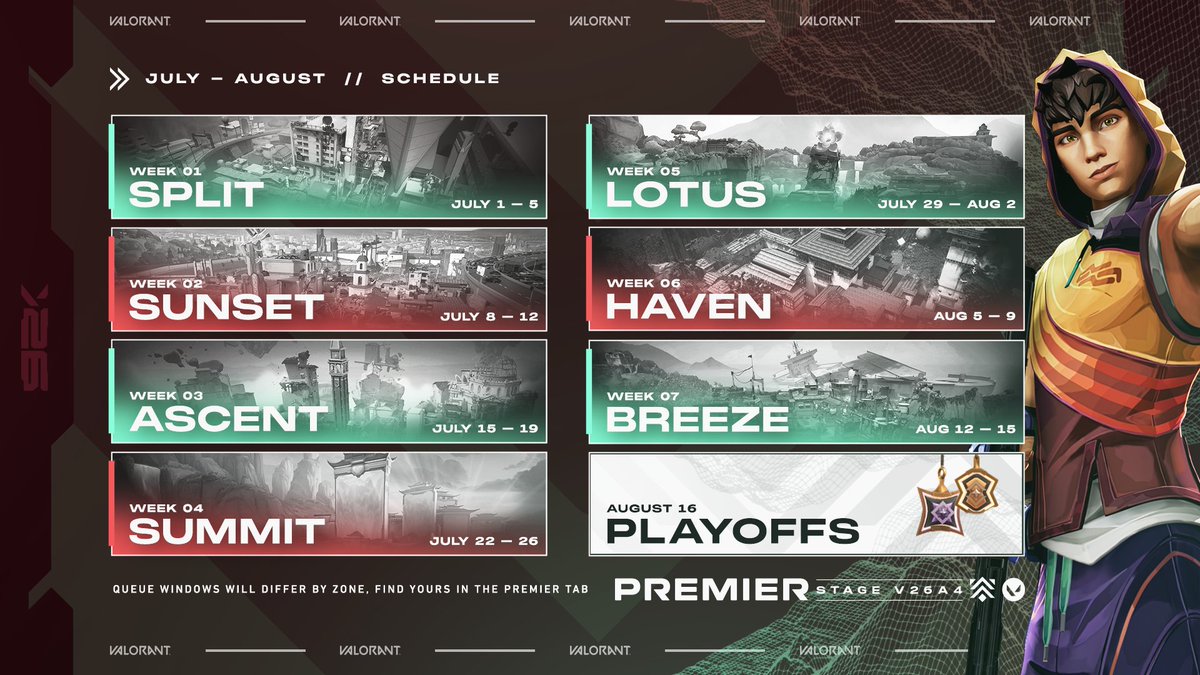
VALORANT Premier is the mode that turns five stacked friends into something that feels like a real organization. Instead of solo-queue chaos, you get a fixed roster, a weekly match window, a division of teams at your level, and a playoff bracket at the end of the Stage. For V26A4, the goal is the same as every Stage: bank enough Premier Score to qualify, then win your bracket. This guide breaks down the 600 Premier Score requirement, the V26A4 playoff dates, and the team strategy that actually gets squads into — and through — playoffs.
What Is VALORANT Premier (and What Changes in V26A4)
Premier is Riot's structured, team-based competitive mode that sits between normal Competitive and the official VCT path. A Premier season runs in three phases: enrollment (build your team), weekly matches (earn Premier Score), and a playoff tournament (single-elimination bracket for your division). Your Competitive rank does not change while you play Premier, but your team's division and seeding are driven by your roster's MMR.
Premier vs Competitive
The biggest difference is commitment. Competitive is solo or flex queue at any time. Premier locks you into a team, a zone, and a recurring match window, then grades you on a Stage-long leaderboard. Weekly matches are played on a predetermined map that every team in your division plays that week — there is no pick-and-ban in the regular season. Map pick-and-ban only switches on once you reach the playoff bracket, which is exactly where Premier starts to feel like pro play.
The V26A4 Stage at a glance
For the current Stage, V26A4, Riot's patch notes place the regular season's first matches around July 1, 2026, with playoffs landing in mid-August. The exact queue windows depend on your zone, so the single source of truth is always the Premier Hub inside the client. Treat any screenshot from another region as a hint, not a schedule.
If your roster is still short on agents or you want the latest skins and battle pass to keep morale high, topping up is simple through Topuplist and the VALORANT product page for secure Valorant Points credit.
The 600 Premier Score Requirement Explained
This is the number every Premier team talks about, and for good reason: you must earn at least 600 Premier Score to qualify for playoffs. Riot's official playoff rules state it plainly — standings and win-loss record do not gate qualification, only your cumulative Premier Score does. Ties do not matter for getting in. What your score does affect is seeding: teams with higher Premier Score are placed better in the bracket.
How Premier Score is earned
Premier Score comes almost entirely from weekly matches. Per Riot's current support pages, a weekly match win awards 100 Premier Score, and tournament matches award none — they decide placement, not your score. Here is the quick reference:
Action | Premier Score awarded |
|---|---|
Weekly match win | 100 |
Weekly match loss | 0 (current Stages; some earlier Stages awarded 25) |
Bye (no opponent available) | 100, no round score |
Playoff / tournament match | 0 (placement only) |
A Bye happens when no opponent is available for your division in the queue window; Riot grants the win and the 100 points, but without a round score for differential tiebreakers.
The math to 600
Because each win is worth 100, the cleanest path is a 6–0 regular season, which lands you at exactly 600. That is the magic line. Any loss makes the cutoff harder:
6 wins, 0 losses = 600 — qualified, clean.
5 wins, 1 loss = 500 — you are 100 short and cannot make it up; you would have needed a 6–0.
A missed week (no match played) simply earns nothing, so consistency is everything.
The practical takeaway: do not drop weeks. Six wins across the Stage is the threshold, and with most Stages offering around six to eight weekly match windows, a single forfeit or no-show can sink a playoff run before the bracket even forms.
Why seeding still matters
Even though 600 gets you in regardless of record, your score sets your seed. A higher seed means an easier early bracket path and a lower chance of meeting the division's strongest team in round one. So while "just hit 600" is the floor, pushing toward 700–800 by winning extra weeks gives your team a real edge on playoff day.
V26A4 Schedule and Playoffs Dates
Premier runs inside most of a single Act, typically six to eight weeks of weekly matches plus a playoff weekend. For V26A4 the rhythm is the standard one.
Regular season weekly matches
Your team plays two Best-of-One weekly matches per week inside your assigned queue window. Everyone in your division plays the same map that week, so preparation is uniform across the bracket. Scores reset into the new Stage each time a Stage ends — your Premier Score does not carry over.
Playoff dates for V26A4
Per the 2026 Stage schedule cited by Riot's patch notes:
V26A4 milestone | Date |
|---|---|
Regular season matches begin | ~July 1, 2026 |
Weekly match windows | Through the Stage (zone-dependent) |
Playoffs — most divisions | ~August 16, 2026 |
Playoffs — Contender / Invite first round | ~August 15, 2026 |
Playoffs — Contender / Invite finals | ~August 16, 2026 |
For Open through Elite divisions, qualification is the straightforward 600 Premier Score rule. For Contender and Invite divisions, qualification is placement-based — you must finish among the top teams on the standings, not just cross a score line. If your team is in Contender or Invite, block both August 15 and 16, because those divisions use a two-day playoff structure (Rounds 1–2 are Bo1, finals are Bo3).
Always confirm the exact dates and times in your Premier Hub, since zone and region shift the windows.
Divisions, Seeding and Provisional Placement
Premier sorts teams so you play opponents near your level. Understanding the ladder helps you set realistic promotion goals.
The division groups
Premier uses a tiered structure. The commonly cited layout is Open (1–5), Intermediate (1–5), Advanced (1–5), Elite (1–5), Contender, and Invite at the very top. Contender and Invite are the elite tiers that feed the VCT Challengers pipeline.
Division group | Who typically plays here |
|---|---|
Open 1–5 | New teams, Iron-to-Silver average rosters |
Intermediate 1–5 | Gold-to-Platinum average rosters |
Advanced 1–5 | Platinum-to-Diamond average rosters |
Elite 1–5 | High-level, near-Immortal rosters |
Contender | Immortal 3+ or prior high-stage performers |
Invite | Top regional teams; direct Challengers path |
In Contender and Invite, only Contender Eligible players can be rostered — that means a player who hit Immortal 3 or higher peak rank, played a Contender/Invite match previously, or played an Elite 5 playoff match. Five Contender-Eligible players guarantee Contender placement.
How seeding is calculated
Your division is set by the Competitive MMR of your top five players. Riot averages those five MMRs into an MMR range and drops your team into the matching division. If your roster has wildly different skills, Riot weighs the best player's MMR more heavily, which can push you into a tougher division than your average suggests.
Provisional vs locked
Before your first match of a Stage, your division is provisional — it updates live as you add or remove players or change zones. The moment you queue your first match, the division locks for the Stage. After that, you can only invite players who would not change your division. Plan your roster before that first match, not after.
Building a Premier Team That Actually Shows Up
The most common reason Premier teams fail is not aim — it is attendance. Premier rewards the team that logs in on schedule more than the team with the highest individual rank.
Roster size and the owner role
Riot's Premier rules allow 5 to 7 players and require one Team Owner. The owner manages invites, roster changes, zone decisions, and basic setup — they do not need to be the best fragger. A team can also have up to one Team Captain to help with management. Every player on the roster can queue for any given match; the owner or captain does not have to be present.
The two-substitute rule
Five players is the legal minimum, but it is a fragile plan. Real life happens: work, school, time zones, bad internet, tilt, sickness. A healthy Premier roster carries six or seven players so a single absence never forces a forfeit or a panic role-swap. Rotate substitutes into regular-season matches so they stay sharp and engaged — players who never play will drift off the roster.
Need an agent unlocked or a skin bundle to round out your main's loadout? Grab Valorant Points quickly through Topuplist and the VALORANT product page so nobody is stuck on a comfort pick they cannot select.
Zone and schedule planning
Your zone decides when you play and your ping. Do not pick a zone just because one player likes the time slot — pick it because the whole roster can realistically show up. Queue early in the window whenever possible; a team that appears at the last second turns any login hiccup into a missed match.
Roles Every Premier Roster Should Define
Premier punishes vague team structure. In ranked, five comfort picks sometimes work. In Premier, you need predictable jobs. That does not mean locking a player to one agent forever, but everyone should know their job before the map loads.
Caller and entry
The Caller / IGL decides default pace, mid-round calls, save timing, and veto decisions. They do not need the best aim, but they must read the game. The Duelist / entry creates first pressure and understands when to entry versus when patience wins the round.
Control, info and structure
The Controller owns smoke timing, retake spacing, lurk denial, and post-plant discipline. The Initiator starts contact, clears angles, and keeps information flowing. The Sentinel controls flanks, anchors sites, and gives the team a stable defensive shape. A clear role table keeps everyone honest:
Role | Primary job |
|---|---|
Caller / IGL | Pace, mid-round calls, veto decisions |
Duelist / Entry | First pressure, entry timing |
Controller | Smokes, retake spacing, post-plant |
Initiator | Angle clears, information flow |
Sentinel | Flank control, site anchor |
Flex / Substitute | Cover missing roles without rebuilding comp |
The flex seat
The most underrated roster spot is the calm flex player who can slide into whatever role a missing teammate leaves open. Premier matches feel heavier than ranked because your teammates remember every mistake — a steady flex keeps the comp intact when someone tilts or drops.
Map Veto Strategy: Win Before the Pistol Round
Map pick-and-ban is Premier's most unique strategic layer, and it only appears in tournament matches. Approaching it correctly can win you rounds before the pistol fires.
Know your map pool
Before the Stage, your team needs an honest map assessment: identify your two strongest maps (practiced executes and retakes), your two weakest maps (your first bans), and stay merely competent on the rest. Opponents who spot a one-map team will exploit it.
Ban and protect logic
Ban your worst map first — remove the chance it ever reaches the table. Watch what your opponent bans; their bans reveal weaknesses you can use later. Protect your best map by not banning it early, and if both teams are comfortable on the same map, confidence usually wins. The team that does not choose the map gets to pick attack or defend, so side selection is a real bargaining chip.
Scout the opponent
Check the opposing team's recent Premier matches before veto. If they force the same map every week, ban it if you are not strong there. A little scouting turns the veto from a coin flip into a planned advantage.
How Playoff Tournaments Work
Playoffs are the payoff, and the rules change from the regular season.
Bracket format and elimination
All qualifying teams in a division are matched into a single-elimination bracket — one loss and you are out. A bracket holds up to 8 teams but can start with as few as 2 depending on who queues at the designated time. If your team misses the tournament queue window, you cannot participate at all, so be online early.
Map pick-and-ban in tournaments
Tournament matches use map pick-and-ban: teams alternate banning maps, all members vote, and the party leader locks the choice. The team that did not pick the map chooses attack or defend. In Contender and Invite, Rounds 1–2 are Bo1 and the finals are Bo3, with a fresh pick-and-ban before each game and at least a 5-minute rest between games.
Subs and rest rules
Riot does not support substitutes during tournaments. The five players who queue for the first match are locked in for the entire tournament. Matches are Bo1 and played consecutively in one day until you are eliminated or reach the finals. Results lock in 24 hours after playoffs end.
Strong team strategy here is about preparation: review your bracket, tighten your map pool to only your most confident maps, ban aggressively to force your strengths, and warm up together with a team Deathmatch or scrim before the first match.
Keep your roster motivated with a clean battle pass and agent unlocks — top up easily through Topuplist and the VALORANT product page so your squad is always match-ready.
Common Mistakes That Keep Teams Out of Playoffs
Most Premier teams do not lose because they lack skill. They lose because they treat Premier like a slightly more serious ranked night.
Treating it like ranked
Premier rewards planning, clean comms, and reliable attendance more than panic energy. Building around a single Radiant player who misses two weeks is worse than an all-Ascendant team that shows up and runs a system. One caller, short info, no mid-round complaining beats five loud voices.
Missing weeks
Because Premier Score only comes from wins and a 6–0 is the clean line to 600, a missed week is nearly fatal. A forfeit also hurts round differential, which is the final tiebreaker after Premier Score and matches played.
No backup controller
If your smoke player is absent and nobody can cover, the whole comp collapses. This is exactly why the two-substitute roster rule exists. Rotate a backup Controller into regular-season matches so playoff night is never a gamble.
Final Tips to Clinch Your V26A4 Playoff Run
Track your score weekly. After every match, note your Premier Score against the 600 line so there are no surprises in the final week.
Protect your weakest map early in veto, protect your best map late, and scout opponents before the bracket.
Warm up together before playoff matches; teams that get on the same page vocally and mechanically before a high-stakes match play measurably better.
Manage nerves. Playoff pressure changes how teams play — remind your squad to run the same system that earned the playoff spot.
Ready to push your V26A4 squad into the bracket? Support your run with fast, secure Valorant Points from Topuplist and the VALORANT product page, and take the 600-score chase seriously from week one.
For the official qualification and bracket rules, see Riot's Premier Playoff Tournaments support page, and for Contender and Invite eligibility details, Riot's Premier Contender & Invite Divisions page.
FAQ
What is the Premier Score requirement for V26A4 playoffs?
You need at least 600 Premier Score to qualify for playoffs in Open through Elite divisions. Contender and Invite use placement-based qualification instead. Since each weekly win awards 100 Premier Score, a 6–0 regular season lands you exactly on the line.
When are V26A4 Premier playoffs?
For most divisions, playoffs fall around August 16, 2026. Contender and Invite run a two-day structure with first-round matches around August 15 and finals on August 16. Always confirm exact windows in your in-client Premier Hub, since zones shift the schedule.
How many players do I need for a Premier team?
Riot requires at least 5 players and allows up to 7, plus one Team Owner. A six- or seven-player roster is strongly recommended so absences never force a forfeit.
Do losses give Premier Score?
In current Stages, a weekly loss awards 0 Premier Score (some earlier Stages awarded 25). Wins award 100, and a Bye also awards 100 with no round score. Tournament matches award none.
Can I change my roster after matches start?
Before your first match of a Stage your division is provisional and you can change freely. After your first match, you can only add players who would not change your division. Invite teams cannot change zones at all.
What divisions exist in Premier?
The structure is Open (1–5), Intermediate (1–5), Advanced (1–5), Elite (1–5), Contender, and Invite at the top. Your division is set by the average MMR of your top five players.
How does Premier connect to VCT?
The top teams in each region's Contender and Invite divisions can qualify for the VCT Challengers pipeline, making Premier the official path-to-pro funnel for aspiring competitive teams.
Are there substitutes in playoff matches?
No. Riot does not support subs during tournaments — the five players who queue for the first match are locked in for the entire bracket. Plan your five carefully.