


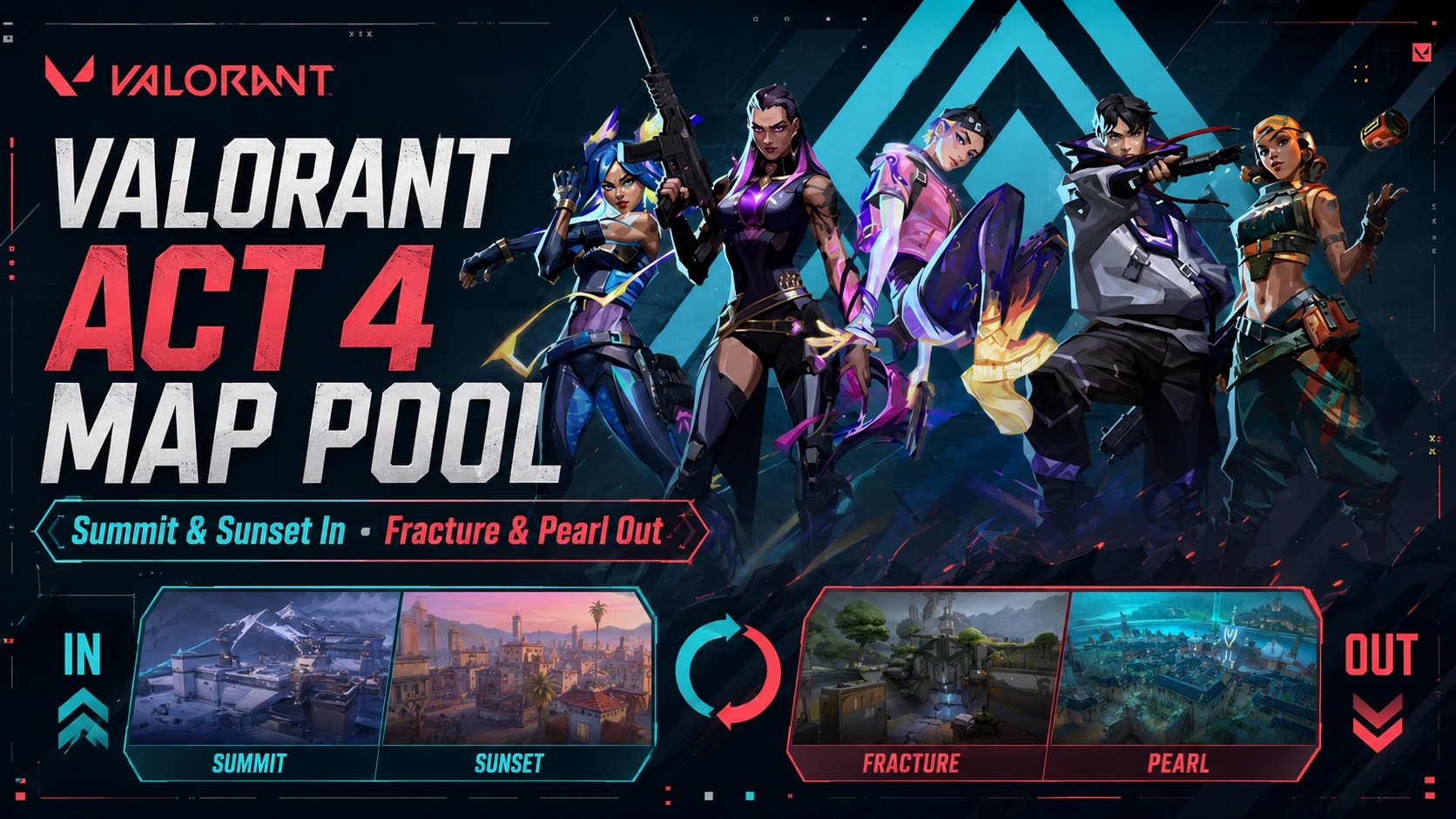
VALORANT Act 4 Map Pool: Summit & Sunset In
Need VALORANT Points for the latest Battle Pass, weapon skins, or Featured Store bundles? Visit the English Topuplist VALORANT Top Up page to view the available VP packages. Confirm your supported region, Riot ID, package details, and final price before completing payment. Topuplist is a third-party recharge platform and is not affiliated with Riot Games.
The VALORANT Season 2026 Act 4 map pool includes Summit, Sunset, Breeze, Haven, Lotus, Split, and Ascent.
Patch 13.00 adds Summit and Sunset to Competitive and Deathmatch while removing Fracture and Pearl. Summit is the only completely new map in the rotation, while Sunset returns after being replaced by Breeze earlier in the season.
The updated pool increases the importance of Mid control, flexible utility, map-specific Agent choices, and adaptable rotations. It also removes Fracture’s unusual multi-directional attack structure and Pearl’s combination of compact Mid fights and long side lanes.
This guide explains every map in the current rotation, what the additions and removals mean for ranked play, which skills and Agent roles gain value, and how to prepare for the Act 4 map pool.
Current VALORANT Act 4 Competitive Map Pool
Riot confirms in the official VALORANT Patch 13.00 notes that Summit and Sunset are entering Competitive and Deathmatch, while Fracture and Pearl are leaving those queues.
The remaining five maps can be confirmed through Riot’s earlier rotations:
Patch 12.00 brought Breeze back.
Patch 12.05 returned Lotus and Fracture while removing Abyss and Corrode.
Patch 12.08 added Ascent and removed Bind.
Patch 13.00 then replaces Fracture and Pearl with Summit and Sunset.
What Changed in the Act 4 Map Rotation?
Summit Enters Competitive Immediately
Summit is a new 5v5 Spike map set in a Radiant training academy in the mountains of China.
Unlike new maps that spend an extended period outside ranked, Summit entered Competitive when Patch 13.00 launched.
Riot also introduced temporary launch protections:
Summit losses remove only 50% of the normal RR during the first two weeks.
Summit victories still award 100% of normal RR.
A dedicated Summit-only queue uses Swiftplay rules for its limited launch period.
These protections are temporary and should be removed from the article once the launch event ends.
Summit creates the largest learning challenge in the new pool because every player must learn new callouts, timings, rotation routes, plant positions, and defensive setups.
For detailed routes and strategies, use a dedicated Summit map guide rather than treating this map-pool article as a full callout guide.
Sunset Returns to Competitive
Sunset previously left the Competitive and Deathmatch pools when Breeze returned in Patch 12.00.
Its return adds another map where controlling the central area strongly affects both sites. Teams that surrender Mid can lose access to important connector and rotation routes, allowing attackers to split site defenders from several directions.
Returning players should not rely entirely on old knowledge. Current Agent balance, utility timings, defensive setups, and professional compositions may differ from the last period when Sunset was active.
Fracture Leaves the Rotation
Fracture is removed from Competitive and Deathmatch in Act 4.
Its structure allows attackers to begin from several sides of the map, creating immediate front-and-back pressure on defenders. Removing Fracture reduces the number of matches built around unusual attacker starting positions and highly rehearsed multi-directional executes.
Players who specialized in Fracture-specific Breach, Neon, Raze, Brimstone, or Killjoy strategies should shift their practice toward active maps.
However, Fracture has not been permanently deleted. Riot has previously explained that a map leaving rotation does not necessarily mean it requires a redesign. Maps are also rotated to change the overall variety of the pool. Riot discusses this philosophy in its official State of the Maps article.
Pearl Leaves the Rotation
Pearl also exits Competitive and Deathmatch.
Pearl combines close engagements around Mid with longer fights along its outer lanes. Its removal reduces the number of ranked rounds centered on B Long control, extended post-plant sightlines, and Pearl-specific Controller utility.
Pearl specialists can transfer several skills to the remaining maps:
Long-range discipline transfers to Breeze.
Structured Mid control transfers to Ascent and Sunset.
Rotation awareness transfers to Haven.
Compact connector fighting transfers to Split.
As with Fracture, no official return date has been announced.
Why VALORANT Uses a Rotating Map Pool
Riot introduced competitive map pools to balance two competing goals: variety and mastery.
Allowing every map into Competitive at the same time would create more variety, but it would also require players and organized teams to maintain substantially more callouts, compositions, lineups, and strategic plans.
A smaller active pool allows players to develop deeper knowledge of:
Defensive rotations
Standard plant positions
Common utility
Site-entry timing
Economy-dependent setups
Agent compositions
Post-plant routes
Riot has also stated that removing a map does not automatically mean the map is considered broken or scheduled for a redesign. Rotations can simply refresh the style and variety of Competitive matches.
For casual queues, Riot moved Unrated, Swiftplay, Spike Rush, and Escalation to an open map pool in Patch 8.11. Queue rules can change, so players should still check the live client before assuming that every mode uses the Competitive rotation.
What Summit Adds to the Map Pool
Summit affects the overall pool in three important ways.
A Completely New Knowledge Test
Players cannot depend on years of established community knowledge.
During the first weeks, ranked matches may include:
Inconsistent callouts
Unfamiliar defensive rotations
Poorly timed site executes
Experimental Agent compositions
Unoptimized plant positions
Teammates misunderstanding available routes
Players who explore Summit in Custom or the temporary dedicated queue will have an advantage over players learning it for the first time in Competitive.
Greater Route-Management Complexity
Summit can change available routes during a round.
This means teams must communicate more clearly about:
Which rotation paths remain available
Whether a teammate has been isolated
Which entrances defenders can use
How attackers should position after planting
Whether a planned fake remains possible
This is different from a traditional static map where every connector remains available throughout the round.
Transferable Skills From Other Maps
Several existing map fundamentals should help players adapt:
Ascent: structured Mid pressure and two-directional site splits
Split: vertical awareness and narrow entry management
Lotus: adapting when routes or structures change
Sunset: controlling central space before committing
Haven: clear rotation communication and information tracking
Summit should still be learned as its own map rather than treated as a direct copy of any existing layout.
What Sunset’s Return Changes
Sunset strengthens one of the main themes of the Act 4 pool: Mid control.
Ascent, Split, Summit, Breeze, and Sunset all give teams meaningful benefits for taking or contesting central space.
On Sunset, Mid control can:
Create access toward Market
Pressure defensive rotations
Enable split attacks
Punish defenders who rotate too early
Give lurkers more options
Reduce the safety of static site anchors
This makes flexible smokes, recon utility, flashes, and reliable trade spacing more valuable.
Sunset is likely to reward teams that play patient defaults instead of immediately committing five players through one main entrance.
How the Act 4 Pool Changes the Ranked Meta
The map rotation does not directly buff or nerf an Agent, but changing the active maps can still shift pick priorities.
More Maps Reward Mid Control
Five maps in the pool place clear value on central pressure:
Ascent
Sunset
Summit
Split
Breeze
Mid control does not always mean taking every central position. Teams can also gain value by forcing defensive utility, gathering information, or preventing opponents from moving freely.
Players should practise:
Early Mid smoke placement
Flash and recon timing
Trading through central choke points
Holding rotation cuts
Falling back after drawing defensive resources
The Pool Retains Strong Strategic Variety
No single Agent composition will work equally well across all seven maps.
A team that uses the same five Agents on Breeze, Split, and Haven will usually sacrifice important map-specific strengths.
Best Agent Roles for the Act 4 Map Pool
Flexible Controllers Gain Value
Controllers must cover maps with very different sightlines.
Useful qualities include:
Rechargeable smokes
Global or long-range placement
Strong retake utility
Ability to support Mid without abandoning a site
Area denial for open plant zones
Omen is a flexible general option, while Astra offers greater global control in coordinated teams. Viper remains valuable on selected open maps or as part of a double-Controller composition.
Players should avoid assuming one Controller is optimal on all seven maps.
Information Initiators Remain Essential
The map pool includes long sightlines, tight site entrances, three-site rotations, and several important central lanes.
Information abilities help teams:
Detect defensive stacks
Clear Operators
Identify lurkers
Confirm rotations
Enter narrow sites
Avoid wasting utility on empty areas
Sova, Fade, KAY/O, Gekko, and Breach each cover different types of information and entry support.
Rather than learning every Initiator, players should select one option for open maps and one for tighter maps.
Sentinel Selection Should Remain Map-Specific
Sentinels have different strengths:
Cypher offers broad information and flank surveillance.
Killjoy provides concentrated site control and post-plant utility.
Sage is strongest when Barrier Orb creates high-value route control.
Deadlock punishes narrow and noisy entries.
Chamber benefits from long sightlines and Operator setups.
Veto provides anti-utility value against structured executes.
The best Sentinel depends on the map and team composition rather than one universal ranking.
Duelist Players Need Multiple Entry Styles
The rotation contains both open and compact maps.
A Duelist player benefits from learning:
A mobility Agent for open or elevated positions
An explosive Agent for close-corner clearing
A comfort pick for uncoordinated ranked matches
Jett remains useful for long sightlines and Operator play. Raze excels at clearing tight spaces, while Neon can create fast pressure across larger routes.
Most Versatile Agents Across the Seven-Map Pool
This is not a strict Agent tier list.
The purpose is to identify Agents that can cover several maps without forcing a player to learn seven completely different picks.
A practical ranked Agent pool could include:
One flexible Controller
One information Initiator
One Sentinel
One Duelist or secondary role pick
How to Prepare for the Act 4 Map Pool
Priority 1: Learn Summit
Summit deserves the most immediate practice because it is completely new.
Before entering Competitive, learn:
Basic callouts
Fast and safe rotations
Common plant areas
Major elevation changes
Which routes can become unavailable
One attack and defense plan for each site
Do not begin with advanced lineups. Basic movement and map awareness provide more value during the launch period.
Priority 2: Refresh Sunset
Returning players should revisit:
Mid routes
Site connectors
Defensive fallback positions
Smoke locations
Current plant zones
Updated Agent setups
Old knowledge remains helpful, but it should be tested in the current version of the game.
Priority 3: Maintain the Five Remaining Maps
Do not spend the entire launch period practising only Summit.
Continue reviewing:
Breeze
Haven
Lotus
Split
Ascent
Players often lose familiar maps after overinvesting practice time into the newest addition.
Lowest Immediate Priority: Fracture and Pearl
Fracture and Pearl are no longer urgent for current Competitive preparation.
Keep saved lineups and strategy notes, but shift most practice time to active maps. Both maps may return in a future rotation.
Seven-Day Act 4 Map Pool Practice Plan
The goal is not to memorize every possible setup in one week.
Players should first develop enough knowledge to avoid losing rounds through incorrect rotations, unknown callouts, or unsuitable Agent choices.
Best Weapons for the Current Map Pool
Vandal vs Phantom
The Vandal remains attractive on maps with longer engagement ranges, particularly Breeze and parts of Haven, Ascent, and Summit.
The Phantom gains value in:
Tight Split fights
Sunset choke points
Smoke-heavy executes
Close-range Lotus positions
Defensive spray transfers
Players who use both rifles should choose according to expected engagement distance rather than treating one weapon as universally superior.
Operator Value
The Operator should remain influential on:
Breeze
Ascent
Haven
Selected Summit positions
Operator players need escape utility, smoke support, and teammates capable of preventing close-range pressure.
Shotgun and SMG Value
Close-range weapons retain niche value on:
Split
Sunset
Tight Lotus positions
Specific Summit entrances
They are less reliable when forced into Breeze’s longer engagements.
How the Rotation Affects Solo Queue
Keep Communication Simple
New and returning maps create communication problems because teammates may use different callouts.
Useful calls include:
Enemy count
Spike location
Mid control status
Rotation direction
Remaining defensive utility
Which site entrance is open
Use the minimap ping system when a location name is unclear.
Avoid Complicated Launch-Week Executes
Detailed strategies often fail when teammates do not share the same map knowledge.
Simple plans are more reliable:
Smoke the main defensive sightlines.
Use recon or a flash.
Enter together.
Trade the first contact.
Secure the Spike plant.
Establish two post-plant positions.
Select Agents With Independent Value
Solo queue rewards Agents that can contribute without perfect coordination.
Useful traits include:
Self-sufficient utility
Flexible smokes
Reliable information
Flank protection
Escape tools
Straightforward entry support
How the Rotation Affects Premier Teams
Premier teams should treat Summit as a new preparation requirement rather than immediately declaring it a permanent ban.
Teams need at least:
A basic Agent composition
One attack default
One defensive setup for each site
Pistol-round plans
Retake roles
A clear map-veto position
Sunset may become an early comfort map for teams that retained previous playbooks, although those strategies should be updated for the current Agent meta.
Fracture and Pearl strategies should be archived rather than deleted. Future rotations may restore either map.
Premier schedules and weekly maps should always be confirmed inside the client because organized-play availability may not be identical to every Competitive queue update.
Winners and Losers of the Act 4 Rotation
Strategic Winners
The rotation should benefit:
Flexible Controller players
Teams with strong Mid protocols
Information Initiator specialists
Players comfortable on Ascent and Sunset-style defaults
Teams that learn Summit early
Players with adaptable Agent pools
Strong rotation callers
Strategic Losers
The rotation may challenge:
Fracture-only specialists
Pearl lineup specialists
Players using one Agent on every map
Teams that surrender Mid without contest
Players entering ranked without learning Summit
Teams dependent on highly rehearsed static setups
These are strategic effects rather than direct Agent buffs or nerfs.
Common Mistakes After the Map Rotation
Entering Ranked Without Learning Summit
The temporary RR protection reduces losses but does not prevent players from developing bad habits.
Learn basic routes before relying on Competitive matches as the only practice method.
Assuming Sunset Plays Exactly as Before
Agent balance and team strategies evolve even when the map layout remains familiar.
Retest old lineups and defensive setups.
Ignoring Familiar Maps
Summit receives the most attention, but five existing maps still make up most of the pool.
Maintain basic preparation across every active map.
Using One Controller Everywhere
Breeze, Split, Haven, and Sunset create different smoke requirements.
Build at least two Controller options or understand when a teammate’s pick better fits the map.
Learning Advanced Lineups Before Basic Rotations
A perfect projectile lineup has limited value if the player cannot rotate correctly or recognize a site split.
Master layout and timing first.
Treating Fracture and Pearl as Permanently Removed
Riot frequently brings maps back in later rotations.
Preserve useful knowledge for future Acts.
Frequently Asked Questions
What is the VALORANT Act 4 map pool?
The current Competitive pool includes:
Summit
Sunset
Breeze
Haven
Lotus
Split
Ascent
Which maps entered the Act 4 rotation?
Summit and Sunset entered Competitive and Deathmatch in Patch 13.00.
Which maps left the Act 4 rotation?
Fracture and Pearl were removed from Competitive and Deathmatch.
Is Summit available in Competitive?
Yes. Summit entered Competitive immediately with Patch 13.00.
For the first two weeks, Summit losses remove 50% less RR, while wins still award full RR. This launch protection is temporary.
Why were Fracture and Pearl removed?
Riot confirmed the rotation but did not provide a detailed map-specific reason in Patch 13.00.
Map removal does not automatically mean Riot considers a map unbalanced or plans an immediate redesign.
Will Fracture and Pearl return?
They may return in a future rotation, but Riot has not announced a date.
How many maps are in the Competitive pool?
There are seven active maps.
Does Deathmatch use the same changes?
Patch 13.00 specifically adds Summit and Sunset to Deathmatch and removes Fracture and Pearl from it.
Are inactive maps available in casual modes?
Riot moved several casual queues to an open map pool in Patch 8.11. Check the live client because mode rules and temporary availability can change.
What map should players practise first?
Summit should be the highest priority because it is completely new. Sunset should be the second priority because returning players may rely on outdated strategies.
What Agents are safest across the entire pool?
Flexible choices include Omen, Sova, Cypher, Jett, Raze, Killjoy, and KAY/O. The best option still depends on the map and team composition.
Is the Act 4 map pool attacker- or defender-sided?
The entire pool cannot be classified with one side-balance label. Each map has different geometry, plant zones, rotation speeds, and developing strategies.
Summit is also too new for a reliable long-term conclusion.
Final Verdict
The VALORANT Act 4 map pool replaces Fracture and Pearl with Summit and Sunset, creating a seven-map rotation built around several distinct tactical styles.
The active pool includes:
Traditional Mid-focused maps
Open long-range maps
Three-site rotation maps
Tight vertical maps
Dynamic route mechanics
The most important shared trend is the value of central control. Summit, Sunset, Ascent, Split, and Breeze all reward teams that pressure Mid, gather information, and threaten split attacks.
Summit creates the largest immediate learning challenge, while Sunset rewards players who already understand disciplined defaults and coordinated Mid pressure. Fracture and Pearl specialists must temporarily redirect their practice, but both maps may return later.
Success in Act 4 will depend on three priorities:
Learn Summit’s basic routes before entering ranked.
Refresh Sunset rather than relying entirely on old knowledge.
Build an Agent pool flexible enough to cover open, compact, vertical, and three-site maps.
The rotation does not make VALORANT simpler. It changes which fundamentals matter most.