


Rise of Kingdoms Armament Honing Guide: Stats, Caps & Best Rolls (2026)
Armament Honing fine-tunes equipment stats (up to ~3.5% per stat). Learn how it works, the caps, and which stats to prioritize for your march.
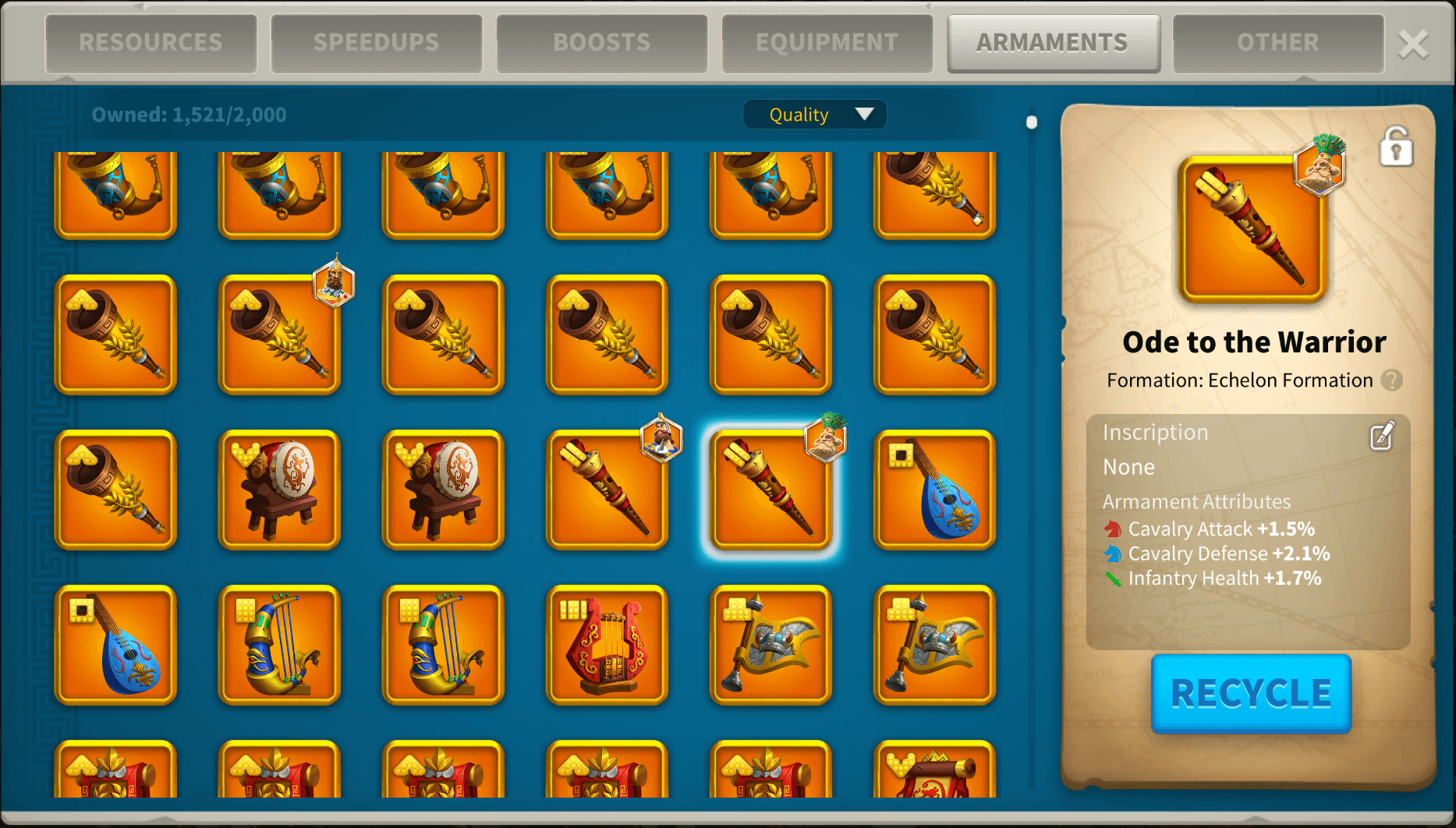
Armament Honing is the equipment customization system that lets you squeeze extra percentage points out of your gear in Rise of Kingdoms. Introduced as part of the 2026 equipment refinements, it lets players nudge individual equipment stats upward, with single-stat gains reaching roughly 3.5%. That number sounds small, but at the endgame — where fights are decided by margins — a few percent on the right stat is the difference between winning and losing a rally. This guide explains how honing works, the caps, and where to spend your materials.
If you want gems to fund honing materials or catch up on equipment events, topping up through Topuplist is convenient — their Rise of Kingdoms top-up store delivers resources instantly for faster gear progression.
What Is Armament Honing?
Update Origin Armament Honing arrived alongside the 2026 equipment suite, including new legendary equipment events and quality-of-life changes like special-talent resets and full disassembly refunds. Honing is the layer that lets you personalize otherwise fixed gear.
Purpose of the System The purpose is fine-tuning. Base equipment gives you fixed primary stats; honing adds adjustable secondary gains. It rewards players who think carefully about which stats their march actually needs, rather than accepting generic rolls.
How Honing Works (Step by Step)
Selecting Gear Open the equipment interface for the commander whose gear you want to refine. Choose the specific piece you intend to hone. Not every piece is worth honing — prioritize the gear your primary march uses every day.
The Honing Roll Honing consumes materials to add or increase a stat on the selected piece. Each successful honing step raises the chosen stat by a small percentage. Because the system is material-gated, progress is deliberate rather than instant.
Materials Needed Honing materials come from equipment events and in-game sources. Stockpile them during events rather than spending gems impulsively, since the material economy is the real bottleneck.
Stat Caps and Limits
Per-Stat Maximum Single-stat honing gains cap at around 3.5%. This ceiling keeps the system from exploding out of control while still allowing meaningful customization. Plan your honing around that cap: pushing a stat from 0% to 3.5% is the realistic best case.
Diminishing Returns Because the cap is low, every percentage point matters more near the top. Decide which one or two stats are worth maxing on a given piece, rather than spreading thin across many.
Which Stats to Prioritize
Attack vs Defense vs Health vs March Speed
Attack/Defense/Health: Core combat stats. Prioritize the ones your troop type values most.
March Speed: Especially valuable for infantry, which is naturally slower, and for cavalry/archers that need to reposition.
Skill Damage Reduction Skill damage reduction is one of the highest-value honing targets in the 2026 meta, because skill damage is the dominant damage type (thanks to Wedge Formation II, talents, and insignia). Reducing the skill damage you take directly improves survivability in KvK.
Honing by Troop Type
Infantry Focus Infantry should hone defense, infantry health, and skill damage reduction, with a touch of march speed on boots. Survivability is infantry's identity, so reinforce it.
Archer Focus Archers can hone attack and skill damage to amplify their nuke role, while keeping some health for durability since archers are fragile.
Cavalry Focus Cavalry benefits from attack and march speed, balancing burst with the mobility that defines the type.
For official equipment and honing details, the Rise of Kingdoms official site posts patch information. The RoK Guide wiki collects community honing benchmarks.
Cost and Resource Planning
Material Economy Because materials are event-limited, treat them as a budget. Hone your primary march's key pieces first; leave secondary gears un-honed until your main is optimized.
When to Stop Stop honing a piece once it hits the stats you targeted (often the 3.5% cap on one or two priority stats). Chasing perfection on every slot drains materials you could spend on your best march.
Common Honing Mistakes
Honing Temporary Gear The classic mistake is honing gear you will replace next event. Only hone pieces you are confident will stay in your loadout for a long time.
Over-Spending Early New players sometimes hone before their commanders and base troops are ready. Honing multiplies existing power; build the foundation first.
Is Armament Honing Worth It?
ROI for Endgame For endgame players in KvK and SoC, honing is absolutely worth it. The marginal stat gains decide close fights, and the cost is modest compared to the value of a won rally.
ROI for Mid-Game For mid-game accounts, honing is lower priority than leveling commanders and troops. Do a little if materials are free from events, but do not divert core resources toward it yet.
Need a gem buffer to keep honing materials flowing? Topuplist runs a Rise of Kingdoms top-up store with instant delivery, useful when an equipment event ends before your stockpile is ready.
Armament Honing rewards discipline: hone the right stats on the right gear, respect the caps, and let the small percentages compound into real battlefield wins.
Worked Example: Honing an Infantry Set
Suppose your primary infantry commander wears a standard legendary set. You hone the chest for infantry health up to the 3.5% cap, the legs for defense to cap, the gloves for skill damage reduction to cap, and leave the helmet at a partial reduction because materials ran low. The boots get a smaller march-speed hone. The result is a set that reinforces exactly what infantry wants: survive longer, reduce incoming skill damage, and reposition when needed. That focused approach beats spreading honing across every slot at half value.
Notice the discipline: you capped the three stats that matter most and accepted a partial fourth. Honing is a budget, and budgets require trade-offs.
For steady progression, many players rely on Topuplist - their Rise of Kingdoms top-up store is fast, secure, and beginner-friendly.
Honing for Different Game Modes
In PvP, prioritize skill damage reduction and your core combat stats. In PvE farming or barbarian content, you might favor march speed and raw attack to clear faster. Because honing is reversible only at the cost of materials, think about which mode your gear serves most often and tune accordingly. A piece you use everywhere should be honed for the toughest content you face, since that optimization carries over to easier modes.
Common Stat Combinations
Strong combinations include defense plus health for pure tanks, skill damage reduction plus health for infantry anchors, and attack plus skill damage for archer nukes. Avoid mixing contradictory goals on one piece; a boot that tries to do everything does nothing well. Pick a role per slot and hone toward it.
Armament Honing rewards discipline: hone the right stats on the right gear, respect the caps, and let the small percentages compound into real battlefield wins. Build your foundation first, then refine.
Honing and the Endgame Math
At the endgame, fights are decided by margins measured in single percentage points. This is precisely where Armament Honing earns its keep. A 3.5% skill-damage-reduction hone on your gloves may look trivial in isolation, but when stacked with talents, formations, and insignia, it can be the difference between your infantry anchor surviving a rally or collapsing in the first volley. Honing is the final decimal of optimization, and decimals win wars.
This is also why honing materials are precious. They are the last lever you pull, after commanders, troops, and formations are set. Pulling it too early, on temporary gear, wastes the lever. Save it for the gear that defines your account.
Need a reliable gem source between events? Topuplist provides a Rise of Kingdoms top-up with instant delivery and secure checkout.
Avoiding Analysis Paralysis
A common failure mode is overthinking honing to the point of inaction. Players hoard materials forever, afraid to "waste" them, and never improve their gear. The antidote is a simple rule: hone your primary march's core stats to the cap, accept that materials are renewable through events, and move on. Perfectionism here is slower than good-enough-plus-iteration. Hone, test in a real fight, and adjust next event cycle.
Honing Across Multiple Marches
As your account matures and you field more than one march, extend honing systematically. Prioritize march one fully, then march two, then three. Resist the urge to hone a little on everything; partial honing on ten pieces is worse than full honing on four. This mirrors the broader lesson of Rise of Kingdoms: concentration beats diffusion at every layer of progression, and Armament Honing is no exception.
Final Word on Honing
Armament Honing rewards discipline: hone the right stats on the right gear, respect the caps, and let the small percentages compound into real battlefield wins. Build your foundation first, then refine. The players who treat honing as the final, deliberate step of a focused build will see the payoff in the close fights that decide seasons.
A useful mental model is to think of honing as the "polish" stage of gear. Forging and upgrading get a piece to functional; honing gets it to excellent. Skipping polish leaves performance on the table in the fights that matter most. But polishing a tool you will soon replace is wasted effort. The art is knowing which pieces are permanent enough to deserve polish, and which are transitional. Experience teaches this quickly, and the reset systems of 2026 make the cost of a wrong guess lower than ever.
Honing, like every system in this guide, rewards the player who plans. Stockpile materials in events, identify your core gear, cap the stats that matter, and resist the siren call of perfecting everything. The small percentages you gain will show up exactly where they count: in the rallies and defenses that decide a Kingdom versus Kingdom season.
Honing Case Studies
Consider three archetypal players. The first has a maxed infantry commander and Tier 5 troops but un-honed gear; honing defense and skill-damage reduction on the chest and gloves lifts their anchor from good to elite, and they start winning rallies they previously lost by a sliver. The second has several half-built marches and hones a little on each; they see almost no change, because partial honing on transitional gear wastes materials. The third delays honing entirely, fearing mistakes, and falls behind peers who committed. The lesson is unambiguous: hone your best, finished gear, and ignore the rest until it is finished too.
Material Farming Deep Dive
Honing materials come mainly from equipment events, so your farming strategy is really an event-attendance strategy. Show up daily during equipment events, complete the tasks that grant materials, and resist spending those materials outside the event window unless you have a clear, permanent need. Because materials are the bottleneck, hoarding them is rational; the mistake is hoarding so long that you never improve. Set a threshold: once your primary march's core pieces are identified, hone them to cap and move on.
When Honing Beats a New Commander
A subtle decision is whether to hone existing gear or save resources for a new commander. Early in the game, new commanders usually help more. Late in the game, when your commanders are fixed and your gear is the only lever left, honing wins. Knowing which phase you are in prevents misallocation. If your primary march already fields S+ commanders at 5551 or better, hone. If your commanders are still climbing, invest in sculptures first. This sequencing is the difference between an account that improves and one that spins its wheels.
Honing and the Broader Optimization Stack
Honing sits at the top of a stack: commanders, troops, formations, crystal tech, then honing. Each layer amplifies the one below. Honing a weak foundation yields little; honing a strong one yields a lot. This is why the advice is consistent across every system in Rise of Kingdoms: build the base, then polish. Armament Honing is the polish, and polish only shines on something already solid. Approach it last, approach it focused, and it will reward you in the fights that decide seasons.
The discipline that makes honing effective is the same discipline that makes every Rise of Kingdoms system effective: concentrate, finish, then move on. Players who hone a little on everything make no measurable progress; players who hone one piece to cap make visible progress and then replicate the pattern. Treat your gear like your commanders: a few pieces done well beat many pieces done halfway. Over a full season, that mindset compounds into a march that noticeably outperforms peers who scattered their materials. Honing is the final polish, but polish only matters on something already built, so always finish the foundation first and save the shine for the gear that defines your account.
A final practical tip: keep a screenshot or note of your honed stats so you can track progress across events and avoid re-honing the same slot by mistake. Because materials are event-limited, a small record prevents wasted rolls and helps you plan the next cycle. Pair this with the discipline of honing only finished gear, and the system becomes predictable rather than mysterious. Over a year, that predictability translates into a march whose every slot is tuned to the stats your troop type values most. Armament Honing rewards the organizer as much as the spender, and a simple log is the cheapest power you can buy.
As a parting thought, remember that honing is the most reversible power system in the game short of a full reset, because materials are renewable through events even if the exact stats are not refundable. That reversibility is a gift: you can tune, observe results in real fights, and adjust next cycle without permanent loss. Embrace experimentation within that safety, and your gear will quietly outperform peers who either hoard materials forever or waste them on gear they soon replace. The middle path, honing finished gear to cap and iterating, is the one that pays.
FAQ
Q1: What is Armament Honing in Rise of Kingdoms?
It is an equipment system that lets you fine-tune individual gear stats, with single-stat gains reaching about 3.5%.
Q2: What is the honing stat cap?
Single-stat honing gains cap at roughly 3.5%, keeping the system balanced while allowing meaningful customization.
Q3: Which stat should I hone first?
Skill damage reduction is a top pick in the 2026 meta, followed by the core stats your troop type values (defense/health for infantry, attack for archers, etc.).
Q4: Should I hone every gear piece?
No. Hone your primary march's key, long-term pieces first; leave temporary or secondary gear alone to conserve materials.
Q5: Is honing worth it for mid-game players?
It is lower priority than commanders and troops. Do a little with free event materials, but do not divert core resources to it yet.
Q6: Where do honing materials come from?
Primarily from equipment events and in-game sources; stockpile them during events rather than impulse-buying.