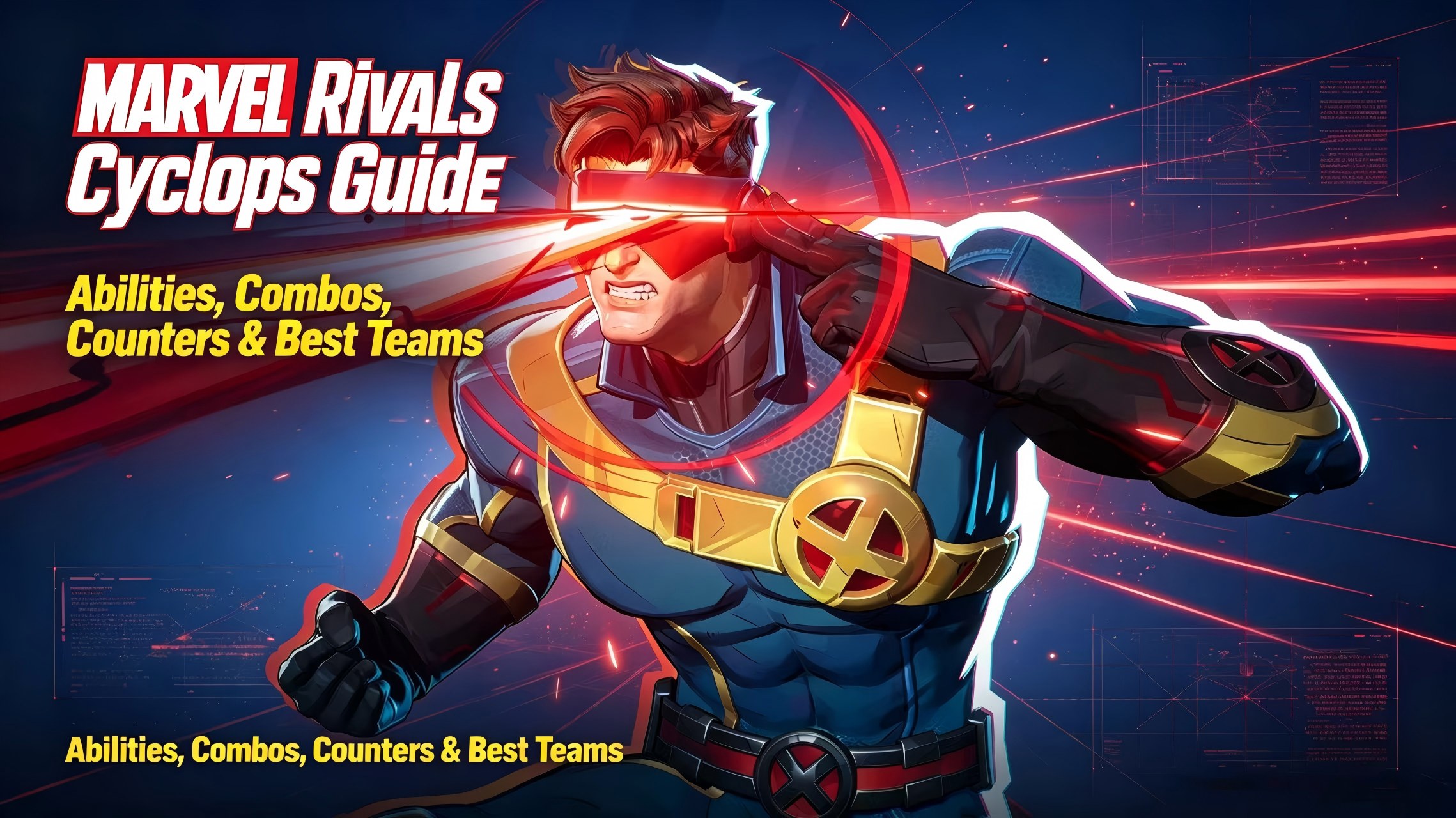
Marvel Rivals Cyclops Guide: Abilities, Combos, Counters & Best Teams
Top Up Marvel Rivals Lattice on Topuplist
Want to unlock Marvel Rivals costumes, Battle Pass rewards, sprays, and other premium content? Visit the Topuplist Marvel Rivals Top-Up page to select a Lattice package and complete your purchase using your Marvel Rivals User ID.
Always double-check your UID before paying. Package prices, discounts, payment methods, and availability may vary by region.
Cyclops joined Marvel Rivals as a Duelist with the Season 8.5 update on June 12, 2026. Unlike close-range brawlers, Scott Summers is built around controlled mid-range pressure, accurate optic attacks, environmental ricochets, and smart repositioning.
His kit looks straightforward, but consistently carrying games with Cyclops requires more than holding down an attack button. You must know when to switch between Optic Blast and Concussive Beam, where to bounce Ricochet Force, and when to preserve Propulsion Burst against enemy divers.
This Marvel Rivals Cyclops guide covers all of his abilities, best combos, strongest teammates, major counters, positioning strategies, and Ruby Rage tips.
The guide reflects the official July 2, 2026 patch. That update fixed abnormal Ricochet Force cooldown timers and UI display errors without announcing a Cyclops damage adjustment. You can check the official Version 20260702 patch notes for the complete update.
Cyclops Quick Overview
Cyclops is strongest when operating behind his Vanguards instead of leading the engagement. His ideal position gives him a clear sightline, nearby cover, access to high ground, and a safe route back to his Strategists.
Is Cyclops Good in Marvel Rivals?
Cyclops is a strong Duelist for players who can maintain accurate pressure while managing their distance from the enemy frontline.
His Optic Blast punishes exposed targets, while Concussive Beam and Ricochet Force become increasingly dangerous when enemies gather around objectives, barriers, doorways, or narrow corridors. He also has two repositioning tools, giving him more survivability than a completely stationary ranged attacker.
However, neither mobility ability makes Cyclops invulnerable. Once both are unavailable, heroes such as Spider-Man, Hulk, Iron Fist, Captain America, and Angela can quickly overwhelm him.
Cyclops’ Biggest Strengths
Cyclops offers several advantages:
Reliable mid-range damage against exposed enemies
Strong pressure against grouped teams
Environmental ricochets that threaten enemies behind cover
Easy access to high ground
Two abilities that create distance from melee attackers
An ultimate that destroys barriers
Strong synergy with crowd-control and displacement effects
A Wolverine Team-Up that strengthens frontline pressure
Cyclops’ Biggest Weaknesses
His main limitations are:
Only 275 base health
Limited durability during sustained close-range combat
High dependence on safe positioning
Long vulnerability window after using mobility abilities
Ruby Rage is easier to avoid without allied crowd control
Ricochet attacks lose value in open areas without useful terrain
Aggressive chasing can separate him from healing and protection
Cyclops is therefore powerful but punishable. He performs best when the player treats positioning and cooldown management as seriously as aim.
All Cyclops Abilities Explained
The official Cyclops hero page lists Optic Blast, Concussive Beam, Propulsion Burst, Ricochet Force, Optic Ascent, Kinetic Hover, Ruby Rage, and his Wolverine Team-Up as the core parts of his kit. See the official Marvel Rivals Cyclops page for the current in-game descriptions.
Optic Blast
Optic Blast is Cyclops’ primary precision attack and should be your default choice against isolated enemies.
Use it when:
An enemy Strategist is exposed
A Duelist has already used a mobility ability
You have a clean angle on a single target
Enemies are too spread out for Concussive Beam
You need to accelerate Ricochet Force charging
Do not automatically switch to Concussive Beam simply because multiple enemies are visible. Optic Blast remains more reliable when you need immediate pressure on one priority target.
A common mistake is shooting only the enemy Vanguard. Tanks are easy to hit, but Cyclops becomes much more dangerous when he uses his accuracy to pressure vulnerable backline targets.
Concussive Beam
Concussive Beam continuously damages enemies and can refract between targets and nearby terrain.
It is most effective around:
Narrow corridors
Objective rooms
Doorways
Corners
Payload paths
Teams grouped behind a Vanguard
Enemies standing near barriers or walls
The first target does not always need to be your intended kill target. You can attack a nearby Vanguard or surface and use the refraction to reach enemies positioned behind them.
Avoid relying on Concussive Beam in open spaces where enemies can spread out and break its chaining opportunities.
Propulsion Burst
Propulsion Burst pushes Cyclops and the affected enemy away from each other while slowing the target.
This is primarily a defensive ability. When Spider-Man, Hulk, Iron Fist, Wolverine, or another melee threat reaches you, Propulsion Burst creates enough separation to retreat toward your team.
The ability should rarely be used to begin an aggressive chase. If you spend it moving forward, an enemy diver can punish you while it is unavailable.
After using Propulsion Burst:
Move toward cover.
Reconnect with your Strategists.
Avoid standing in an open sightline.
Track the diver’s next mobility ability.
Use Optic Ascent if the enemy immediately re-engages.
Ricochet Force
Ricochet Force becomes especially valuable near walls, floors, door frames, and other surfaces.
After striking terrain, the beam can diffract and track nearby enemies. Cyclops also gains Bonus Health when activating it, which gives the ability both offensive and defensive value.
Use Ricochet Force to:
Finish enemies retreating behind cover
Pressure multiple targets around an objective
Gain Bonus Health during a dangerous exchange
Force enemies out of narrow positions
Attack around corners without fully exposing yourself
Follow up after Optic Blast or Concussive Beam pressure
The July 2 patch fixed an issue that could cause abnormal Ricochet Force cooldown timers or incorrect UI information.
Optic Ascent
Optic Ascent fires a propulsion beam downward, launching Cyclops into the air while knocking back and slowing enemies caught underneath him.
Its most important uses are:
Reaching high ground before a fight
Escaping a melee attacker
Changing your angle over a barrier
Crossing vertical terrain
Creating space without spending Propulsion Burst
Use Optic Ascent before the engagement whenever possible. Starting from high ground means the ability may be available again by the time an enemy reaches you.
The June 25 patch corrected an issue that caused Optic Ascent’s horizontal displacement to vary with client frame rate.
Kinetic Hover
Kinetic Hover activates when Cyclops fires Concussive Beam while airborne, placing him into a slow-fall state.
This passive can extend your sightline after Optic Ascent, but hovering too long makes your movement predictable. Use it briefly to see over cover, finish an enemy, or reach another platform.
Do not remain suspended over the enemy team without protection. Long aerial exposure makes Cyclops an easy target for ranged Duelists.
Ruby Rage
Ruby Rage removes Cyclops’ visor and releases a large sweeping beam. The attack destroys barriers in its path and leaves volatile energy that erupts for additional damage.
The secondary explosion is a major part of Ruby Rage. Enemies who survive the initial sweep may still be eliminated if they remain inside the affected area.
Ruby Rage is strongest when:
Enemies are trapped in a narrow area
A teammate has applied crowd control
Enemy movement abilities are unavailable
The opposing team is hiding behind barriers
Multiple enemies are contesting an objective
Cyclops can attack from high ground or a side angle
The June 18 update fixed an issue where the secondary ground explosion could fail to damage enemies behind barriers on uneven terrain.
Blast Slash Team-Up With Wolverine
Cyclops supercharges Wolverine’s claws, extending Wolverine’s effective attack range and improving his ability to stay on targets.
This Team-Up is useful because the two heroes cover different combat zones:
Wolverine pressures the frontline and disrupts enemy formations.
Cyclops attacks from mid-range.
Enemies reacting to Wolverine may group together or expose their backline.
Cyclops can punish those formations with Concussive Beam, Ricochet Force, or Ruby Rage.
Do not follow Wolverine too deeply into the enemy team. Your job is to support his pressure from a safer angle, not copy his engage.
How to Play Cyclops in Marvel Rivals
Cyclops’ basic gameplay loop is:
Establish a safe mid-range angle.
Use Optic Blast against isolated targets.
Switch to Concussive Beam when enemies group together.
Build and use Ricochet Force around terrain.
Use Optic Ascent to maintain high ground.
Preserve Propulsion Burst for enemy dives.
Wait for crowd control or spent mobility before using Ruby Rage.
Position Behind Your Vanguard
Cyclops should normally play one layer behind his frontline. This gives him enough distance to avoid direct brawls while remaining close enough to receive healing and protection.
Avoid standing directly beside your Strategists. Doing so allows one diver or area attack to pressure the entire backline simultaneously.
Instead, create a small triangle between yourself, your frontline, and your healers.
Use High Ground Whenever Possible
High ground gives Cyclops:
Better sightlines on enemy Strategists
More cover from the edge of platforms
Additional protection from melee heroes
Better Ruby Rage angles
More options for Optic Ascent and Kinetic Hover
Before each engagement, identify the next high-ground position and your escape route from it.
Choose the Correct Attack
Use Optic Blast when the enemy is isolated or when immediate single-target pressure matters.
Use Concussive Beam when enemies are grouped, standing near terrain, or defending a narrow objective.
Use Ricochet Force when you can bounce it from terrain, need Bonus Health, or want to finish someone escaping behind cover.
Preserve at Least One Escape
Cyclops has strong repositioning only while his cooldowns remain available.
Using Optic Ascent and Propulsion Burst together may save you once, but it also creates a window where you have no answer to the next engage.
Unless death is otherwise guaranteed, stagger the two abilities:
Optic Ascent for vertical repositioning
Propulsion Burst for emergency self-peel
Best Cyclops Combos
Cyclops is not built around one fixed mechanical combo. His sequences change based on enemy positioning, terrain, and available cooldowns.
Basic Single-Target Combo
Optic Blast → Optic Blast → Ricochet Force
Start with accurate Optic Blast pressure. Once the enemy retreats toward cover, bounce Ricochet Force from nearby terrain to track them.
This is safer than chasing around the corner and exposing yourself to the enemy team.
High-Ground Pressure Combo
Optic Ascent → Concussive Beam → Kinetic Hover → Ricochet Force
Use Optic Ascent to create a temporary aerial angle. Fire Concussive Beam while airborne to activate Kinetic Hover, then use Ricochet Force before dropping back into cover.
Keep the sequence brief. The goal is to gain an unexpected sightline, not remain in the air indefinitely.
Anti-Dive Combo
Propulsion Burst → retreat toward allies → Optic Ascent
Propulsion Burst creates initial horizontal distance. If the diver immediately closes the gap again, Optic Ascent provides vertical separation.
Do not automatically use both abilities at once. Wait to confirm that the enemy can continue chasing before spending Optic Ascent.
Ruby Rage Combo
Allied crowd control → Ruby Rage → Optic Blast or Ricochet Force
Ruby Rage is most reliable after a teammate restricts enemy movement. Once the initial beam and delayed explosion finish, immediately target surviving enemies with Optic Blast or Ricochet Force.
How to Use Ruby Rage Effectively
Ruby Rage can win a team fight, but using it directly into six mobile enemies usually wastes the ultimate.
Track Enemy Mobility
Before activating Ruby Rage, identify which enemies can escape with a dash, teleport, leap, flight ability, invulnerability effect, or rescue skill.
A strong timing window appears after those abilities have been used.
Attack From an Angle
Using Ruby Rage directly from your team’s frontline gives enemies a clear warning and obvious escape direction.
Better positions include:
High ground above the objective
A side lane
A corridor entrance
A corner near the enemy retreat route
An angle that forces enemies toward your teammates
Use It Against Barriers
Ruby Rage destroys barriers in its path, making it useful against teams relying on shields to hold a fixed position.
However, destroying a barrier is not automatically worth an ultimate. Aim to hit both the barrier and the players behind it.
Coordinate With Crowd Control
Ruby Rage works best with teammates who can stun, slow, trap, pull, knock down, or otherwise restrict enemy movement.
A short control effect may be enough to keep opponents inside both the initial sweep and delayed explosion.
Best Teammates and Counters for Cyclops
Best Cyclops Team Composition
A balanced Cyclops composition can use:
Vanguard: Doctor Strange
Vanguard: Emma Frost or Magneto
Duelist: Cyclops
Duelist: Wolverine
Strategist: Invisible Woman
Strategist: Gambit or Cloak & Dagger
This composition gives Cyclops:
Frontline protection
The Wolverine Team-Up
Crowd-control opportunities
Strong backline defense
Reliable healing
Space to use high ground and mid-range angles
Poke-Focused Cyclops Composition
A ranged pressure composition can use:
Magneto
Angela
Cyclops
Phoenix
Cloak & Dagger
Adam Warlock
Cyclops and Phoenix apply pressure from mid-range while the Vanguards protect their angles. The double-Strategist backline improves sustain, although the team must still react quickly to coordinated dives.
Crowd-Control Composition
Cyclops also performs well with heroes who can restrict movement before Ruby Rage.
The exact roster matters less than the composition’s ability to:
Hold enemies in one area
Block retreat routes
Protect Cyclops during his ultimate
Finish survivors after the delayed explosion
Best Cyclops Counters
The easiest way to counter Cyclops is to deny him comfortable space.
Long-range trades may allow him to continue charging Ricochet Force and applying pressure. Coordinated dive heroes are generally more effective because they force him to spend Propulsion Burst and Optic Ascent.
Spider-Man
Spider-Man can quickly reach Cyclops from unexpected vertical angles. Even after being pushed away, he may have enough mobility to re-engage before Cyclops reaches safety.
Against Spider-Man:
Stay near teammates with crowd control
Avoid isolated high ground
Preserve Propulsion Burst
Use Optic Ascent before Spider-Man completes his full engage
Do not chase low-health enemies while Spider-Man is missing
Hulk
Hulk can leap directly onto Cyclops and force an immediate defensive response.
Against Hulk:
Track Incredible Leap
Avoid standing far from your Strategists
Use Propulsion Burst only after Hulk commits
Move toward allied control rather than retreating alone
Save Optic Ascent for the second engage
Iron Fist
Iron Fist is dangerous because Cyclops has limited room for error in close-range combat.
Against Iron Fist:
Avoid firing predictably into defensive abilities
Use terrain to interrupt his approach
Push him away before your health becomes critical
Call for team focus instead of trying to win the duel alone
Captain America
Captain America can repeatedly pressure ranged heroes and block straightforward attacks.
Against Captain America:
Do not continuously attack his shield
Change vertical angles
Move around cover rather than retreating in a straight line
Force him to choose between chasing you and protecting his team
Angela
Angela can use shields and mobility to absorb Cyclops’ pressure and separate him from his team.
Against Angela:
Avoid positioning near ledges
Maintain crossfire with another Duelist
Do not stand too far from allied protection
Reposition before she begins a direct charge
How to Counter Cyclops as Any Role
As a Vanguard
Close the distance and force Cyclops to use Propulsion Burst. Once that cooldown is gone, coordinate a second engage before he can safely reset.
Avoid standing directly beside teammates near walls, since this improves his Concussive Beam and Ricochet Force value.
As a Duelist
Approach from a side or vertical route rather than challenging Cyclops in a predictable mid-range duel.
Track Optic Ascent and Propulsion Burst. Cyclops becomes significantly easier to eliminate when both are unavailable.
As a Strategist
Spread out enough to reduce ricochet value, but remain close enough to support teammates.
Preserve rescue, invulnerability, movement, or defensive abilities when Ruby Rage may be ready. Moving out of the initial path does not always guarantee safety because of the delayed explosion.
Best Maps and Positions for Cyclops
Cyclops performs best in areas containing:
Elevated platforms
Long but partially covered sightlines
Walls suitable for Ricochet Force
Narrow objective entrances
Predictable enemy approach routes
Multiple retreat paths
He struggles more in:
Tight rooms dominated by melee heroes
Areas with several flank routes
Open spaces with little ricochet terrain
Positions without access to allied healing
High ground with only one exit
Before every fight, identify three things:
Your primary firing angle
Your nearest cover
Your escape route
If one of those is missing, the position is probably unsafe.
Common Cyclops Mistakes
Using Propulsion Burst Aggressively
This removes your most reliable horizontal escape and gives divers a clear opportunity to attack.
Spending Both Mobility Abilities Together
Using Optic Ascent and Propulsion Burst at the same time leaves Cyclops vulnerable to the enemy’s next engage.
Using Concussive Beam Against Every Target
Concussive Beam is strongest against groups and terrain-based formations. Optic Blast is generally better when focusing an isolated opponent.
Firing Ricochet Force in Open Space
The ability becomes more reliable when you can deliberately strike terrain and activate its tracking behavior.
Using Ruby Rage Without Setup
Mobile enemies can escape a poorly timed ultimate. Wait for crowd control, restricted terrain, or spent movement cooldowns.
Hovering for Too Long
Kinetic Hover creates useful angles, but predictable aerial movement makes Cyclops easy to target.
Chasing Too Far
Cyclops is strongest when enemies must enter his effective range. Following a low-health target into the enemy backline often removes your protection and escape route.
Ignoring Dive Heroes
Before taking an aggressive angle, locate Spider-Man, Hulk, Iron Fist, Captain America, Angela, and other heroes capable of rapidly reaching you.
Cyclops Tips for Ranked Play
Use Optic Ascent to take high ground before the fight begins.
Preserve Propulsion Burst until an enemy commits to diving you.
Attack isolated targets with Optic Blast.
Switch to Concussive Beam when the enemy team groups around terrain.
Bounce Ricochet Force from nearby walls rather than firing randomly.
Use its Bonus Health before or during a dangerous trade.
Track enemy mobility before activating Ruby Rage.
Coordinate your ultimate with allied crowd control.
Return to your team immediately after escaping a dive.
Reposition after every major engagement instead of repeatedly using the same angle.
Marvel Rivals Cyclops FAQ
Is Cyclops a Duelist in Marvel Rivals?
Yes. Cyclops is a Duelist focused on mid-range damage, precision attacks, ricochet pressure, and tactical repositioning.
When Was Cyclops Released?
Cyclops officially joined Marvel Rivals on June 12, 2026, with the Season 8.5 update. The release was confirmed in the official Season 8.5 patch notes.
What Is the Best Cyclops Combo?
A reliable basic sequence is Optic Blast into Ricochet Force. Against grouped enemies, use Concussive Beam followed by Ricochet Force and finish survivors with Optic Blast.
What Is Cyclops’ Best Escape Ability?
Propulsion Burst is his primary horizontal escape and self-peel tool. Optic Ascent provides vertical separation and should normally be used separately rather than simultaneously.
Who Is the Best Counter to Cyclops?
Spider-Man, Hulk, Iron Fist, Captain America, and Angela are strong options because they can close the distance, force Cyclops to spend his mobility, and pressure his limited health pool.
Who Is the Best Teammate for Cyclops?
Wolverine is his direct Team-Up partner. Doctor Strange, Magneto, Emma Frost, Invisible Woman, and other heroes offering protection or crowd control are also strong partners.
How Does Cyclops’ Wolverine Team-Up Work?
Cyclops supercharges Wolverine’s claws, increasing Wolverine’s effective reach and improving his ability to engage and remain on nearby targets.
Does Ruby Rage Destroy Barriers?
Yes. Ruby Rage fires a sweeping beam that destroys barriers in its path and leaves volatile energy that later explodes.
Is Cyclops Good for Ranked Play?
Cyclops is a strong ranked choice when the player has accurate aim, understands high-ground positioning, and preserves mobility against dive heroes. He becomes less reliable when played too aggressively or without frontline protection.
Final Verdict
Cyclops is a flexible mid-range Duelist who rewards aim, positioning, terrain awareness, and patient cooldown management.
His attacks can pressure both isolated targets and grouped teams, while Optic Ascent and Propulsion Burst give him multiple ways to reposition. Ricochet Force makes cover less reliable for weakened enemies, and Ruby Rage can dismantle barrier-heavy formations when combined with crowd control.
The key to mastering Cyclops is discipline. Stay behind your frontline, choose the correct optic attack for each situation, preserve one escape ability, and avoid using Ruby Rage before the enemy has committed its defensive cooldowns.
Played correctly, Cyclops can control important sightlines, punish grouped opponents, and turn a well-timed optic assault into a decisive team-fight victory.