

Honor of Kings Token Packs: Bonus Tokens vs a Lower Price
A bigger bonus does not always make an Honor of Kings Token pack the better purchase. If two offers cost the same, more usable Tokens improve the unit price. If you only need enough Tokens for one planned purchase, however, a smaller final payment may be the better fit—even when its bonus is less impressive.
This guide covers Tokens for the global Honor of Kings game. It does not use prices or recharge rules from China’s separate game. The comparison is simple: work out what you receive, what you actually pay and how much of the balance you intend to use.
What Should Count as the Value of a Token Pack?
The official global website links to Midasbuy, whose Honor of Kings recharge page identifies the paid currency as Tokens. Keep the currency purchase separate from the item you want inside the game: buying a balance and spending it on an eligible offer are different steps.
For a pack advertised as base Tokens plus bonus Tokens, add those quantities only when the offer says both are credited and usable for your intended purchase. A coupon, a separate item or a reward to claim later should have its own line. Otherwise, the denominator in your price calculation becomes larger than the balance you can actually spend.
Use the final checkout charge as the cost, including any disclosed fees and tax. When comparing different currencies, convert the final amounts to the same currency. A headline discount and a crossed-out reference price are not enough to compare two differently sized packs.
 Honor of Kings

Calculate the Price per 100 Tokens
Divide the final price by the total Tokens usable for the target purchase, then multiply by 100. The result gives both offers the same measuring unit. Keep enough decimal places during calculation and round only the displayed result.
Cost per 100 Tokens = final payment ÷ usable Tokens × 100. The following prices and pack sizes are hypothetical arithmetic examples, not live Honor of Kings offers or Topuplist quotations.
Illustrative offer | Usable Tokens | Final payment | Cost per 100 Tokens |
|---|---|---|---|
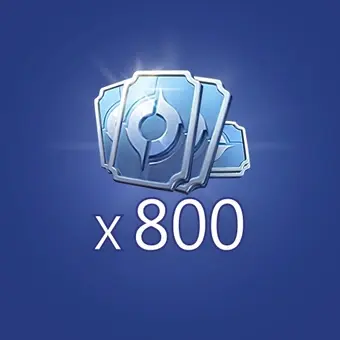
A: base pack | 1,000 | $10.00 | $1.00 |
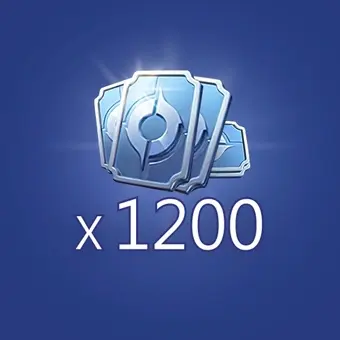
B: same price, extra Tokens | 1,000 + 200 = 1,200 | $10.00 | About $0.83 |
C: lower price, same base amount | 1,000 | $9.00 | $0.90 |
Offer B has the lowest unit cost in this example. Offer C has the lowest payment for someone who needs 1,000 Tokens. Both statements are true. Unit value answers how efficiently you buy currency; total payment answers how much cash leaves your budget today.
Why 20% More Tokens Is Not 20% Off
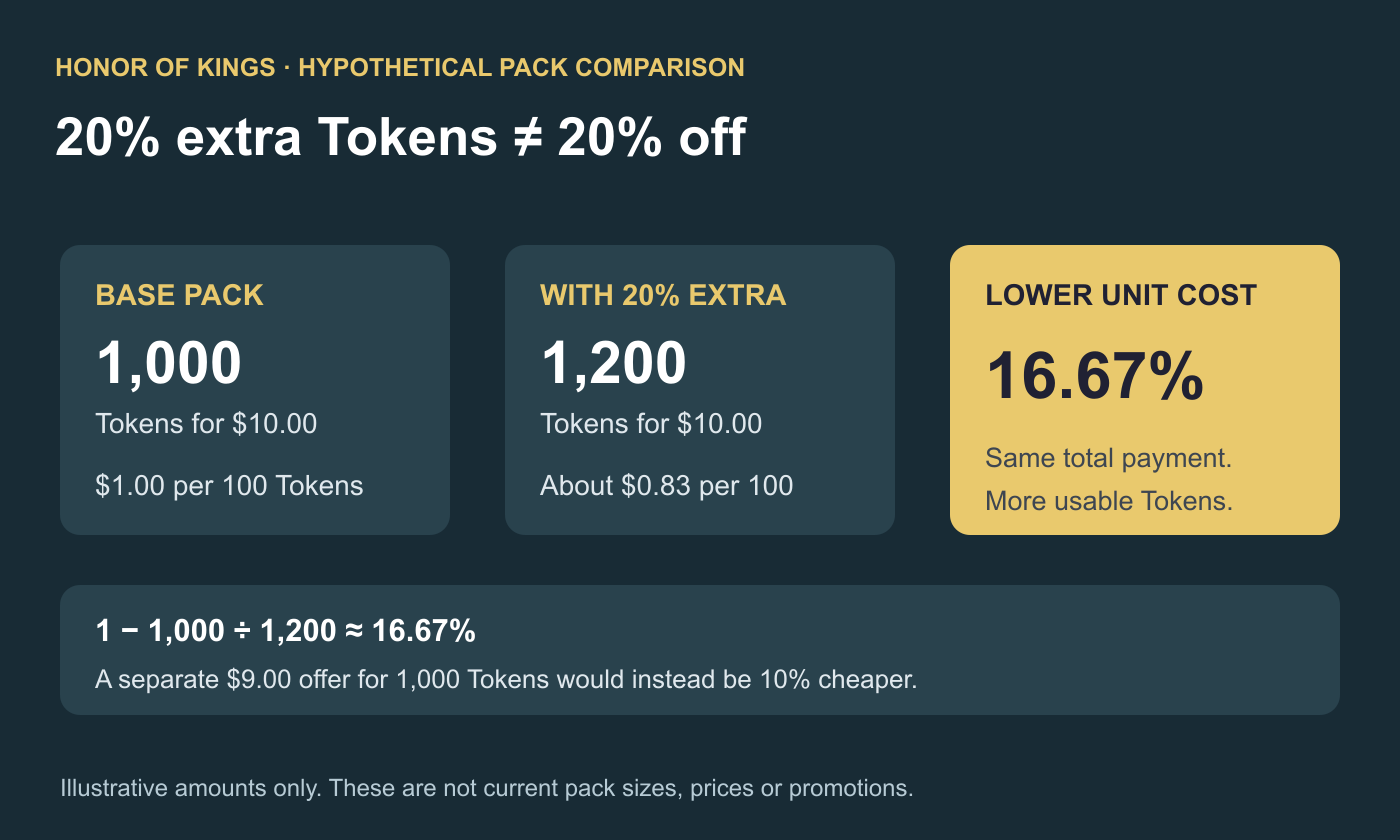
In the example, adding 200 to a base amount of 1,000 gives 20% more Tokens for the same $10.00 payment. But the price is spread across 1,200 instead of 1,000 Tokens. Relative to Offer A, the unit cost falls by about 16.67%, not 20%.
The calculation is 1 − 1,000 ÷ 1,200 = about 16.67%. By contrast, reducing the same 1,000-Token pack from $10.00 to $9.00 is a 10% reduction in both total payment and unit cost. A bonus changes the quantity; a price discount changes the payment.
A promotional percentage can still be useful, but first identify its reference. Does it compare with the base Token amount, a previous selling price or a different bundle? Recalculate from the actual quantity and charge rather than comparing two percentages that use different baselines.
Choose the Pack That Funds Your Planned Purchase
Start with the item’s current Token price and subtract the balance you can use for it. That gives the shortage. Then compare the available packs against that shortage before considering their unit prices. You are buying enough currency to complete a task, not trying to maximize an unused balance.
Using the hypothetical offers above, someone with no balance who needs 1,000 Tokens could pay $9.00 with C, or pay $10.00 with B and retain 200 Tokens after the purchase. B costs an extra $1.00 today. Its lower unit price matters more when those remaining Tokens are useful for another purchase you genuinely intend to make.
The outcome changes if the target requires 1,200 Tokens. B covers it with one $10.00 purchase; one C pack does not cover it. If these were the only pack choices, buying C twice would cost $18.00 and leave 800 Tokens after that purchase. Real stores may offer other pack sizes, so compare combinations before treating the smallest pack as the cheapest solution.
The global game’s license agreement says virtual currency has no cash redemption value and is generally non-transferable, subject to expressly permitted game functions. An unused Token balance should therefore be valued for its planned in-game use, not treated as money you can freely withdraw or pass to another account.
From Comparing Packs to Completing the Recharge
Choose the global game and supported purchase region. Use a route intended for your Honor of Kings account. A country selector is part of service availability, not a reason to enter a false billing location.
Identify the receiving account. Use the account identifier required by that checkout and confirm any displayed player information before paying.
Read the selected offer. Record base Tokens, any qualifying bonus, its conditions and the final payment. Count later-claim rewards separately.
Complete payment and confirm credit. Retain the order reference and check the receiving game account before spending the balance.
When comparing Topuplist’s Honor of Kings Token options with another route, use the same quantity-and-payment method. Compare the offer available for your account rather than copying a bonus from another seller or region. Recharge credit also does not automatically purchase the skin or other item you selected inside the game.
Questions About Token Pack Value
Is the largest Token pack always the cheapest choice?
It can have a lower unit cost while still requiring a larger payment than your goal needs. Compare both cost per usable Token and the lowest payment that covers the purchase.
Can I assume the same bonus applies to every recharge channel?
No. Include a bonus only when the selected offer explicitly grants it under conditions your account meets. The useful comparison is the credited, usable amount against your own final payment.