

Free Fire Flame Grenades: Teammates Take Armor Damage Too
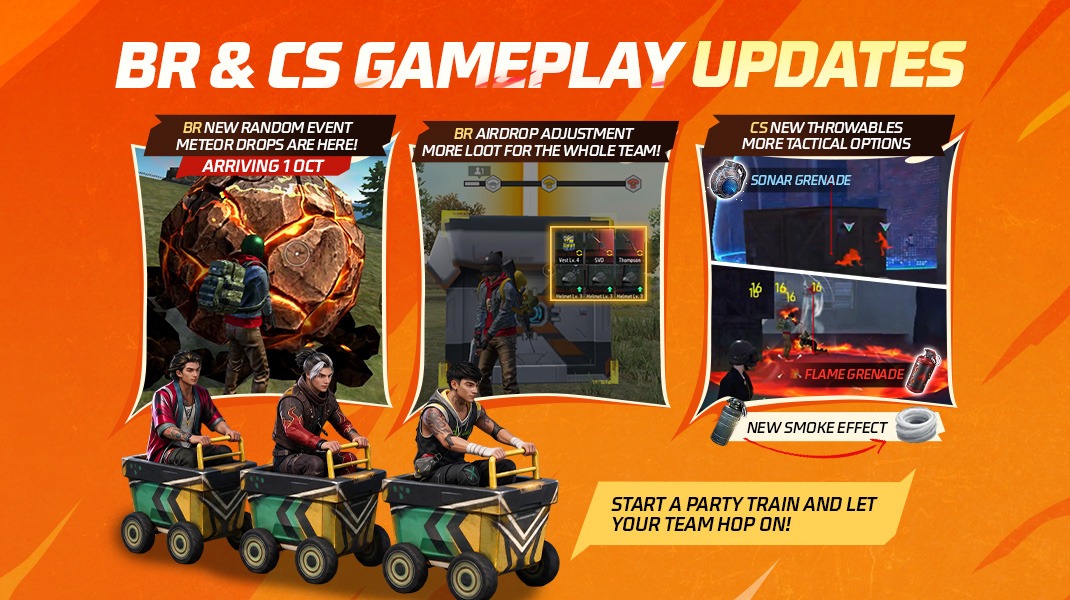
A Flame Grenade can ruin your own team’s push in Free Fire. In Clash Squad, its fire damages allied players caught inside: their listed damage per tick is lower than an enemy’s, but the armor-durability damage is the same. Throwing fire across the doorway your teammate is about to enter is therefore a real cost, even when no opponent is standing in it.
The OB55 throwable changes give you three different tools: fire for damage and area pressure, sonar for information, and smoke for obscuring sightlines. Choosing between them starts with the problem you need to solve. A position you want to deny is different from a doorway you need your whole squad to cross.
Free Fire Flame Grenade damage: enemies, allies and Gloo Walls
Garena’s OB55 patch notes describe a burning area that lasts six seconds and expands over one second. Damage is applied every half-second while a player remains inside. The important comparison is the damage per interval, rather than an assumed full-duration total that ignores when someone enters or leaves the fire.
Target in the flames | Damage every 0.5 seconds | Armor-durability damage every 0.5 seconds |
|---|---|---|
Enemy player | 16 | 10% |
Allied player | 8 | 10% |
Gloo Wall | 100 | Not applicable |
An ally’s listed damage per tick is half an enemy’s, but there is no equivalent halving of the armor-durability percentage in the patch table. A teammate can survive the crossing and still enter the next gunfight in worse condition. That makes friendly fire worth considering before the throw, not only after someone complains about lost health.
 Free Fire



A good denial grenade can be a bad entry grenade
Use fire where you want opponents to stop moving or abandon cover. A narrow approach, a position behind a Gloo Wall, or a route an enemy must use can make the burning area relevant. These are tactical applications of the damage rules, not a guarantee that a throw wins the fight. The opponent may simply choose another route.
The same area becomes inconvenient when your teammate is already committed to entering it. Before throwing, decide whether the squad is holding the outside or moving through. If the plan is to breach immediately, placing fire directly on the entry can force allies to wait, accept damage or abandon the push. A short callout can prevent a throwable from working against the team’s timing.
Do not mistake damage to a Gloo Wall for an instant wall-removal effect. The official value is 100 damage every half-second. Whether a particular wall disappears before an opponent reacts depends on its remaining condition and the situation. Watch the wall itself and the opening it creates instead of assuming the path is clear as soon as the grenade lands.
Sonar and smoke solve different parts of the push
The Sonar Grenade scans enemies within a ten-meter radius and reveals their locations for three seconds. Garena specifically describes it as a way to locate opponents behind cover and create attacking opportunities. If the immediate problem is uncertainty—someone may be holding the corner, but you do not know where—information can be more useful than placing damage on a guessed position.
That reveal is a short window. Communicate the position while it is useful and remember that an opponent can move after being detected. A location seen during the scan should not become a permanent assumption about where the enemy will remain. Sonar helps you make a better decision; it does not remove the need to clear the next angle.
OB55 also changes the Smoke Grenade’s effect to match the Smoke Vortex available in the Tactical Market. It belongs in the sightline-control part of your plan. Smoke does not provide the Sonar Grenade’s stated scan, and the patch does not give it the Flame Grenade’s damage profile. Choose it when controlling visibility is the task rather than treating all three throwables as interchangeable.
Build the round around the utility, not the cosmetic
For a squad preparing to enter a defended area, the practical questions are simple: do you know the defender’s location, do you need to block a sightline, and will your own route cross the fire? Answering those questions separates a useful sonar, smoke or flame throw from an automatic purchase that never fits the round.
If you also have purchases planned outside the match, you can review the Free Fire top-up options. Keep that Diamond budget separate from the tactical question of which throwable fits the round.
The clearest reason to hold a Flame Grenade is sometimes your teammate’s position. If they are already crossing the doorway, wait for a better target area. Saving the throw can preserve both their armor and the momentum of the push.