

Free Fire FFWS SEA Fall 2026: Schedule and Format Guide
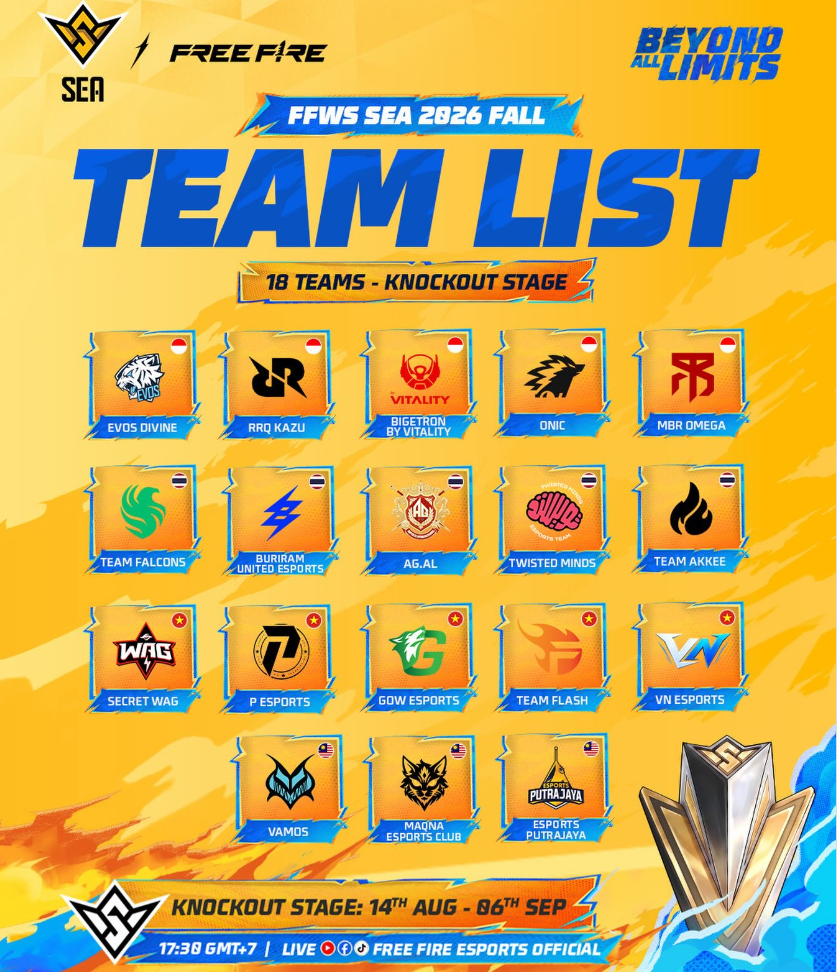
Free Fire World Series Southeast Asia 2026 Fall runs from August 14 to September 20 with 18 teams competing through a Knockout Stage and a 12-team Grand Final. The top eight teams qualify for the 2026 Global Finals. This guide explains the confirmed dates, weekly advancement structure, Points Rush, Champion Rush, scoring priorities, broadcast preparation, and the best match days for viewers who cannot follow every game.
Free Fire World Series Southeast Asia 2026 Fall begins on August 14 and continues through September 20, bringing together 18 teams for one of the region's most important qualification events. Players returning to Free Fire during the tournament can prepare account purchases through Topuplist and the dedicated Free Fire top-up page, while viewers should first understand the unusual progression system because not every week carries the same elimination risk.
The season has two major sections: a Knockout Stage from August 14 to September 6 and a 12-team Grand Final on September 19 and 20. Eight teams are expected to earn places at the 2026 Free Fire World Series Global Finals, making late Knockout weekends and the final especially important.
Confirmed FFWS SEA Fall 2026 Dates
The regional Fall season is scheduled for August 14 through September 20, 2026. Eighteen teams enter the competition, including returning regional participants and national qualifier champions from key Southeast Asian markets.
The Knockout Stage runs across multiple weekends rather than one continuous block. It is followed by a break before the two-day Grand Final. That gap gives finalists time to prepare while viewers can review standings and choose teams to follow.
Stage | Dates | Main Purpose |
|---|---|---|
Knockout Stage | August 14-September 6, 2026 | Reduce 18 teams to 12 finalists |
Points Rush | September 19, 2026 | Award Champion Rush headstart points |
Champion Rush Final | September 20, 2026 | Decide the regional champion |
Global qualification | Based on final placement | Top eight advance to the 2026 Global Finals |
Broadcast start times, language channels, and team rosters can be updated closer to each match day. Viewers should confirm the official Free Fire Esports announcement for their region before the stream begins.
How the 18-Team Knockout Stage Works
The Knockout Stage is designed to reward consistency while gradually changing the pressure on different team pools. The field includes 14 teams connected to the previous regional season and four national Fall qualifier champions from Vietnam, Thailand, Indonesia, and Malaysia.
The opening period creates ranking and pool positions for later weekends. As the stage develops, certain teams receive direct opportunities to qualify for the Grand Final, while the remaining teams continue into another match day or the final Knockout weekend.
The crucial viewer lesson is that a team can have a poor individual map without being immediately eliminated. Qualification depends on the full scheduled set and the specific advancement rule for that day. Conversely, one excellent Booyah does not guarantee safety if the team lacks elimination points and consistency across the remaining matches.
By the final Knockout weekend from September 4 to 6, the pressure becomes straightforward. Twelve remaining teams play 18 matches across three days. The top six advance to the Grand Final, while the bottom six are eliminated. Earlier routes supply the other six finalists, creating a total field of 12.
The Most Important Knockout Dates
Viewers who cannot watch every weekend should prioritize August 28 to 30 and September 4 to 6. The late-August match days provide direct Grand Final opportunities, while the first September weekend determines the final six places.
On August 28, the relevant teams compete for two direct final positions. A similar process continues on August 29. On August 30, the remaining field is joined by the next pool, and another two teams advance directly.
The teams that do not secure those six early places move into the final Knockout weekend with the last pool. At that point, there is no later recovery stage. Performance across the 18 matches decides which six complete the Grand Final lineup.
For casual viewers, this structure creates a natural entry point. Watching the last Knockout weekend provides the clearest elimination story without requiring detailed knowledge of every opening match.
Free Fire Scoring Explained
FFWS rewards both placement and eliminations. A Booyah earns the highest placement score, but aggressive teams can remain competitive by collecting elimination points even when they do not survive to the final circle.
The published placement scale awards 12 points for first, 9 for second, then decreases through the remaining positions. Each elimination adds one point. This means a team finishing outside the top three can still produce a strong map if it secures many eliminations.
Viewers should track total points, not only wins. A team with multiple Booyahs but several early exits may rank below a team that repeatedly reaches late circles and collects steady eliminations. Tournament broadcasts normally display placement and elimination contributions separately, which helps explain sudden movement in the standings.
Ties are resolved through ordered criteria, beginning with total Booyahs, followed by total elimination points and then the best placement in the most recent match. The exact official rulebook remains the final reference if the broadcast graphic and a community table appear different.
What Points Rush Does on September 19
The first Grand Final day is Points Rush. Twelve finalists play six matches to earn headstart points for the Champion Rush finale. These points create an advantage, but they do not automatically crown the champion.
Points Rush rewards teams that arrive prepared after the break. A strong first day can lower the amount needed to reach the Champion Rush threshold on September 20. A weaker first day does not necessarily eliminate a team, but it makes the final route harder.
For viewers, September 19 is not a disposable warm-up. It shapes the strategic landscape of the championship day. Teams near the top may enter September 20 with freedom to pursue an early decisive win, while teams with fewer headstart points may need several high-scoring maps before they can become eligible.
Watch how teams balance safe placement with eliminations. Headstart points have long-term value, so unnecessary early fights can be more damaging than they appear.
How Champion Rush Decides the Winner
Champion Rush is different from a standard fixed-match final. Teams first need to reach a defined championship threshold. Once eligible, a team must then secure a Booyah to become champion.
This creates two layers of tension. A high-scoring team can reach eligibility early but still fail to win the required map. Another team can become eligible later and immediately convert its next opportunity. The event therefore remains open longer than a simple cumulative table might suggest.
The format also changes tactical incentives. Eligible teams seek the decisive Booyah, while opponents may target, pressure, or deny them. Teams below the threshold still need points and cannot focus only on blocking the leader.
The official broadcast should display which teams are on Champion Rush status. Viewers should keep that indicator in mind because the overall points leader is not always the only team capable of ending the tournament.
Global Finals Qualification Stakes
The top eight teams from FFWS SEA Fall 2026 are expected to qualify for the 2026 Global Finals. That creates an important contest below first place. A team can miss the regional championship yet still achieve the season's strategic goal by finishing inside the qualifying range.
Watch the eighth-place boundary during the final. Teams around that line may choose safer rotations and controlled engagements when a single early elimination could cost international qualification. Others may need aggressive maps because placement alone cannot close the point gap.
This dual objective produces different definitions of success. The champion earns the regional title, while the remaining qualified teams secure another opportunity on the global stage. Analysts and fans should avoid treating every nonwinning finalist as a failure.
The final official allocation and any replacement rules should be checked in tournament announcements, especially if roster eligibility or travel conditions affect a qualified team.
How to Choose a Team to Follow
New viewers do not need to memorize all 18 rosters. Choose a team based on region, playing style, or one familiar player, then use the broadcast standings to learn the surrounding competition.
Aggressive teams are easy to notice because their elimination totals remain high. Rotation-focused teams may appear quieter but repeatedly reach valuable late circles. Flexible teams change pace according to zone, resources, and lobby behavior.
Observe drop locations in the first few maps. Contested drops can create rivalries and explain why a strong team sometimes exits early. Also watch vehicle routes, utility use, high-ground control, and how teams protect knocked players. These patterns reveal more than highlight clips alone.
After one weekend, compare the chosen team's average placement with its elimination production. That simple comparison shows whether it depends on survival, fighting, or a balanced approach.
Best Viewing Plan for Busy Fans
A viewer with limited time should watch the final match day of each major phase. Begin with the late-August direct-qualification days, then prioritize September 6, September 19, and September 20.
September 6 completes the Knockout field. September 19 establishes Champion Rush headstarts. September 20 contains the title decision and the final Global Finals qualification battle.
Use official highlights for missed opening weekends. Highlights are useful for major plays, but they do not fully explain standings because consistent placement can be omitted from short clips. Review the table before the next live day.
Set reminders using the stream's local start time, not only the tournament date. Southeast Asian broadcasts may begin at an inconvenient hour for viewers in other regions, and daylight or platform scheduling can create confusion.
Broadcast and Reward Expectations
Free Fire Esports commonly supports multiple regional-language broadcasts. For FFWS SEA, viewers can expect attention across English, Indonesian, Vietnamese, Malay, and Thai communities, although the final channel list and talent lineup should be confirmed through official announcements.
Do not assume that watching automatically grants in-game rewards. Viewership campaigns, redeem codes, Drops, or milestone gifts must be announced separately with eligibility rules. A tournament can have a full official broadcast without any account reward.
If a reward campaign appears, verify the required platform, account-linking method, watch duration, claim deadline, and region. Never enter account credentials into an unofficial page advertised in stream chat.
Redeem codes can expire quickly or work only in selected regions. Use the official redemption process and treat a failed code as a regional or timing issue, not a reason to share account access with a third party.
What Players Can Learn From the Matches
Competitive matches are useful beyond entertainment. Squad players can study rotation timing, spacing, utility discipline, and how professional teams disengage from unfavorable fights.
Focus on decisions that transfer to normal play. Notice when a team leaves a strong position because the next zone would trap it, how scouts gather information without separating too far, and when resources are saved for the final circles.
Do not copy drop locations or aggressive pushes without context. Professional teams have practiced communication, assigned roles, and detailed knowledge of opponent tendencies. The transferable lesson is the decision process, not a single spectacular move.
After each map, ask why the leading team scored. The answer may be early eliminations, a clean rotation, superior zone control, or patient late-game timing. That question turns viewing time into practical improvement.
Common Format Misunderstandings
The first misunderstanding is assuming all 18 teams reach the Grand Final. Only 12 advance after the Knockout routes are completed.
The second is treating Points Rush as the championship itself. September 19 provides headstart points; the champion is decided through Champion Rush on September 20.
The third is watching only Booyahs. Placement and elimination points combine across matches, so consistency can defeat a team with more isolated wins.
The fourth is assuming the regional title and Global Finals qualification are identical. Eight teams can qualify internationally, while only one wins FFWS SEA Fall.
The fifth is relying on an old Spring format graphic. Fall dates and advancement details should be read from the 2026 Fall announcement and current broadcast.
Final Viewing Recommendation
FFWS SEA Fall 2026 is worth following because the format creates meaningful pressure before and during the final. The August 14 opening establishes the field, late-August days award direct final places, September 4 to 6 eliminates the last six teams, and September 19 to 20 decides both the champion and the Global Finals qualifiers.
Busy fans should prioritize the final Knockout weekend and both Grand Final days. Competitive players can gain the most by watching rotations and resource decisions instead of only highlight eliminations.
Keep official tournament channels as the source for live start times, roster changes, streams, and reward campaigns. The broad schedule is clear, but operational details can change before a match day.
FAQ
When does FFWS SEA Fall 2026 start?
The tournament begins on August 14, 2026. The Knockout Stage runs through September 6, followed by the Grand Final on September 19 and 20.
How many teams compete?
Eighteen teams begin the regional Fall season, and 12 advance to the Grand Final.
What is Champion Rush?
Teams must first reach the championship eligibility threshold and then secure a Booyah to win. Points Rush on September 19 provides headstart points for the September 20 finale.
How many teams qualify for the Global Finals?
The top eight FFWS SEA Fall teams are expected to qualify for the 2026 Free Fire World Series Global Finals, subject to the final official competition rules.
Where can returning Free Fire players prepare Diamonds?
After verifying the correct player ID, region, and exact amount, players can review Topuplist and the dedicated Free Fire top-up page. Tournament viewing itself does not require a purchase, and any reward campaign should be verified separately.