


Arena Breakout Misty Valley Guide: Sound and Sanity Mechanics Explained
Arena Breakout Misty Valley guide: how fog reduces visibility, why sound decides fights, how the Sanity meter works, and the best sound-focused loadouts.
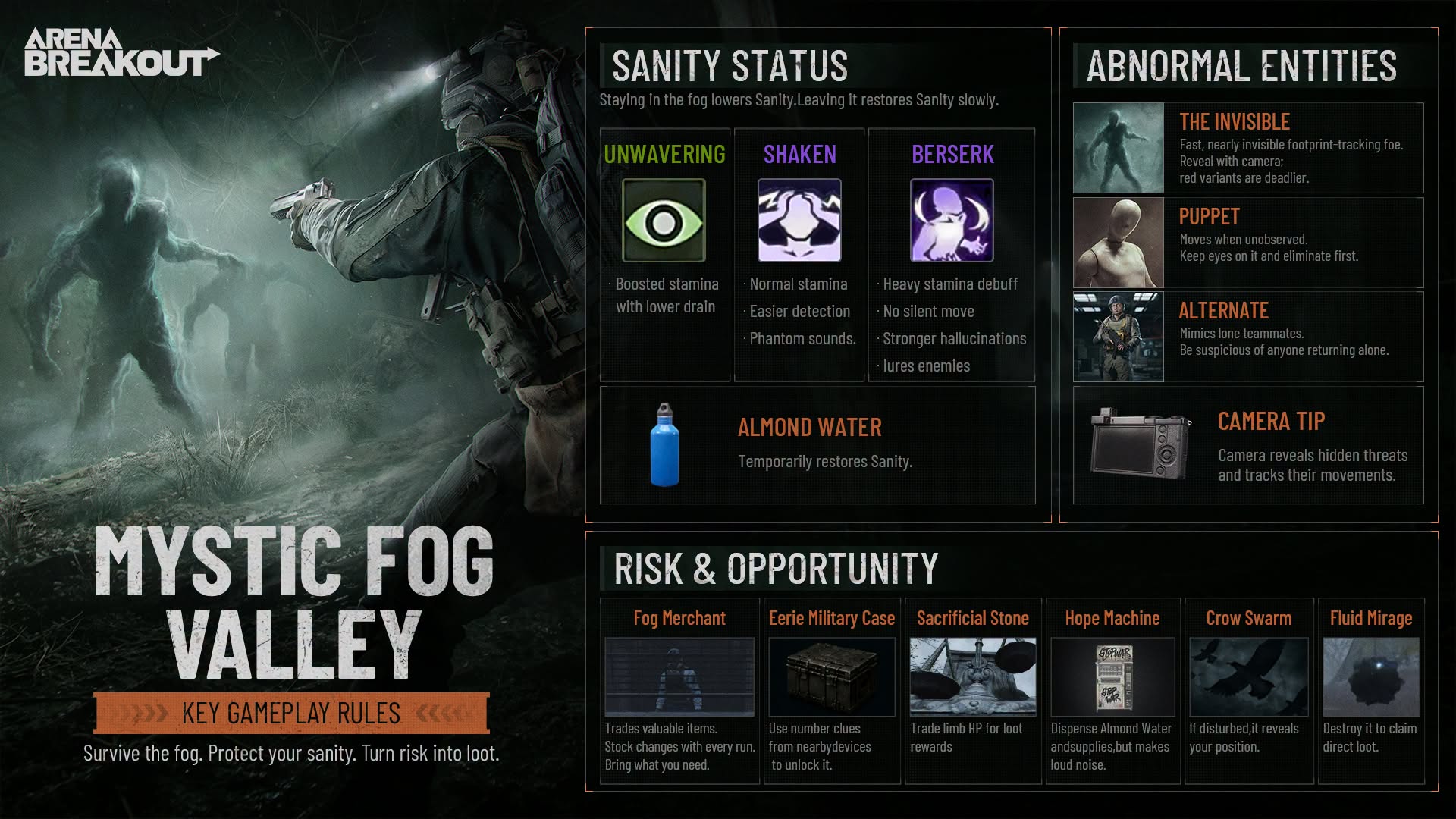
Misty Valley is the headline map of Arena Breakout Season 13 "Liminal Space," and it is the clearest example of the season's core lesson: this season rewards the operator who reads the battlefield faster, not the one who shoots first. Misty Valley is a reworked Valley map wrapped in heavy fog, and the fog does not just change how the map looks — it changes how every engagement flows. Visibility falls hard, sound becomes the most reliable sense you have, and a Sanity meter quietly drains your vision and stamina in the worst zones. This guide explains the sound and Sanity mechanics in detail and shows how to build a loadout that turns the fog into your advantage.
For the official Misty Valley map details and confirmed mechanic notes, the official Arena Breakout site is the most reliable reference.
Before you drop into the fog, stock up on Bonds and Koen with the Arena Breakout top-up at Topuplist so you can grab the Season 13 Battle Pass and loadout upgrades the moment servers go live.
What Misty Valley Actually Is
Misty Valley is the Season 13 rework of the classic Valley map, reskinned and re-mechanic'd around the "Liminal Space" theme of uncertainty. The theme is delivered mechanically rather than just visually: reduced visibility turns your usual playbook upside down. The operators who used to hold an angle across the map now have to rely on sound and movement instead of a scope. That single change reshuffles the power order across the entire roster of maps.
The map is designed to weaken the traditional sniper advantage and force players into close combat and teamwork. If you are still using the old long-range playstyle, Misty Valley is where it breaks down first. Unlike the open sightlines of the original Valley, the rework trades distance for pressure — you feel hunted in the haze rather than hunting from afar.
Visibility Drops Hard: The Fog Effect
The fog in Misty Valley greatly reduces visibility, which has two direct consequences. First, long-range "eagle eye" sniper play is heavily nerfed — you simply cannot read the map the way you used to. Second, close-range encounters happen far more often, which completely changes the flow of firefights. The sightline you depended on in earlier seasons no longer exists, so the habit of holding a far angle stops paying off.
This is not a cosmetic fog. It is a systemic shift that makes audio information more important than ever. Footsteps, gunshot echoes, and ambient sounds are more reliable than your eyes. The operator who adapted to weather-driven meta shifts in earlier seasons will recognize the pattern: an environmental system reweights weapon and ability choices, and the players who read it fastest win. Misty Valley is the season's loudest statement that information now beats raw aim.
Sound Decides Life or Death
Because your eyes lie in the fog, sound becomes the primary source of truth. The practical guidance is straightforward: play with headphones and listen carefully. Footsteps and reload sounds are now worth more than your scope. You can hear an enemy reposition, hear a mag swap that signals a vulnerable moment, and hear ambient cues that reveal movement you cannot see.
Three sound rules define success in Misty Valley:
Shorten your engagement distance. Do not force long-range holds. The fog punishes operators who wait for a shot that never comes.
Use a suppressor. One unsuppressed shot can expose your position, which is a huge mistake on a map where you can barely see. A suppressor keeps you invisible to the ear as well as the eye.
Move with purpose. Running around blindly creates noise that others will read. Deliberate movement is quieter and smarter.
The squad that communicates footsteps and gunfire will beat the squad that only communicates sightlines. Audio discipline is a team sport here, and a single loud operator can give away an entire push.
The Sanity Meter and Draining Zones
On top of the fog, Misty Valley introduces a Sanity meter. Certain zones drain Sanity, and it only slowly recovers once you leave them. As Sanity drops, it eats into your vision and stamina — so lingering in the worst pockets of the valley costs you the exact senses you need most. The map literally taxes you for standing still in the wrong place.
Reading the danger pockets is a skill in itself. The zones that drain Sanity are the ones you want to transit quickly, not hold. If you hear or see signs of a draining pocket, treat it like a timed objective: grab value, then leave. The Sanity mechanic rewards constant, purposeful rotation and punishes campers who think the fog will hide them forever.
If you want the kit to clear the fog on day one, load your account through Topuplist with an Arena Breakout top-up and skip the early grind.
The Role Split That Wins the Fog
The practical adaptation to Misty Valley is a four-role squad split:
Scout: Reads movement and sound, calls out enemy positions by ear, and avoids long holds.
Assault: Pushes and clears the dangerous pockets where Sanity drains fastest.
Support: Holds covering fire and controls the tight engagement distances the fog creates.
Medic: Keeps the run alive through the close-range trades the map forces.
Solo players should lean into the scout or assault role and prioritize information abilities, because without a squad you need the fog to work for you, not against you. A solo scout with Ammo Estimation and a suppressor can thrive by listening and rotating, while a solo assault player needs the Combat edge to win the close fights the fog forces.
Loadouts Built for Sound, Not Sight
Misty Valley is where the Tactical Ability system's Intel family shines. Abilities like Ammo Estimation, which shows the approximate ammo remaining in your current magazine, and Temporary Map, which supports navigation when visibility is poor, directly counter the fog's biggest weakness. Pair an Intel ability with a stable assault rifle or a marksman rifle — the SCAR-H and T87A are reliable mid-range defaults, and the G28 covers the precision role the fog makes harder but not impossible.
Weapon-by-weapon for the fog:
Weapon | Fog verdict |
SCAR-H | Strong 7.62 default, high damage at mid range |
T87A | Stable and forgiving in haze |
G28 | Precision pick when a sightline opens |
SPC9A | Mobility king for quick rotations |
Shotgun (M1887/AA12) | Only if expecting door fights |
Avoid building for pure sightline control. A Misty Valley loadout should prioritize sound over sightlines, and the weapon should be one that performs when an enemy appears at close-to-mid range out of the haze. Suppressors are effectively mandatory, and Rat Mimic helps you reposition quietly when Sanity drains.
Rebuilding after the reset is easier when your Bonds are ready — visit Topuplist for an Arena Breakout top-up and jump straight into the 2x loot event on Misty Valley.
Sanity Management: Rotate Before You Blind
The discipline that separates good Misty Valley runs from bad ones is Sanity rotation. Watch your Sanity and rotate out of draining zones before your vision and stamina suffer. A simple rule: if you are in a fog pocket and your Sanity is dropping, extract value quickly and move. Do not over-commit to a fight you cannot see.
Combine Sanity management with sound play. Listen for enemies before you push, keep your suppressor on, and use your Intel ability to compensate for what the fog hides. The operators who read the drop and manage their Sanity accordingly are the ones who farm Misty Valley instead of feeding it. A clean rotation also protects your stamina, which matters when you need to sprint out of a bad pocket or reposition to a safer loot route.
Team Comms Protocol for the Fog
Because sightlines fail, your comms have to carry the load. A workable protocol: the scout calls contacts by sound direction ("steps left, close"), the assault confirms before pushing, support announces reloads so the squad knows when to hold, and the medic tracks who is hurt. Keep calls short and positional. The squad that turns audio into shared knowledge turns the fog from a liability into a weapon — your enemies are just as blind, and disciplined sound play wins the exchanges they cannot read.
Common Misty Valley Mistakes
The biggest mistake is playing Misty Valley like an old sniper map — holding a far angle, waiting for a scope shot, and ignoring the Sanity drain. The fog ends that playstyle. The second mistake is pushing Port-style aggression without the sound discipline the map demands. The third is forgetting a suppressor and broadcasting every shot. The fourth is camping a Sanity-draining pocket and going blind at the worst moment. Fix those four habits and Misty Valley becomes one of the most rewarding maps of Season 13, especially during the 2x loot window when a 400,000+ Koen Gold Loot extraction here is a season-defining payday.
Sound Cue Encyclopedia
Because the fog strips your sight, the audio layer becomes a language you have to read. Footsteps reveal an enemy's direction and approximate distance; a walking pace signals caution while a sprint signals a push or a retreat. Reload sounds are among the most valuable cues — a mag swap tells you an enemy is vulnerable for a moment, and a suppressor hides your own. Ambient cues like doors, glass, and movement through debris reveal presence you cannot see. Gunshot echoes locate firefights elsewhere on the map, letting you avoid or third-party them.
Headphones are effectively mandatory on Misty Valley, and a suppressor is the other half of the equation: it hides your own shots so you do not broadcast your position. Learn to distinguish sprint from walk and reload from idle, and the fog stops being blindness and starts being information.
Sanity Zone Movement Guide
The Sanity meter drains in certain zones and only slowly recovers after you leave, eating into your vision and stamina. The movement rule is to transit draining pockets quickly rather than hold them. Rotate to cleaner air the moment your Sanity starts dropping, and pair that rotation with Rat Mimic so the move costs less stamina. If your Sanity is already low, prioritize extraction over another fight — a blind, exhausted operator is the easiest kill on the map.
Best Weapons Per Engagement Range in Fog
The fog compresses effective ranges, which reshapes weapon choice:
Range | Best choice | Why |
Close (under 20m) | Shotgun or SMG | Fog forces frequent close fights |
Mid (20–60m) | SCAR-H or T87A | Stable, high damage at the fog's real range |
Opportunistic long | G28 | Only when a rare sightline opens |
Avoid investing in pure sniper builds; the fog nerfs them directly. Put a suppressor on every weapon, because one unsuppressed shot exposes you on a map where you can barely see.
Solo vs Squad Fog Tactics
Solo players should adopt the scout or assault role with an Intel ability and a suppressor, rotating on sound and avoiding prolonged holds. Without a squad, you need the fog to work for you through information, not firepower. Squads should run the four-role split — scout, assault, support, medic — and follow a comms protocol that calls contacts by sound direction. The squad that turns audio into shared knowledge turns the fog from a liability into a weapon, because your enemies are just as blind and disciplined sound play wins the exchanges they cannot read.
Audio Settings and Hardware for the Fog
The single biggest Misty Valley upgrade is not a gun — it is your audio setup. The map is built so that footsteps, reloads, and ambient sound carry more information than your eyes, so a proper headset is effectively mandatory rather than optional. In-game, push volume and positional audio settings so cues are distinguishable, and keep a suppressor on your weapon so your own shots do not drown out enemy sounds or broadcast your position. Operators who treat audio as a primary sensor read the fog; operators who treat it as background noise get caught flat-footed.
Fog Engagement Drills
Translating sound into wins takes repetition. A simple drill is to pre-aim common lanes and hold angles at close range rather than sniping across the map, because the fog compresses real engagement distance. Use cover to break line of sight while you listen, then peek only when a sound cue confirms a target. Practice rotating out of Sanity drains on a timer so the habit is automatic under pressure. The squads that run these drills treat Misty Valley as a readable map instead of a blind one, and they are the ones who extract with the Gold Loot.
Misty Valley Extract Timing
Extraction discipline matters more in the fog than on open maps, because a low-Sanity operator who overstays a draining pocket can lose a full bag to a blind fight. The rule is to call extraction the moment your objective is met — a Gold Loot item, a filled materials stack, or a completed mission — rather than hunting one more fight. During the 2x loot window, the doubled payout makes an early, safe extract worth more than a risky push, so discipline beats greed. Plan your exit route before the raid and keep a quiet flank open so you are never forced through a loud, contested lane.
Cover and Peeking in the Fog
Fog rewards operators who use cover to manage information. Hold behind a wall, listen for the approach, then peek only when a cue confirms a target — random peeking into the haze is how you get deleted by a shotgun you never saw. Stack cover so you can break line of sight the instant you take fire, and use tight angles where the fog limits the enemy's options. The principle is the same as sound play: let the map feed you information, then act on it, instead of acting blind and hoping.
Misty Valley Map Flow
A reliable Misty Valley raid follows a simple loop: loot, listen, rotate. Start by hitting your planned containers quickly while your Sanity is full, then stop and listen at every intersection rather than pushing blind. When a sound cue confirms an enemy, decide whether to engage on your terms or rotate away using Rat Mimic and cover. Keep the loop moving — the map punishes operators who plant in one spot, because Sanity drains and enemies close in. Run that loop with an Intel ability and a suppressor, and Misty Valley becomes a controllable, profitable map instead of a blind gamble.
Misty Valley Quick Tips
A few fast reminders keep the fog on your side: always wear a suppressor, keep your Sanity high by rotating out of drains, call contacts by sound direction, and extract the moment a Gold Loot item is in your bag. The operators who internalize these basics stop fearing Misty Valley and start farming it, especially during the 2x loot window when a 400,000+ Koen extraction is the season's best payday.
FAQ
What is Misty Valley in Arena Breakout Season 13?
Misty Valley is the Season 13 rework of the Valley map, covered in heavy fog that greatly reduces visibility and shifts fights toward sound and close range.
How does the Sanity meter work in Misty Valley?
Certain zones drain a Sanity meter that only slowly recovers after you leave. As Sanity drops, it reduces your vision and stamina, so lingering in draining zones hurts your senses.
Why is sound more important than sight in Misty Valley?
The fog greatly reduces visibility, so footsteps, gunshot echoes, and ambient sounds become more reliable than your eyes for locating enemies.
Should I use a suppressor on Misty Valley?
Yes. One unsuppressed shot can expose your position on a map where you can barely see, so a suppressor is effectively mandatory.
Which abilities work best on Misty Valley?
Intel-family abilities like Ammo Estimation and Temporary Map perform best, because they counter the fog's loss of visibility and support navigation.